The radio is one of the most anxiety-producing parts of student pilot training. New students freeze up, say the wrong thing, or key the mic and stay silent. But aviation radio communication follows predictable patterns — once you learn the templates, it becomes routine. This guide covers every standard call you'll make as a student pilot.
ℹ️
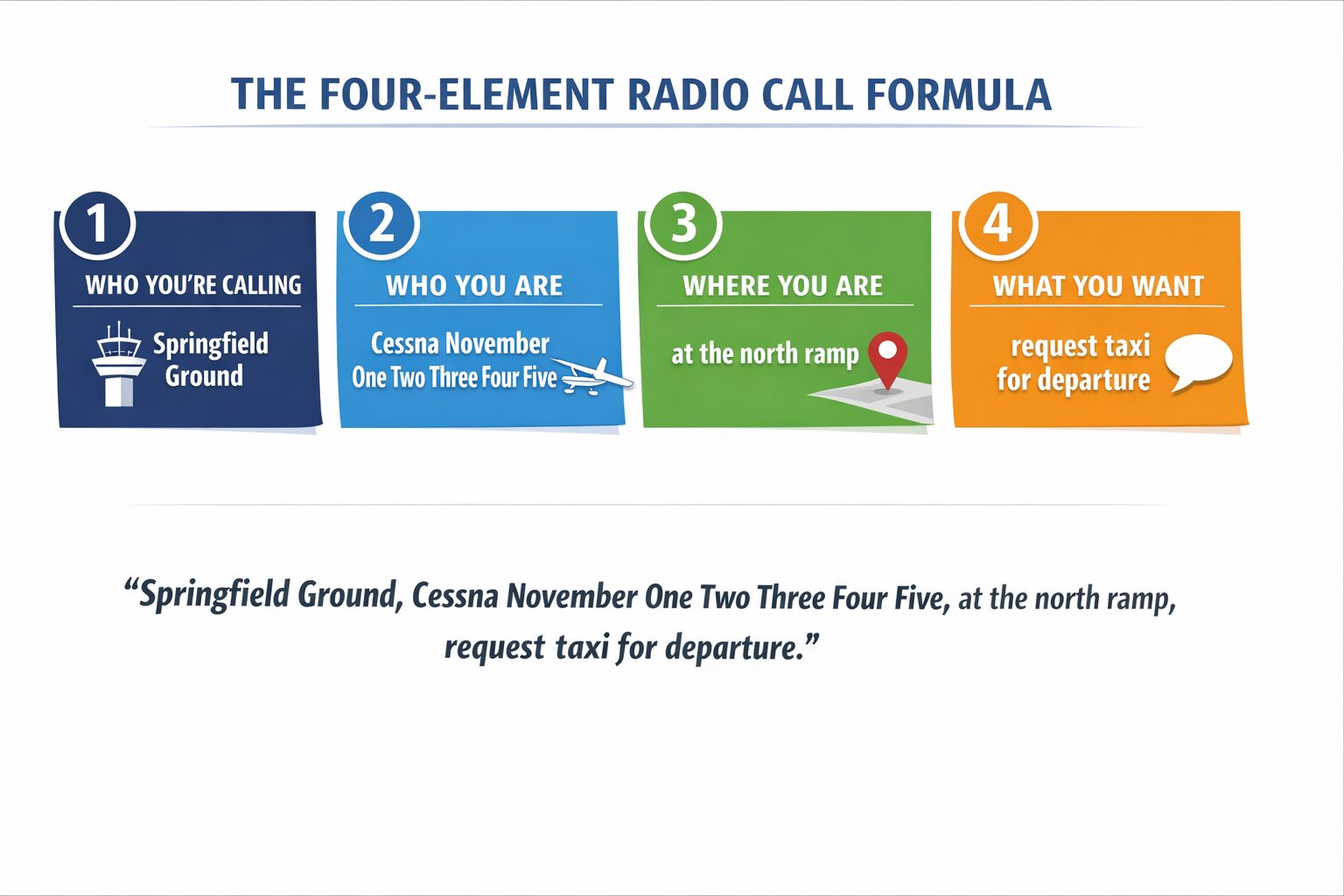
The golden rule: Who you're calling, who you are, where you are, what you want. Every radio call follows this structure. Internalize it and you'll never be lost for words.
The phonetic alphabet
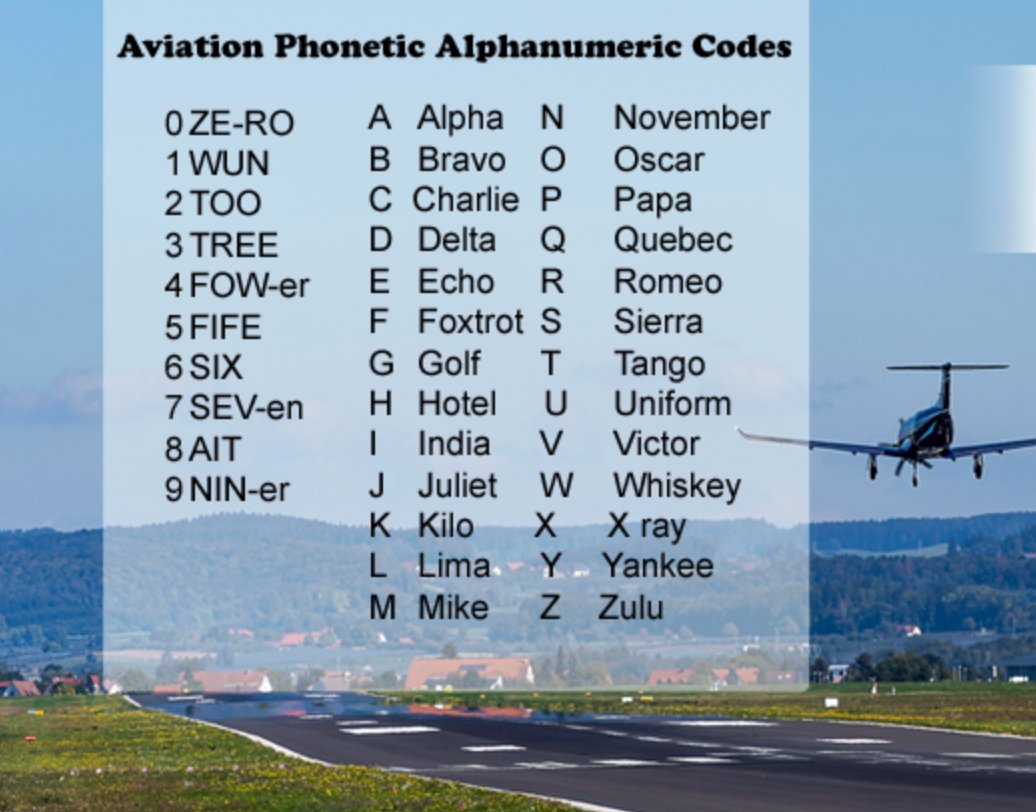
Every letter has a standard phonetic word used on the radio to avoid confusion between similar-sounding letters. Know these cold — your aircraft registration, runway designations, and clearances all use them.
A — Alpha
B — Bravo
C — Charlie
D — Delta
E — Echo
F — Foxtrot
G — Golf
H — Hotel
I — India
J — Juliet
K — Kilo
L — Lima
M — Mike
N — November
O — Oscar
P — Papa
Q — Quebec
R — Romeo
S — Sierra
T — Tango
U — Uniform
V — Victor
W — Whiskey
X — X-ray
Y — Yankee
Z — Zulu
Aircraft registrations drop the "N" and use the last three characters phonetically for abbreviated calls after initial contact. N12345 becomes "November One Two Three Four Five" initially, then "Three Four Five" after ATC uses your abbreviated call sign.
Numbers and time
Numbers are spoken digit by digit: runway 27 is "two-seven," not "twenty-seven." Altitudes: 3,500 feet is "three thousand five hundred." Frequencies: 122.8 is "one-two-two-point-eight." Time is always Zulu (UTC) in aviation: 1430Z is "one-four-three-zero Zulu."
Non-towered airport calls (CTAF / UNICOM)
At non-towered airports, pilots self-announce on the Common Traffic Advisory Frequency (CTAF) — typically 122.8 or another frequency shown on the sectional chart. There is no ATC to respond; you're informing other traffic of your position and intentions.
Inbound call — 10 miles out
You say:
"[Airport name] Traffic, Cessna November One Two Three Four Five, ten miles to the [north/south/east/west], inbound for landing, [Airport name]."
Entering the pattern
"[Airport name] Traffic, Cessna One Two Three Four Five, entering [left/right] downwind, runway [number], [Airport name]."
Pattern position calls
"[Airport name] Traffic, Cessna Three Four Five, [left/right] base, runway [number], [Airport name]."
"[Airport name] Traffic, Cessna Three Four Five, final, runway [number], full stop, [Airport name]."
Departing the pattern
"[Airport name] Traffic, Cessna Three Four Five, departing runway [number], [direction of departure] departure, [Airport name]."
Class D towered airport calls
At Class D airports, you communicate with the control tower. The tower gives instructions — you read them back correctly.
Calling ground control for taxi
You say:
"[City] Ground, Cessna November One Two Three Four Five, at [location on airport], VFR to [destination or 'local area'], with [ATIS information letter], request taxi."
ATC responds:
"Cessna One Two Three Four Five, [City] Ground, taxi to runway [number] via [taxiway names], altimeter [setting]."
You read back:
"Taxi runway [number] via [taxiways], Cessna Three Four Five."
Calling tower for takeoff
"[City] Tower, Cessna Three Four Five, holding short runway [number], ready for departure."
ATC responds:
"Cessna Three Four Five, runway [number], cleared for takeoff, [wind]."
You read back:
"Cleared for takeoff, runway [number], Cessna Three Four Five."
Inbound to a Class D airport
"[City] Tower, Cessna November One Two Three Four Five, [distance and direction], [altitude], inbound for landing with [ATIS letter]."
ATC responds:
"Cessna Three Four Five, [City] Tower, report [left/right] downwind runway [number]." — or — "Cessna Three Four Five, enter [left/right] base runway [number], number two, traffic is [description]."
Landing clearance readback
ATC: "Cessna Three Four Five, cleared to land runway [number]."
You: "Cleared to land runway [number], Cessna Three Four Five."
Flight following (VFR traffic advisories)
Flight following is a free radar traffic advisory service from ATC. Highly recommended for cross-country flights — ATC will call out traffic and help with sequencing. To request:
"[Facility] Approach/Center, Cessna November One Two Three Four Five, VFR request."
ATC: "Cessna One Two Three Four Five, go ahead."
"Cessna November One Two Three Four Five, [aircraft type], [departure airport], [destination], [altitude], request VFR flight following."
ATC: "Cessna Three Four Five, squawk [code], ident."
You: "Squawking [code], Cessna Three Four Five."
Emergency calls
If you have an emergency, declare it clearly. ATC will clear the frequency and provide maximum assistance. There is no paperwork penalty for declaring an emergency that turned out to be minor — the FAA actively encourages declaring emergencies early.
"MAYDAY, MAYDAY, MAYDAY, [facility or 'any station'], Cessna November One Two Three Four Five, [nature of emergency], [position], [altitude], [souls on board], [fuel remaining]."
If no contact, transmit on 121.5 MHz (guard frequency). Squawk 7700 on your transponder.
What to do when you freeze
Every pilot has frozen on the radio at least once. The controller knows you're a student — they've heard it a thousand times. If you need to, just say: "[Facility], Cessna Three Four Five, student pilot, say again please." Controllers will slow down, repeat, and help. No one is judging you.
If you're completely lost: "[Facility], Cessna Three Four Five, request progressive taxi/instructions." ATC will guide you step by step.
Radio tips for student pilots
- Listen before you transmit — make sure the frequency is clear before keying the mic. Stepping on another transmission helps no one.
- Think before you key — mentally rehearse your call before pressing the push-to-talk. A half-second pause prevents "uh, um" openings.
- Be concise — controllers handle many aircraft. Say what needs to be said and stop. Don't narrate.
- Read back critical items — runway assignments, hold-short instructions, altimeter settings, and cleared/not cleared for takeoff or landing must always be read back verbatim.
- If you're unsure, ask — "Say again," "Say again slowly," and "Unable" are all completely acceptable responses.
- Practice at home — listen to LiveATC.net for your local airport. You'll hear patterns and phraseology become familiar fast.
💡
LiveATC.net streams real ATC audio from hundreds of airports worldwide. Listening to your local approach frequency for 20 minutes before your next lesson is one of the most effective radio preparation tools available — and it's free.