Aviation career guides
Most student pilots start training with a destination in mind — usually "airline pilot." But aviation offers far more career paths than most people realize, ranging from flight instruction to corporate flying to military service to niche operations like agricultural or aerial survey work. Each path has different hour requirements, timelines, lifestyle tradeoffs, and earning potential.
This guide gives you the honest overview of every major aviation career path — what it takes to get there, what you'll earn along the way, and what life actually looks like once you're doing it.
The pilot career roadmap — from zero to career
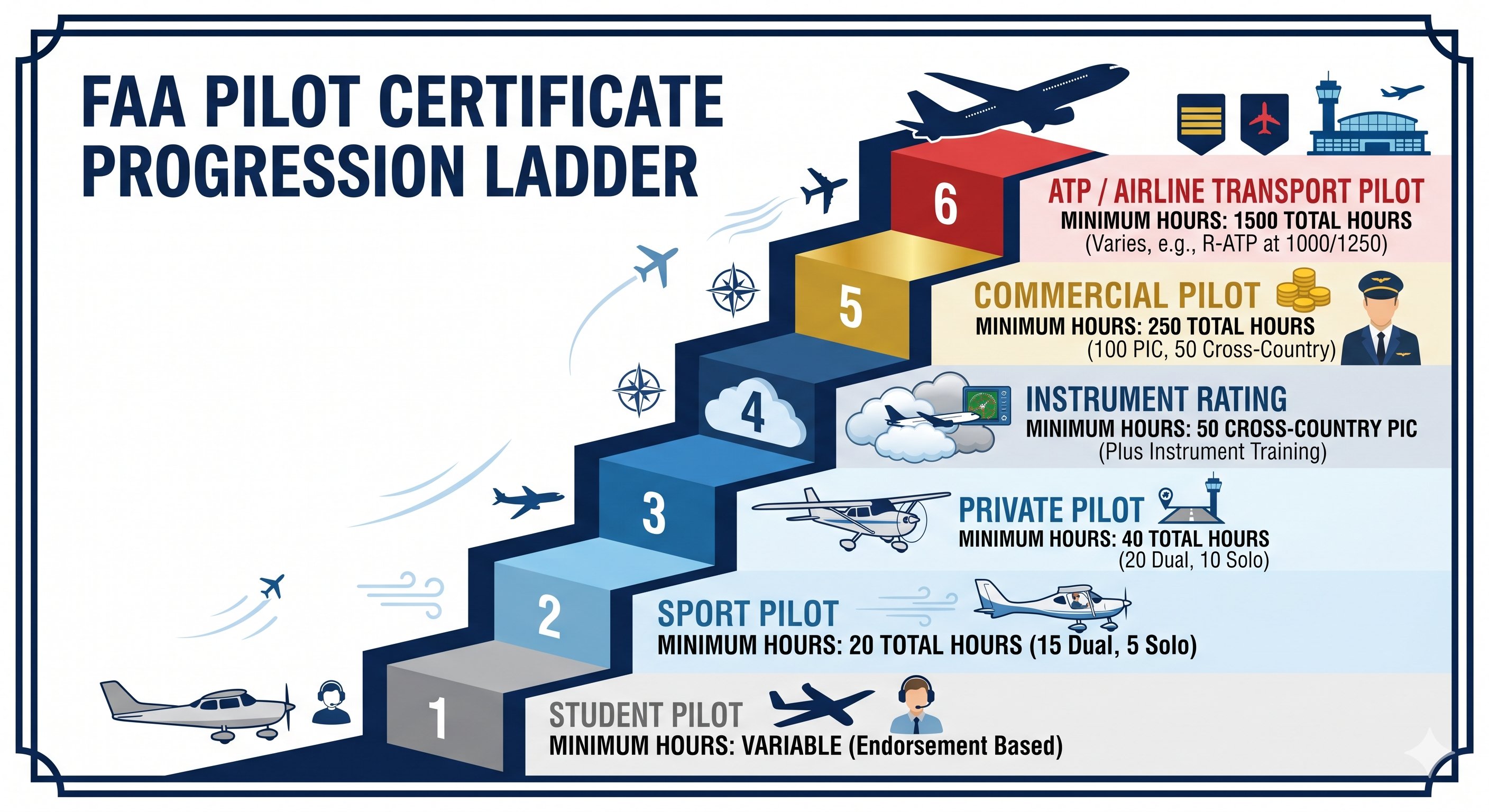
Regardless of which career you're targeting, nearly every professional pilot follows a similar early path:
- Private Pilot Certificate (PPL) — ~60–80 hours, ~$14,000–$18,000
- Instrument Rating (IR) — 50 additional hours, ~$8,000–$12,000
- Commercial Pilot Certificate (CPL) — 250 total hours, ~$15,000–$25,000
- Multi-Engine Rating — 10–20 hours, ~$3,000–$5,000
- CFI / CFII / MEI — teach to build hours, earn while you fly
- Build to ATP minimums — 1,500 hours (1,000 with aviation degree, 750 with military)
- ATP Certificate — required for airline first officer
Total cost from zero to airline-ready: roughly $80,000–$120,000 at a Part 61 school or $60,000–$90,000 at an accelerated Part 141 program. Scholarships, GI Bill, and airline cadet programs can significantly offset this.
Career paths at a glance
| Career | Min Hours | Entry Salary | Senior Salary | Timeline from zero |
|---|---|---|---|---|
| Flight Instructor (CFI) | 250 CPL | $40,000–$55,000 | $70,000+ | 2–3 years |
| Regional Airline FO | 1,500 ATP | $50,000–$90,000 | $120,000–$180,000 | 4–6 years |
| Major Airline FO | 1,500 ATP | $100,000–$130,000 | $300,000–$500,000+ | 8–15 years |
| Corporate / Part 91 | 500–1,000 | $60,000–$80,000 | $120,000–$200,000 | 3–6 years |
| Charter / Part 135 | 500–1,200 | $45,000–$70,000 | $90,000–$140,000 | 3–5 years |
| Military Pilot | Military training | $50,000–$80,000 + benefits | $100,000–$150,000+ | 5–7 years |
| Agricultural Aviation | 500+ | $50,000–$70,000 | $80,000–$120,000 | 3–5 years |
The airline pilot path
The most common destination for career-focused student pilots. Regional airlines hire at 1,500 hours ATP minimums (or 1,000 with an aviation degree). After 2–5 years at a regional, pilots typically upgrade to captain or flow to a major airline through partner agreements.

Major airline captains at United, Delta, American, and Southwest earn $300,000–$500,000+ annually at the top of the pay scale. The path is long but the destination is financially exceptional. Full airline pilot career guide →