Aviation career guides
The full timeline — zero to major airline
Becoming a major airline pilot is a long-game career. Most pilots take 8–15 years from zero flight time to a major airline seat, depending on training speed, luck with hiring cycles, and whether they pursue military or civilian routes. Here's what that journey actually looks like.
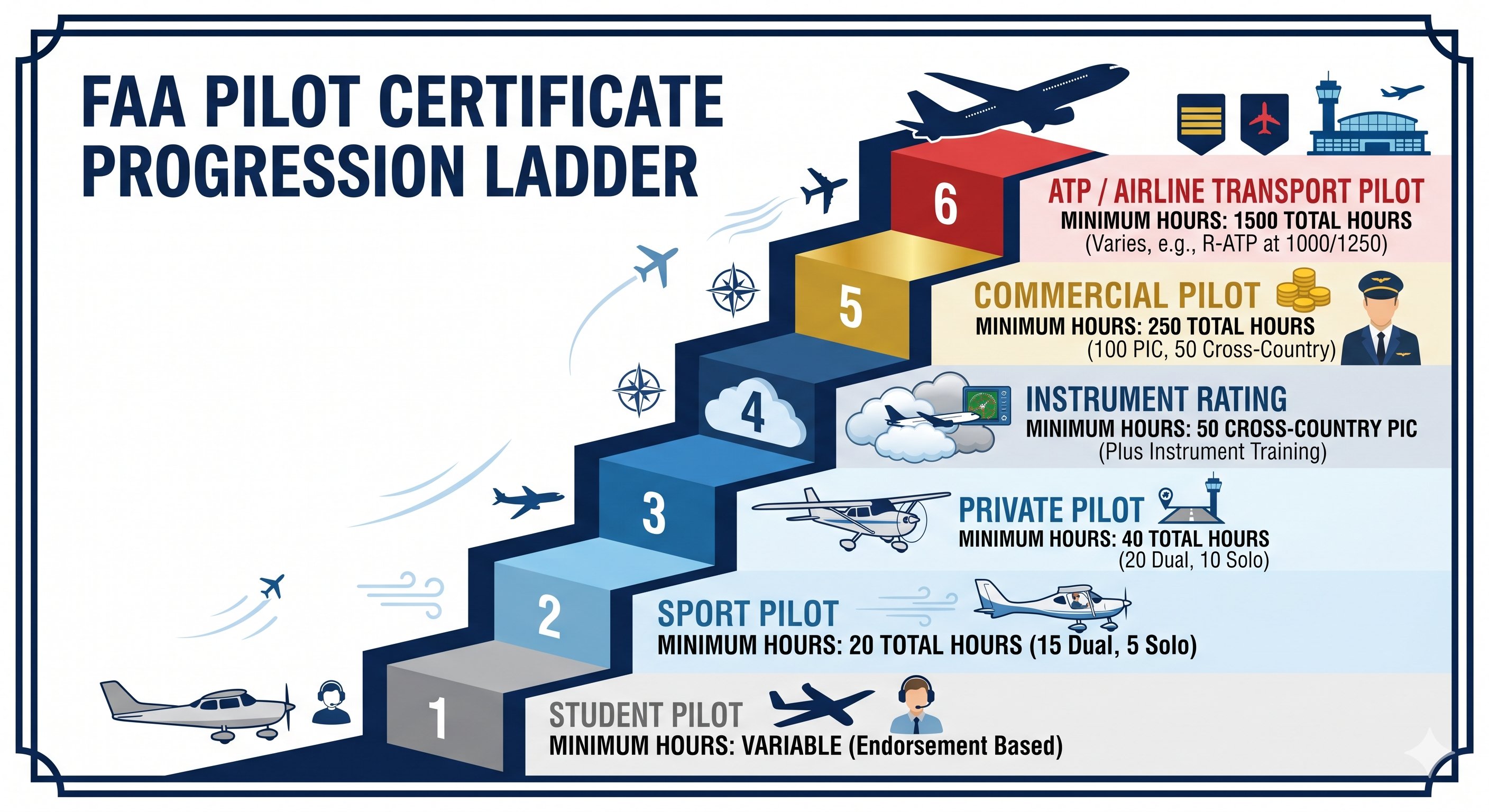
- Get your Private Pilot Certificate (~60 hrs)
- Add Instrument Rating (~50 hrs)
- Earn Commercial Certificate (250 total hrs)
- Add Multi-Engine Rating (~15 hrs)
- 1.5–3 years part-time, 12–18 months full-time
- PPL: ~$14,000–$18,000
- Instrument: ~$8,000–$12,000
- Commercial + Multi: ~$20,000–$35,000
- Get your CFI and CFII certificates
- Instruct students to build flight time
- Log 1,000+ hours of instruction given
- Build cross-country and night time
- Takes 2–4 years instructing full-time
- You're paid to fly — hours are the currency
- Some pilots do charter or pipeline patrol instead
- Military pilots skip this stage entirely
- Earn ATP Certificate (written + checkride)
- Apply to regional carriers (SkyWest, Envoy, GoJet, etc.)
- Fly as First Officer on turboprops or regional jets
- Upgrade to captain in 2–5 years
- Year 1 FO: $50,000–$90,000 (improved dramatically post-2022)
- Regional Captain: $100,000–$180,000
- Flow agreements → direct path to majors
- SkyWest, Envoy, Piedmont have United/American flows
- Hired via flow agreement or direct application
- Fly wide and narrowbody jets (737, A320, 777, etc.)
- Commute or live in base city
- Hold junior reserve or line schedule
- Delta FO Year 1: ~$120,000+
- United FO Year 1: ~$115,000+
- American FO Year 1: ~$110,000+
- FedEx/UPS FO: ~$120,000–$150,000
- Delta 777 Captain: ~$400,000–$500,000+
- United 787 Captain: ~$380,000–$480,000+
- Southwest 737 Captain: ~$300,000–$400,000
- FedEx/UPS widebody captain: $300,000–$400,000+
- ~75–80 flight hours/month (FAA maximum: 100)
- 10–15 days away from home per month
- Excellent benefits, pension, travel perks
- Mandatory retirement at age 65 (FAR 121.383)
ATP Certificate requirements
The Airline Transport Pilot (ATP) certificate is required to serve as Pilot in Command of an airline aircraft. As of 2013, it's also required for all Part 121 first officers. Here's what you need:

- 1,500 total flight hours (or 1,000 with an aviation bachelor's degree, 750 with military training)
- 500 hours cross-country time
- 100 hours night flight time
- 75 hours actual or simulated instrument time
- 250 hours as PIC
- Pass the ATP written knowledge test
- Pass the ATP practical test (checkride) in a Part 142 full-motion simulator
Aviation degree advantage: An FAA-approved aviation bachelor's degree reduces the ATP hour requirement from 1,500 to 1,000. At $40–50/hour to build time as a CFI, that 500-hour difference is worth roughly $20,000–$25,000 and 1–2 years of your career.
Fastest routes to the airlines
Civilian route (most common)
PPL → IR → CPL → CFI → instruct to 1,500 hours → ATP → regional airline → major airline. Total timeline: 6–10 years from zero.
Aviation university route
Attend an aviation-focused university (ERAU, UND, Purdue, Western Michigan) and graduate with an aviation degree and 250+ hours. ATP minimums drop to 1,000 hours. Timeline shaved by 1–2 years. Cost is higher upfront but some universities have airline partnerships.
Military route
Military pilots graduate with thousands of flight hours in high-performance aircraft and are highly sought after by major airlines. The tradeoff is a service commitment of 8–10+ years. Many military pilots transition to majors in their mid-30s and fast-track to captain due to their experience.
Airline cadet programs
United Aviate, Delta Propel, and American Cadet Academy offer direct pipeline programs for student pilots. You get mentorship, possible financial support, and a conditional job offer before you've even soloed. Highly competitive to enter but worth applying early.
Mandatory retirement and career length
FAR 121.383 requires airline pilots to retire at age 65. If you start training at 20 and reach a major airline at 30, you have a 35-year major airline career ahead of you. Starting at 35 still leaves 30 years — plenty of time for a full career at a regional and potentially a major.
It's not too late to start. Pilots who begin training in their 30s and even early 40s routinely reach regional airlines and some reach majors. The math still works — a 45-year-old who reaches a major airline still has 20 years of major airline pay ahead of them. Start now.