This guide discusses a fatal accident scenario directly. That is the point. Understanding exactly why VFR into IMC kills so reliably is the most effective prevention available.
The statistic that should stop you cold
A 1989 AOPA Air Safety Foundation study found that VFR pilots who inadvertently enter instrument meteorological conditions have a median survival time of approximately 178 seconds — just under 3 minutes. More recent analysis suggests this number has not improved meaningfully despite better avionics and more training.
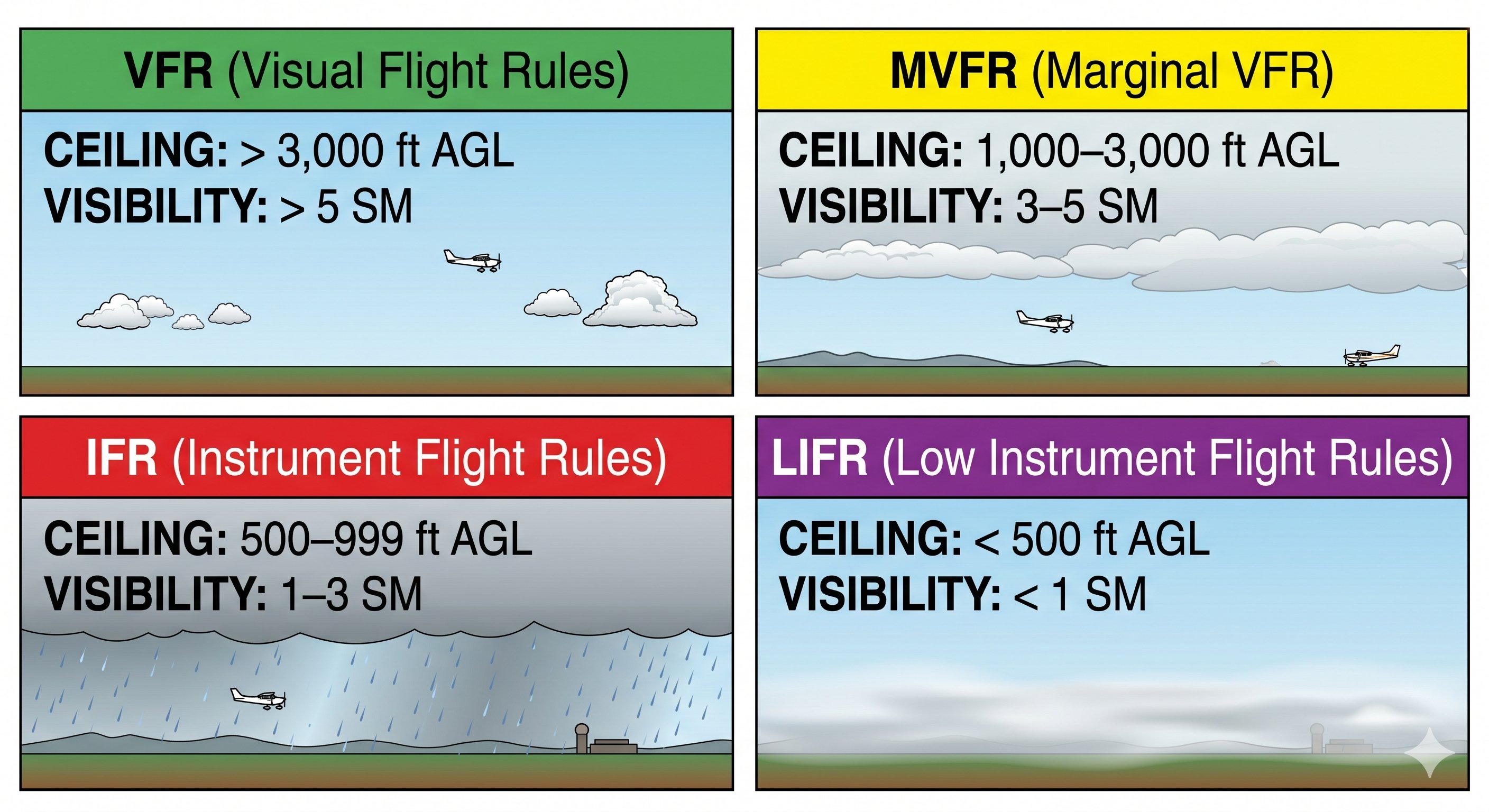
Know these minimums — VFR into IMC is preventable
Why three minutes — what actually happens to the pilot
The killer is not the cloud. It is spatial disorientation. Human balance depends on three systems working together: your eyes, your inner ear (the vestibular system), and the pressure sensors in your muscles and joints. In visual conditions your eyes dominate and keep you oriented. The moment you lose the outside horizon, your eyes go silent and your inner ear takes over — and the inner ear is a liar.
The vestibular system cannot distinguish a gentle, sustained turn from straight-and-level flight. After about 20 seconds in a constant-rate turn, the fluid in your inner ear stabilizes and tells your brain you have stopped turning. Roll level and it now feels like you are turning the other way. This produces the "leans," the false sensation of bank, and ultimately the graveyard spiral: the aircraft settles into a descending banked turn, the pilot feels only the descent, pulls back on the yoke to stop it, and tightening the turn steepens the spiral. Airspeed, descent rate, and G-load all build until the aircraft strikes terrain or comes apart. The pilot is fighting the airplane with exactly the wrong inputs, and feels certain they are correct.
Experience does not save you. The 178-second figure includes instrument-rated pilots. Disorientation is physiological — it happens to everyone, and instrument proficiency degrades fast without recent practice. This is not a skill gap you can will your way through in the moment.
If it happens to you: the escape
If you find yourself entering cloud or losing the horizon, the single most effective action is an immediate, controlled 180° turn to reverse course back into the conditions you just came from. The air behind you was flyable three minutes ago. Execute it before you are fully enveloped, on instruments, at a standard-rate turn:
1. Aviate. Level the wings using the attitude indicator — not your senses. Set a known pitch and power for level flight. Make small, smooth inputs and resist every urge to chase the sensations in your body. If you have an autopilot or wing-leveler, use it; it has no inner ear.
2. Turn. Using the attitude indicator and turn coordinator, roll into a standard-rate turn and hold it for about one minute to reverse direction. Keep the ball centered and the pitch level.
3. Communicate. Squawk 7700, and call ATC on your current frequency or 121.5. Declare an emergency and say the words "VFR into IMC." Controllers train for this. They will give you headings to clear terrain and route you to better weather or an instrument approach. There is no certificate action for using these words to save your life — the regulations explicitly authorize deviating from any rule to the extent required to handle an emergency.
Prevention — the decision is made on the ground
Almost every VFR-into-IMC accident traces back to a decision made before takeoff or to a refusal to turn around once airborne. The defenses are mundane and they work:
Get a real weather briefing. Use 1800wxbrief.com or an app like ForeFlight, and read the synopsis and the trend, not just the current observation. Ask whether conditions are improving or deteriorating along your route and at your destination, and what the ceiling and visibility will be when you arrive — not when you leave.
Set personal minimums above the legal ones. Legal VFR can be as low as 1 statute mile and clear of clouds in some airspace. That is not survivable for a low-time VFR pilot. A common student/low-time personal minimum is ceilings no lower than 3,000 ft AGL and visibility no less than 5 statute miles — and you raise them further for unfamiliar terrain, night, or marginal forecasts.
Name the pressure. The accident chain almost always includes "get-there-itis" — a passenger waiting, a meeting, a paid-for trip, the desire not to look timid. Recognize that pull as a hazard in itself. The airplane does not care about your schedule.
Always keep an out. On every leg, know where the better weather is and at what point you will divert. Decide the turn-around trigger in advance ("if I have to descend below 2,500 to stay clear of clouds, I turn around"), because a pre-made decision is one you can actually execute when the windscreen turns gray.
Run your conditions through the Go/No-Go Weather Tool before you fly, and review Weather for Pilots for how to read the products that warn you in advance.