GuidesTools GearCareers Find a CFIFind a School About
Training Guide · Aviation Weather
Student Pilot2026

Weather for Pilots — What You Actually Need to Know

Aviation weather is one of the richest and most poorly understood subjects in student pilot training. This guide covers what matters in the real world — how to read the signs, understand the products, and make sound go/no-go decisions.

Weather for Pilots — What You Actually Need to Know

Pilots don't need to be meteorologists. But they need to understand weather well enough to recognize conditions that kill and make smart decisions about whether to fly. Most student pilot weather education covers the textbook concepts; this guide focuses on what you'll actually use every time you preflight.

The atmosphere and why it matters

The standard atmosphere decreases in temperature at approximately 2°C per 1,000 feet (the standard lapse rate). When the actual lapse rate is greater than standard, the atmosphere is unstable — air rises vigorously, building cumulus clouds, turbulence, and potentially thunderstorms. When it's less than standard or inverted (temperature inversion), the atmosphere is stable — smooth air, but also fog, haze, and persistent low ceilings that don't burn off.
Practically: puffy cumulus clouds with vertical development = unstable air = potential for thunderstorms. Flat, layered stratus clouds = stable air = smooth but often IFR conditions. The type of clouds you see tells you a great deal about what's happening above.

Weather systems — fronts and what they bring

Cold fronts

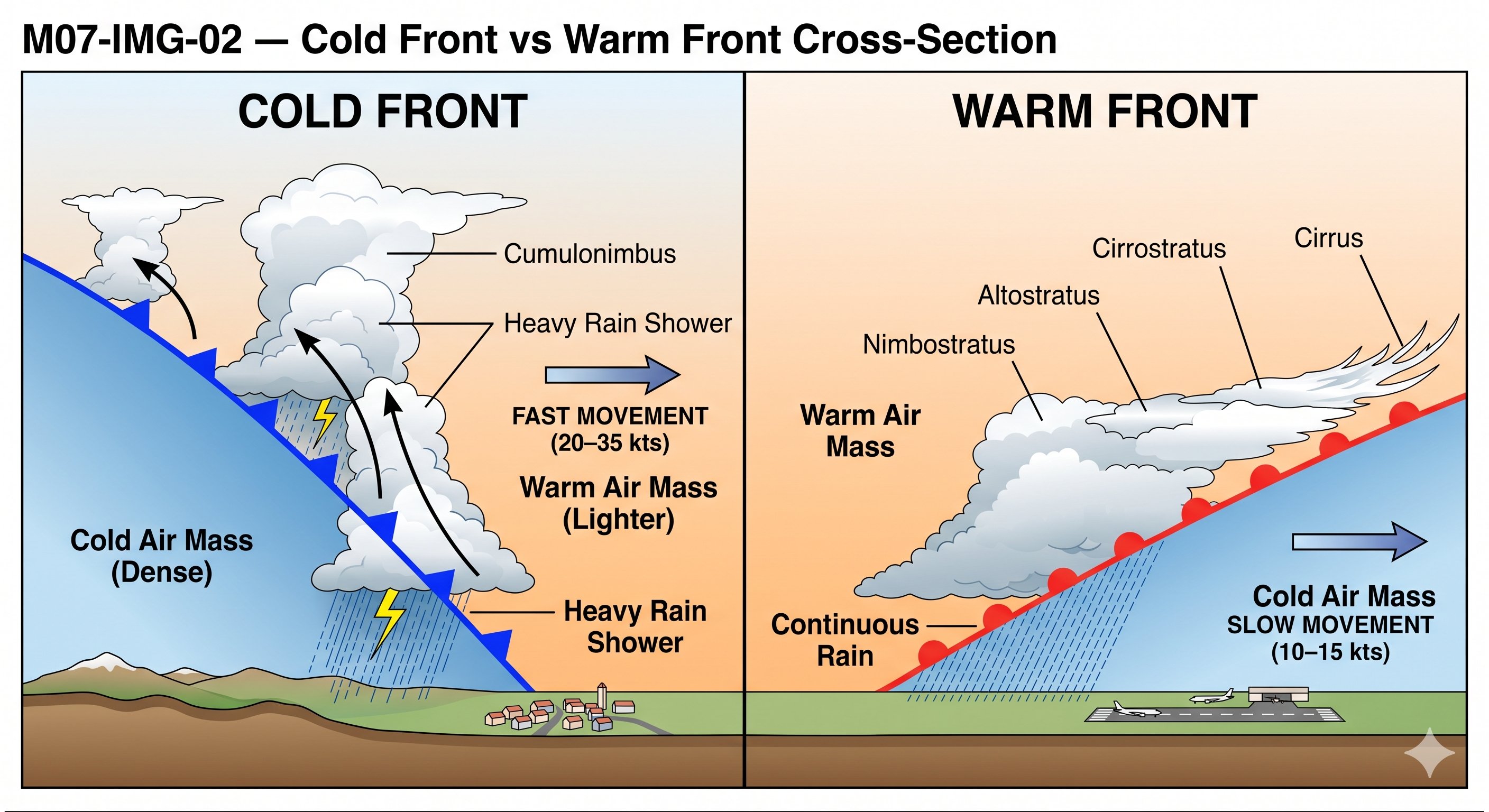
A cold front is the leading edge of a cold air mass pushing under warmer air. Cold fronts typically move faster than warm fronts (25–30 kts vs. 10–15 kts). The weather associated with a cold front is often dramatic: towering cumulus, cumulonimbus, squall lines, and thunderstorms in a narrow band ahead of and along the front, followed by rapid clearing and improved visibility after passage. The "line" of weather can extend hundreds of miles ahead of the surface front.
Student pilot lesson: do not fly toward an approaching cold front assuming you'll get through before it arrives. Cold fronts move faster than they appear on synoptic charts.

Warm fronts

A warm front is the leading edge of warm air overriding cold air. Warm fronts move slowly and produce gradual weather deterioration over a large area — sometimes 500–1,000 miles ahead of the surface front. The sequence typically is: cirrus clouds (high and thin), followed by altostratus (middle layer, gray overcast), followed by nimbostratus (low thick overcast with continuous rain or snow). Ceilings lower and visibility decreases steadily for hours before front passage.

Student pilot lesson: warm fronts give more warning time but can trap VFR pilots who start a long flight hoping to outrun deteriorating conditions. The forecast often underestimates how far ahead the low ceilings extend.

Stationary fronts and occluded fronts

Stationary fronts are essentially stalled cold or warm fronts — they can produce persistent poor weather for days in one area. Occluded fronts occur when a faster cold front catches a warm front — weather can be complex and hard to predict. Both types are reasons to wait for better conditions rather than press on.

Clouds — reading the sky

Cloud types tell you what's happening in the atmosphere. The key types for VFR pilots:

METARs and TAFs — your primary tools

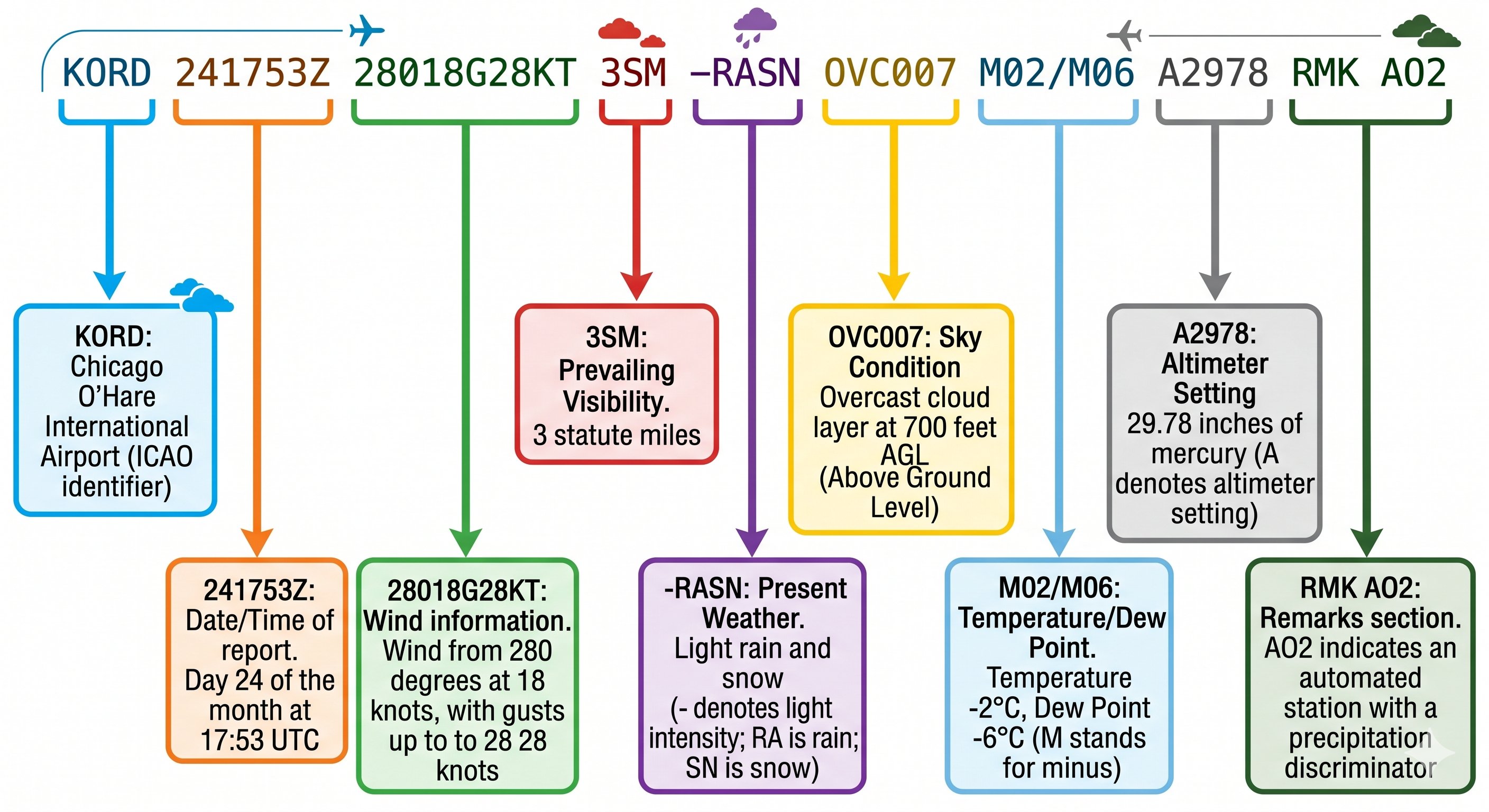
The METAR (hourly observation) and TAF (24-hour forecast) are the core weather products for preflight planning. You need to be fluent in both — not just able to decode them mechanically, but able to visualize what they mean for your flight. Use our METAR decoder tool for any specific decoding.

Key METAR elements in plain English

TAF groups

TAFs use "FM" (from), "TEMPO" (temporary), and "PROB30/40" (probability). FM indicates a permanent change in forecast conditions from a time. TEMPO indicates conditions expected to last less than an hour at a time. PROB40 means 40% probability — not reliable enough to plan around. PROB30 even less so. When the TAF shows TEMPO BKN010 in your arrival window, plan for a possible ceiling at 1,000 ft and have a divert plan.

AIRMETs and SIGMETs — the advisories

These products flag conditions that affect flight safety beyond what appears in a standard METAR/TAF.

AIRMETs (lower-level advisories)

SIGMETs (significant meteorological advisories)

SIGMETs cover hazardous conditions for all aircraft. Non-convective SIGMETs cover severe turbulence, severe icing, and volcanic ash. Convective SIGMETs cover thunderstorm-related hazards — any convective SIGMET on your route should be a hard no-go for VFR. They indicate active or imminent severe convective activity.

Icing — the invisible killer

Structural icing forms when supercooled water droplets (liquid water below 0°C) contact the aircraft's surfaces and freeze instantly. Icing adds weight, disrupts airflow over wings (rapidly degrading lift), clogs pitot tubes, and can freeze control surfaces. VFR aircraft without anti-ice or deice equipment cannot legally fly into known icing conditions.

The practical rules: if visible moisture is present (clouds, rain, fog) and temperature is between +2°C and -20°C, icing is possible. At the freezing level and just above, risk is highest. Check PIREPs (pilot weather reports) for icing reports and check AIRMETs Zulu. When in doubt, stay on the ground — structural ice accumulates faster than most non-pilots imagine, and recovery is often impossible.

Thunderstorms — absolute avoidance

No thunderstorm is safe to penetrate in any light aircraft. The reasons: updrafts and downdrafts exceeding 6,000 fpm can exceed aircraft structural limits, lightning can damage electronics and temporarily blind the pilot, hail (which can exist well away from visible precipitation) can destroy a leading edge in seconds, and wind shear near thunderstorms can overwhelm aircraft performance.

Avoidance rules: circumnavigate by at least 20 nm. Never attempt to fly between two cells that appear to have a gap — the gap may close, and the turbulence between active cells is severe. Do not attempt to fly under a thunderstorm — the downdrafts and rain curtain at the base are as dangerous as the cell itself. If you find yourself near thunderstorms en route, land immediately and wait.

Building a go/no-go decision process

The most dangerous weather-related flying accidents don't happen because pilots don't know the rules. They happen because pilots know the rules but feel pressure to go anyway. Building a structured decision process reduces the impact of get-there-itis.

Before every flight

  1. Get a full standard briefing from 1800wxbrief.com — not just a quick app check
  2. Identify your personal minimums for this flight (write them down before you check weather)
  3. Check AIRMETs and SIGMETs along your entire route
  4. Look at the trend — is weather improving or deteriorating?
  5. Identify your divert airports and what their weather looks like
  6. Set a go/no-go decision point and commit to it before you're in the aircraft

Our go/no-go weather tool walks through this assessment systematically for any conditions you enter.

💡

Personal minimums should be higher than legal minimums. The legal VFR minimum in Class E is 3 SM and 500 ft below clouds. A student pilot's personal minimum should be more like 5 SM and 2,000 ft ceiling — a buffer that allows for error, deterioration, and the simple fact that new pilots are less skilled at managing marginal conditions than experienced ones.