Cross-country flying is one of the most rewarding parts of PPL training — and one of the most involved. This guide walks through every step of planning a cross-country flight from start to departure.
The FAA defines a cross-country flight in two ways depending on the context. For logging purposes, a cross-country is any flight with a landing at a point other than the departure airport that involves use of dead reckoning, pilotage, electronic navigation, or radio aids — and is more than 50 nautical miles straight-line from the departure airport. For the PPL solo cross-country requirement, at least one leg must be 50+ nm from the departure point.
The solo cross-country requirements for a Private Pilot License are:
Cross-country planning is a critical checkride topic. Your DPE will almost always work through a cross-country plan with you during the oral exam and assign a new destination during the flight test. Master this process completely.
Start by picking your destination and drawing the most direct route on a sectional chart. Then evaluate that route for the following before committing:
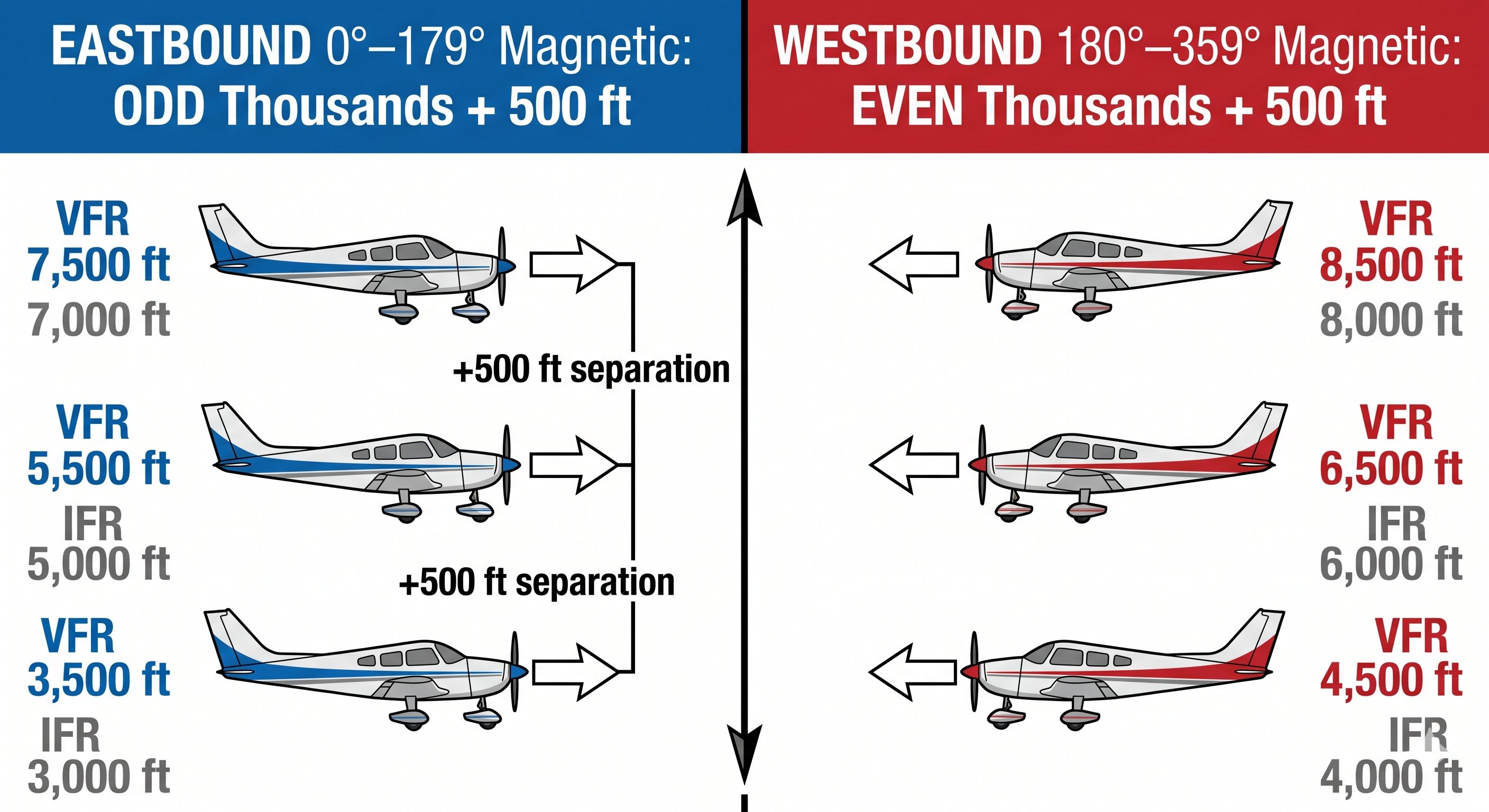
VFR altitude rules (FAR 91.159) require: when flying on a magnetic course of 0°–179°, fly at odd thousands + 500 ft (3,500, 5,500, 7,500). When flying on a magnetic course of 180°–359°, fly at even thousands + 500 ft (4,500, 6,500, 8,500). Below 3,000 ft AGL, the hemispheric rule doesn't apply.
Choose altitude based on terrain clearance, wind (winds aloft forecast), airspace, and aircraft performance. Higher altitudes typically provide better glide distance in an emergency and more favorable winds for long flights.
You must obtain a preflight weather briefing before any cross-country flight. The standard source is 1800wxbrief.com (Leidos Flight Service). A standard briefing covers:
Winds aloft forecasts are issued four times daily for altitudes from 3,000 to 53,000 feet. Format: DDSSHH — two-digit direction (in tens of degrees), two-digit speed (knots), two-digit temperature (°C). Example: 2715-04 = wind from 270° at 15 knots, temperature -4°C.
Use the winds aloft forecast to compute your true heading and groundspeed for each leg. The classic method uses the E6B flight computer (or our digital fuel planner) to resolve the wind triangle.
"I'll check it on the app" is not a weather briefing. While apps like ForeFlight are excellent tools, you need a proper standard briefing from Leidos or an equivalent AFSS. The briefing creates a record that you checked weather and is your legal documentation of preflight preparation.
The navigation log (nav log) is the core planning document for a VFR cross-country. It organizes all your calculations into a flight-by-flight-segment format. For each leg, compute:
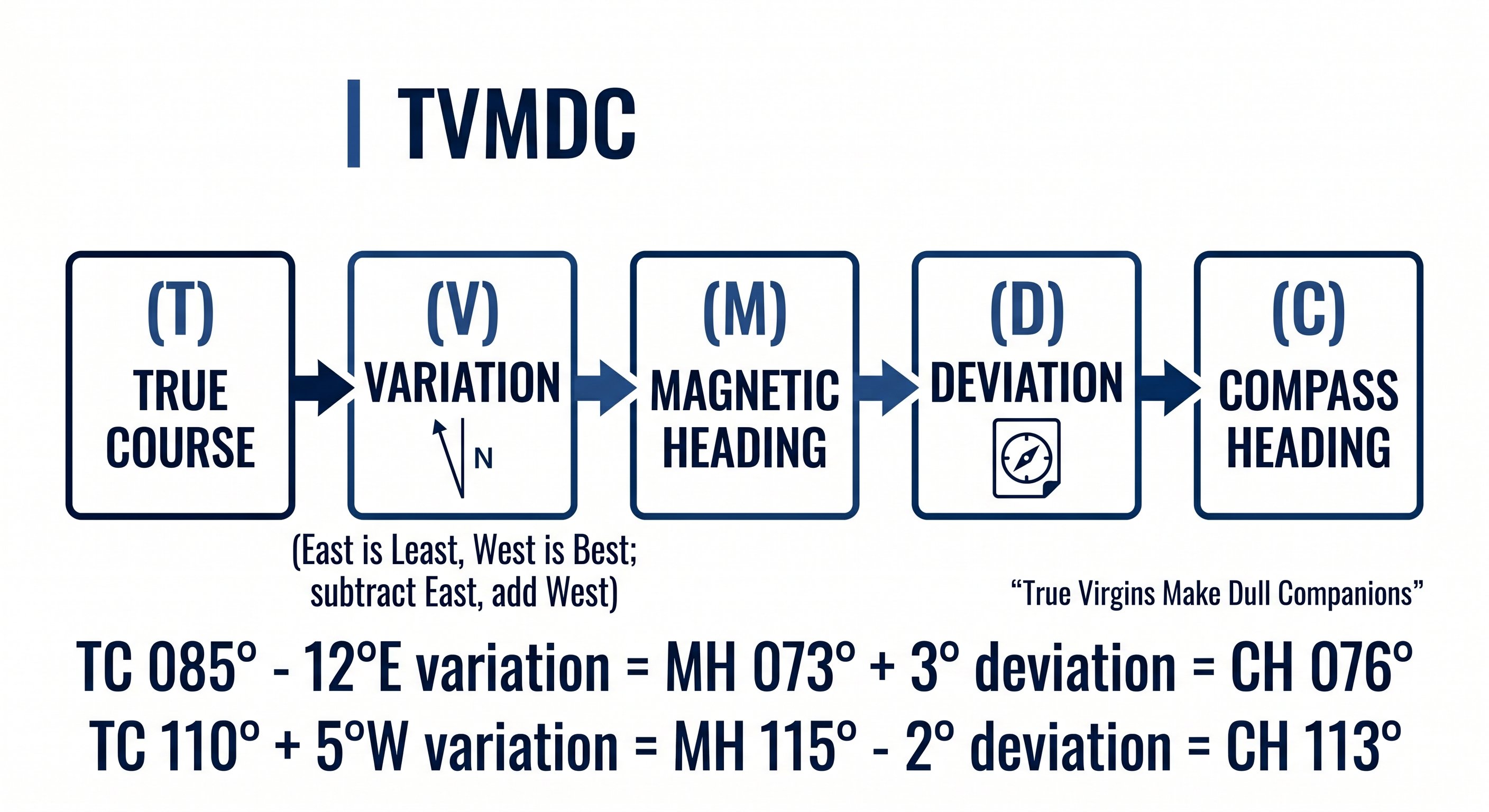
Measure the true course from your sectional using a plotter. This is the direction of your planned flight path relative to true north.
Using winds aloft data and your true airspeed, compute the wind correction angle using the E6B. True heading = True course ± WCA. This is the direction you must point the nose to track the desired course over the ground.
True heading ± magnetic variation = magnetic heading. Magnetic variation is shown on sectional charts as isogonic lines. East variation subtracts, west variation adds (TVMDC — True Variation Magnetic Deviation Compass).
Magnetic heading ± compass deviation = compass heading. Deviation is found on your aircraft's compass correction card.
Use the E6B to compute groundspeed for each leg given true airspeed and wind. Leg time = distance ÷ groundspeed.
Fuel per leg = leg time × fuel burn rate. Sum all legs plus taxi/runup, reserve, and alternate fuel. Compare to fuel on board — this is your go/no-go fuel check.
Let the tool do the fuel math. Our fuel planner shows the full calculation with reserves and go/no-go status.
Fuel Planner →For VFR day flight, you must have enough fuel to fly to the first point of intended landing and then fly for at least 30 minutes at normal cruise speed. For VFR night flight, the reserve is 45 minutes. These are legal minimums — most experienced pilots plan for significantly more.
The reserve fuel is calculated at cruise fuel burn, not best economy — don't shortchange it. If in doubt, add a fuel stop. Running low on fuel is one of the most preventable causes of GA accidents.
Check NOTAMs for every airport you plan to use, plus any major airports near your route. Critical things to look for:
NOTAMs are available through 1800wxbrief.com, ForeFlight, or the FAA's NOTAM search at notams.aim.faa.gov.
Complete a weight and balance calculation for your specific loading. Do not skip this step — CG outside limits is a real safety issue, not a paperwork formality. See our W&B Calculator for C172 and PA-28.
Remember: the calculation you do before departure assumes the fuel load at departure. Your CG will shift as you burn fuel. For most training aircraft with passengers in front seats only, this shift is small and predictable — but always verify.
VFR flight plans are not legally required for domestic US flights, but they are highly recommended for cross-country flights over remote or unfamiliar terrain. A VFR flight plan filed with Leidos (via 1800wxbrief.com, ForeFlight, or phone) means search and rescue will be notified if you don't close it within 30 minutes of your destination ETA. Always close your flight plan on arrival.
As you fly, update your nav log at each checkpoint. Record the actual time over each checkpoint and compare to your planned time. If you're off by more than a few minutes, recalculate your groundspeed and ETA to identify the cause — you may have stronger or weaker winds than forecast.
If you can't identify a checkpoint when you expect it: don't panic. Maintain your heading and continue flying — the next checkpoint may appear before your expected one does. If you remain unsure of your position, use the "5 C's": Climb, Communicate (with ATC or CTAF), Confess (to ATC that you're uncertain), Comply (with ATC instructions), and Circle (maintain position while you assess).