What is a Commercial Pilot Certificate?
A Commercial Pilot Certificate (CPL) is the FAA certificate that authorizes you to act as pilot-in-command of an aircraft for compensation or hire. Without it, you can carry passengers (with a PPL) but you cannot legally be paid to fly. With it, a wide range of flying careers become available — from flight instruction to charter to cargo to aerial work.
The commercial certificate requires a higher standard of airmanship than the PPL. The aircraft control tolerances in the ACS are tighter, new precision maneuvers are introduced, and the overall competency bar is noticeably higher. Most pilots find the commercial training genuinely challenging and rewarding.
The full pathway to a commercial certificate
The commercial certificate doesn't exist in isolation. It sits at the end of a chain of prerequisites that most pilots complete in this order:
FAA requirements in detail (Part 61)
Under FAR 61.129, here are the specific hour requirements for a Commercial ASEL (single-engine land) certificate:
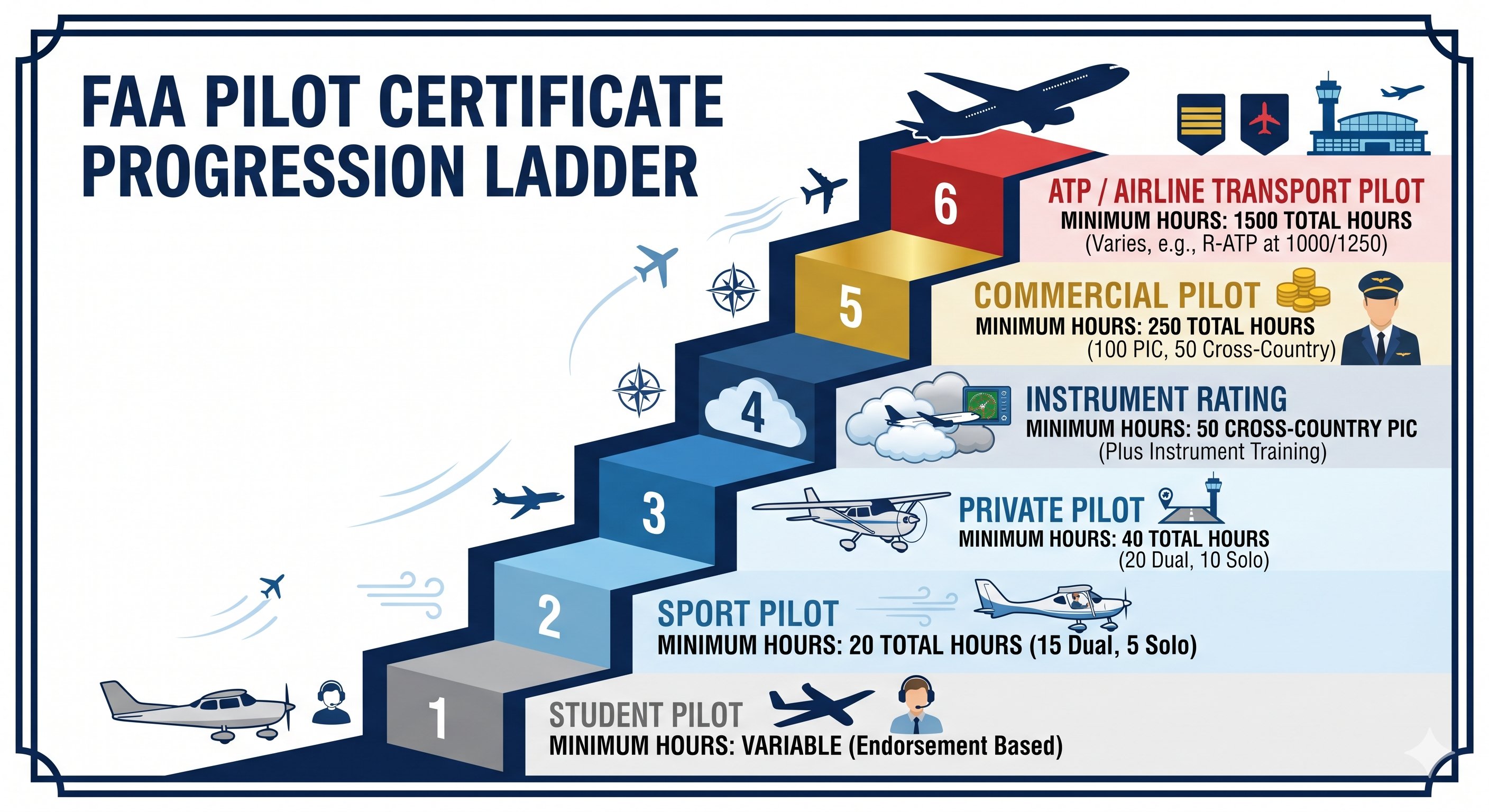
- 250 total flight hours — including all time logged as student, solo, and PIC
- 100 hours in powered aircraft — as pilot-in-command
- 50 hours in airplanes — as pilot-in-command
- 50 hours cross-country PIC time — in any aircraft category
- 10 hours instrument time — in airplanes (not simulator)
- 10 hours in a complex aircraft — retractable gear, constant-speed propeller, and flaps
- One solo cross-country — at least 300 nm total, with a full-stop landing at a point 250+ nm from departure
- 5 hours of night VFR — including 10 takeoffs and landings at an airport with a control tower
Part 141 reduces the total time requirement to 190 hours — a 60-hour reduction worth roughly $9,000–$15,000 in aircraft rental savings. For full-time students at an approved school, Part 141 is significantly more cost-efficient for the commercial rating specifically.
The time-building gap — the biggest challenge
Here's the reality that most pilot guides gloss over: after earning your PPL and instrument rating, you'll have roughly 80–120 total hours. The commercial certificate requires 250. That gap of 130–170 hours is what's often called the "time-building problem," and it's the primary cost driver on the commercial path.
Options for building those hours:
- Earn your CFI and instruct — the most common path. You get paid (modestly) while logging PIC time. See our full certificates guide for the CFI pathway.
- Flying clubs — lower rental rates than commercial schools. Good for PIC cross-country time.
- Fly-away programs — some operators pay low-time pilots to fly aircraft deliveries or positioning flights.
- Own or share ownership in an aircraft — reduces per-hour cost significantly for dedicated time-builders.
- Scenic/tour operations — some states allow lower-time pilots to fly sightseeing tours under specific exemptions.
The complex aircraft requirement
Commercial training requires at least 10 hours in a complex aircraft — defined as having retractable landing gear, a constant-speed (controllable-pitch) propeller, and flaps. This introduces new systems management demands: gear operation, prop control, and engine management for the first time.
Common complex training aircraft:
- Piper Arrow (PA-28R) — most common complex trainer. ~$175–220/hr wet.
- Beechcraft Bonanza (V35/A36) — higher performance, ~$200–280/hr.
- Cessna 210 — good cross-country platform, ~$190–260/hr.
- Mooney (various) — efficient, fast, ~$200–270/hr.
Commercial maneuvers — what's new
The commercial ACS introduces maneuvers you didn't do for your PPL. These require a higher level of precision and planning:
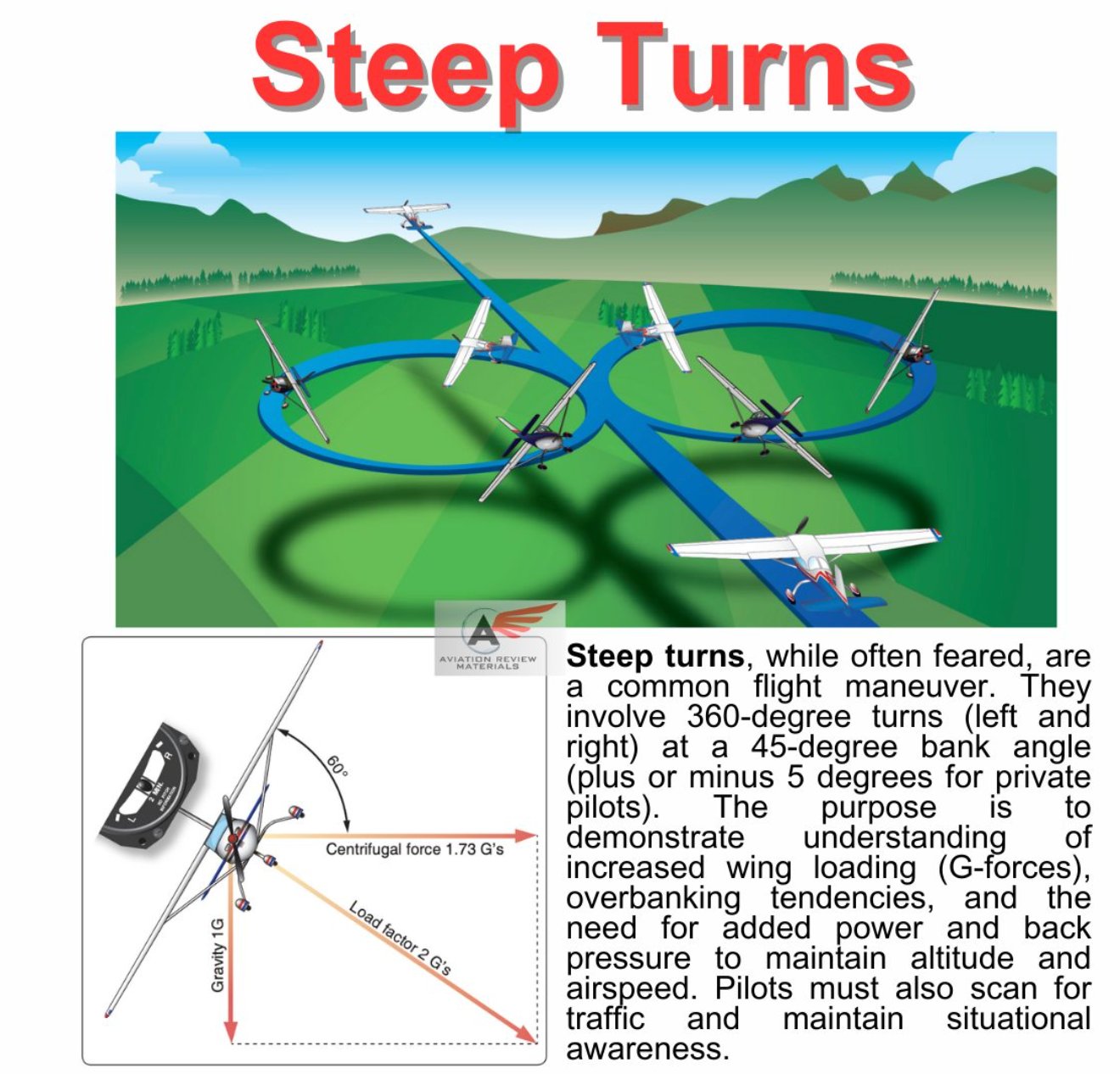
- Chandelles — maximum performance climbing turn
- Lazy eights — coordinated climbing and descending turns
- Eights on pylons — ground reference at pivotal altitude
- Steep turns (50° bank)
- Power-off 180° accuracy approach
- Short-field takeoff and landing (tighter tolerances)
- Soft-field takeoff and landing
- Go-around from low approach
The commercial-level tolerances are noticeably tighter than PPL. For example, steep turns require maintaining ±100 ft altitude and rolling out within ±10° of the entry heading at 50° of bank — more demanding than the PPL standard.
Cost breakdown for the commercial certificate
| Component | Details | Cost range |
|---|---|---|
| Aircraft rental (complex) | ~25–30 hrs in complex aircraft | $4,500–$8,000 |
| CFI instruction | ~20–30 hrs dual in commercial training | $1,200–$2,500 |
| Time-building flights | 130–170 hrs to reach 250 total | Varies widely (see above) |
| Commercial ground school | Online course | $150–$350 |
| Knowledge test | FAA Commercial written | $175 |
| Checkride (DPE fee) | Oral + flight | $700–$950 |
| Training only (excl. time-building) | The CPL-specific portion | $6,725–$11,975 |
Note: The table above covers the commercial training itself. Time-building costs (to reach 250 hours from ~100) vary enormously depending on your method — from $0 if instructing to $15,000+ if renting a trainer.
Get a personalized commercial pilot cost estimate based on your region, aircraft, and training pace.
Open Cost Estimator →What jobs can you get with a commercial certificate?
The commercial certificate opens the door to paid flying — though the specific jobs available depend heavily on your total hours and additional ratings.
The CFI route is the most efficient path to the airlines. Earning your CFI right after your commercial and instructing for 2–3 years builds the 1,500 hours required for an ATP while generating income. Many regional airlines have direct pipeline agreements with flight academies that include conditional job offers for students in structured programs.
Common questions
Do I need an instrument rating to get a commercial certificate?
For a Commercial ASEL (single-engine), yes — the instrument rating is required under FAR 61.123. Without it, your commercial privileges are limited to VFR-only operations. In practice, virtually all career-track pilots earn their instrument rating before their commercial, so this isn't a meaningful limitation.
Can I fly for the airlines with just a commercial certificate?
No. All airline first officers operating under FAR Part 121 (scheduled air carriers) must hold an Airline Transport Pilot (ATP) certificate, which requires 1,500 total hours. The commercial certificate is a prerequisite for the ATP, but by itself it doesn't authorize Part 121 operations.
How long does commercial pilot training take?
The training itself (the 25–30 hours of commercial-specific dual instruction) takes 2–4 months. But reaching the 250-hour total time requirement — starting from typical PPL/IR graduation at ~100 hours — takes most pilots 1–3 years depending on how quickly they build time.
What's the difference between Part 61 and Part 141 for the commercial?
This is where Part 141 has its biggest advantage: the total time requirement drops from 250 to 190 hours — a 60-hour reduction worth $9,000–$15,000 in aircraft costs. For full-time students at an accredited Part 141 school, this is significant. See our complete Part 61 vs Part 141 guide.