What is BasicMed?
BasicMed is an alternative medical qualification pathway that allows eligible pilots to fly without holding a traditional FAA medical certificate. It was created by Congress under the FAA Extension, Safety, and Security Act of 2016 and became effective in May 2017. Instead of an aviation medical examination with an AME, BasicMed uses an examination by any licensed state physician combined with an online medical education course.
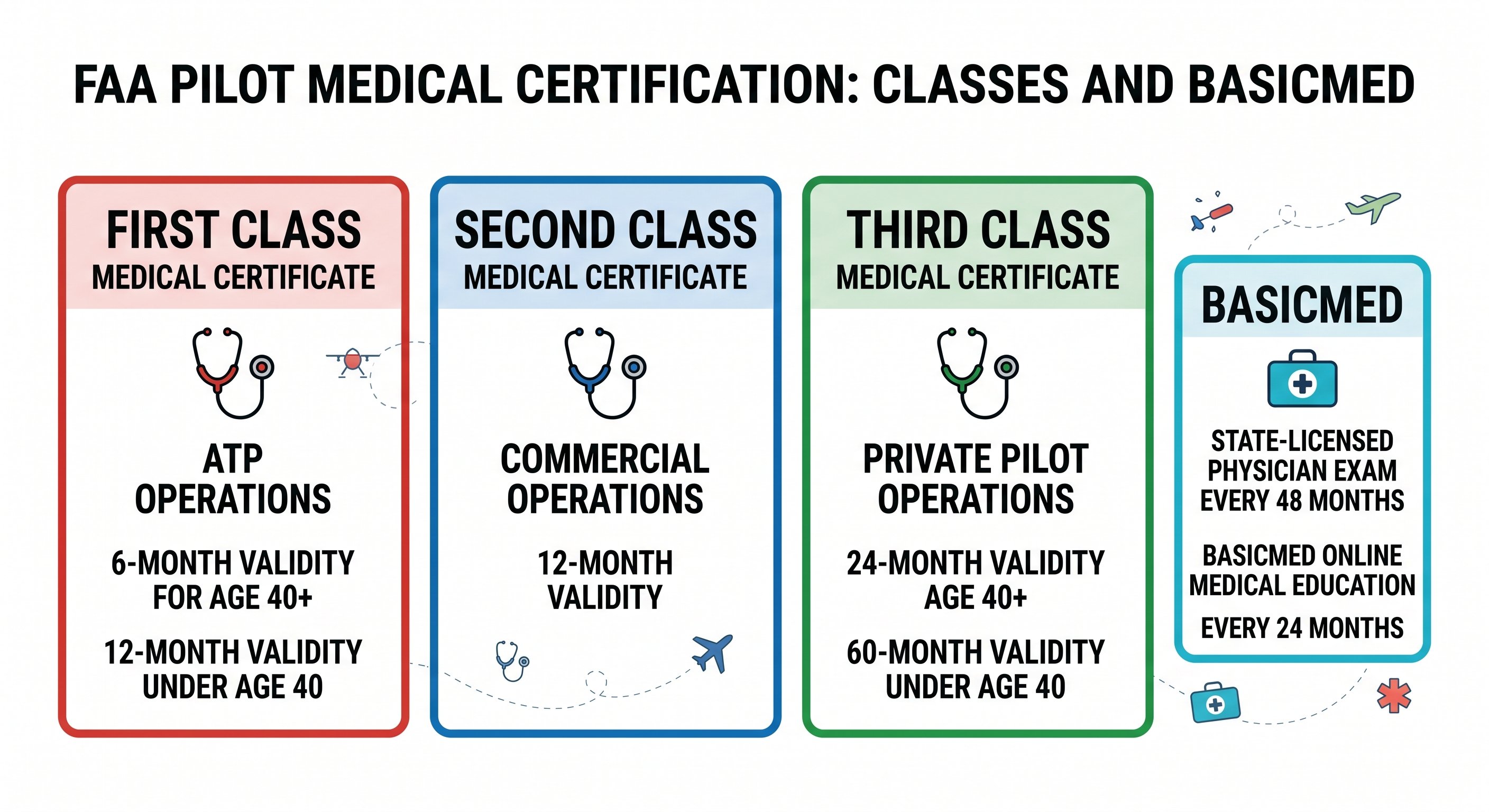
BasicMed is governed by 14 CFR Part 68 and offers a practical alternative to the Third Class medical for pilots who fly small general aviation aircraft for personal and recreational purposes. It is not available for commercial operations.
What BasicMed allows
Under BasicMed, a pilot may act as pilot-in-command of an eligible aircraft if all of the following conditions are met:
- Aircraft weight: The aircraft has a maximum certificated takeoff weight of no more than 6,000 pounds
- Passengers: No more than 5 passengers (6 total including pilot)
- Altitude: No higher than 18,000 feet MSL
- Speed: No faster than 250 knots indicated airspeed
- Operations: Domestic US operations only — no international flights
- Not for hire: No operations requiring an FAA medical certificate (Part 121, 135, commercial operations)
These limits cover the vast majority of general aviation flying — including cross-country trips in a Cessna 172, Piper Archer, Beechcraft Bonanza, Cirrus SR22, and most other common GA aircraft.
BasicMed does not allow flight instruction for compensation. A CFI operating under BasicMed cannot receive compensation for flight instruction. However, a CFI may provide instruction to students without compensation while operating under BasicMed.
Eligibility requirements
To use BasicMed, a pilot must meet all of the following:
- Hold a valid U.S. driver's license (not suspended, revoked, or expired)
- Hold or have held an FAA medical certificate at any point after July 14, 2006 — this is the critical requirement. If you have never held any class of FAA medical, you cannot use BasicMed. You must obtain at least one traditional medical certificate first.
- Not have had an FAA medical application denied or revoked — if the FAA has previously denied or revoked your medical application, you cannot use BasicMed unless you obtain an authorization from the FAA.
- Not be subject to any FAA special issuance conditions that conflict with BasicMed operations
The "previously held a medical" requirement catches many pilots off guard. Student pilots who have never obtained an FAA medical certificate cannot use BasicMed as their first medical qualification. You must get a Third Class medical first, then you can transition to BasicMed at renewal time.
How to get BasicMed — step by step
-
1
Complete the AOPA online medical course
The FAA-approved BasicMed course is available through AOPA at aopa.org/go/basicmed. It takes approximately 2–3 hours and covers medical conditions, medications, and aviation safety topics. Cost is free for AOPA members, $25 for non-members. You must complete this course every 24 calendar months to maintain BasicMed.
-
2
Download the Comprehensive Medical Examination Checklist (CMEC)
The CMEC is the FAA form your physician completes during your examination. Download it from the FAA website (FAA Form 8700-2) before your appointment so your doctor has it ready.
-
3
Visit your regular doctor
Any licensed physician in a U.S. state or territory can conduct the BasicMed examination — your family doctor, internist, or primary care physician. They do not need to be an Aviation Medical Examiner. The exam follows the CMEC checklist and covers the same basic health areas as a Third Class medical (vision, hearing, cardiovascular, neurological).
-
4
Keep the completed CMEC
Once your physician signs the CMEC, keep it with your logbook. You do not submit it to the FAA — you simply possess it and present it if asked during a ramp check. The physician exam must be repeated every 48 calendar months.
-
5
Fly under BasicMed
With a current CMEC and current AOPA course completion, you may act as PIC within the BasicMed limitations. You do not need to notify the FAA or hold any FAA medical certificate to exercise BasicMed privileges.
BasicMed vs. Third Class medical — comparison
When BasicMed is clearly better
- You have a medical condition that has previously required special issuance, is borderline, or generates ongoing uncertainty at AME exams
- You want the flexibility of seeing your own physician rather than scheduling with an AME
- You fly purely for personal/recreational purposes and never plan commercial operations
- You want to avoid the potential of a denied medical application going on your record
- The 6,000 lb / 18,000 ft / 250 kt limits are compatible with your aircraft and flying plans
When a Third Class medical is better
- You plan to become a flight instructor and accept compensation for instruction
- You want a path to a Second Class (commercial operations) or First Class (airline) medical in the future
- You need to fly internationally (BasicMed is domestic US only)
- Your aircraft or planned operations exceed BasicMed limits
- You have never held any FAA medical certificate — you must get one before using BasicMed
Common medical conditions and BasicMed
BasicMed does not create a new list of acceptable or disqualifying conditions — the FAA's medical standards still apply as a baseline. However, the key difference is how those conditions are evaluated. Under BasicMed:
- Your personal physician makes the determination about fitness to fly (within FAA guidelines)
- There is no mandatory reporting to the FAA unless your physician specifically notes a condition on the CMEC that the physician believes could interfere with safe flight
- Conditions that previously required AME special issuance can often be handled through BasicMed if your regular physician is comfortable signing off
Common conditions that many pilots manage under BasicMed include well-controlled hypertension, stable type 2 diabetes (on certain medications), treated sleep apnea, and certain cardiac conditions. Always discuss your specific situation with your physician and an aviation medical attorney if uncertain.
If you have any medical concerns, consult AOPA's Medical Certification Services before your first AME visit. They offer free and confidential consulting to help pilots understand their options before any information goes on FAA record. Going to an AME uninformed can result in a denied special issuance that limits your future options including BasicMed.
What happens to my current medical under BasicMed?
If you currently hold a valid Third Class medical, you can transition to BasicMed at any time — you don't need to wait for your medical to expire. Simply complete the AOPA online course and get your physician to sign the CMEC. Once you're operating under BasicMed, you no longer need to renew your FAA medical certificate, as long as you remain within BasicMed's operational limitations.
If your existing medical expires, you can still fly under BasicMed as long as you meet all the requirements — an expired medical is not an issue for BasicMed operations.
Key references and resources
- 14 CFR Part 68 — Requirements for operating certain aircraft without a medical certificate
- FAA BasicMed page — official requirements
- AOPA BasicMed online course
- AOPA Medical Certification Services — free consultation
- FAA Form 8700-2 — Comprehensive Medical Examination Checklist (CMEC)