FAA night flight requirements for the PPL
The Private Pilot License requires a minimum of 3 hours of night flight training under FAR 61.109(a)(2). Those 3 hours must include:
- One cross-country flight of more than 100 nautical miles total distance
- 10 takeoffs and 10 landings to a full stop at an airport with an operating control tower
These requirements apply to training conducted with a CFI present (dual instruction). Night solo flight, including the solo cross-country, does not need to occur at night — your solo requirements can be completed entirely during daytime.
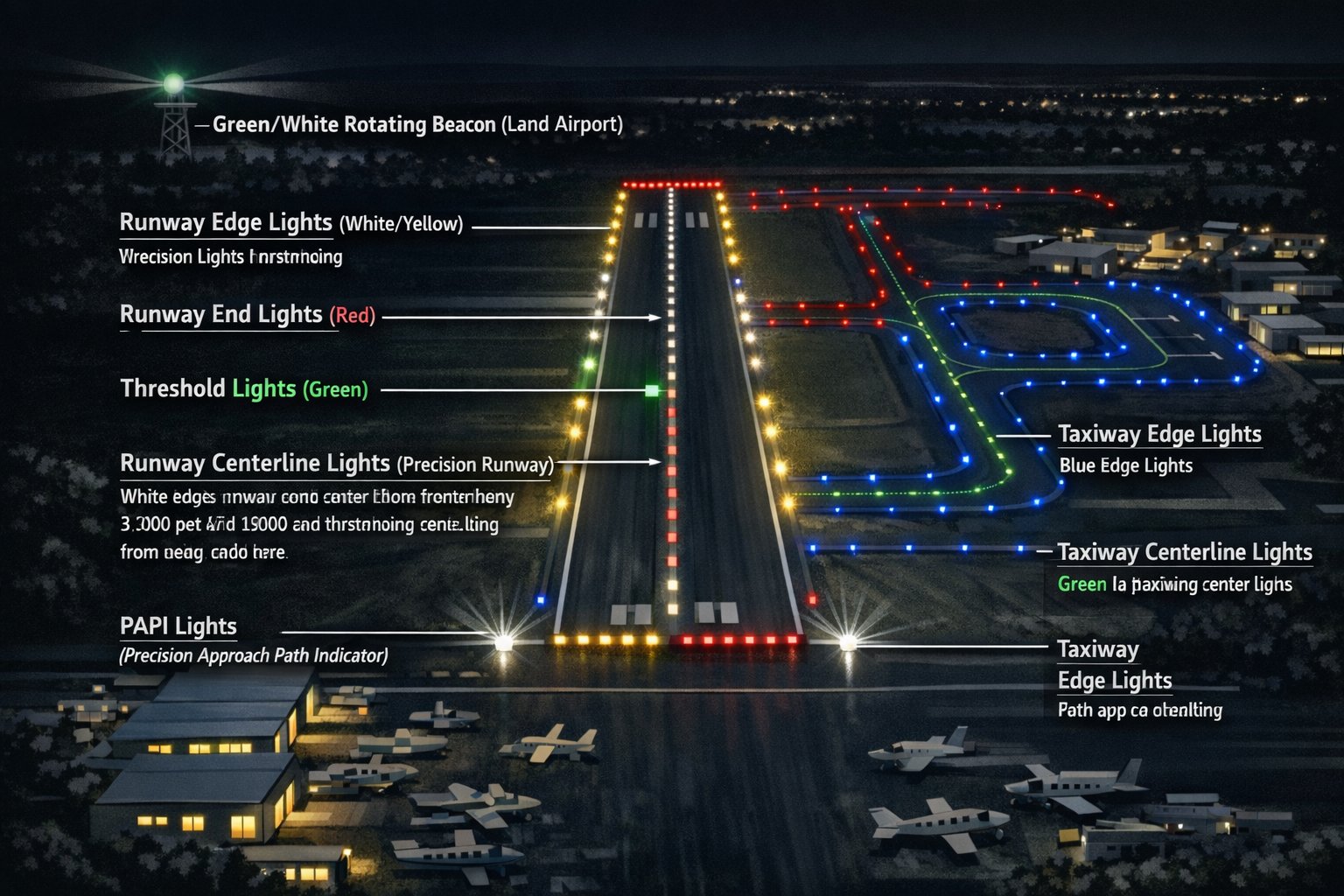
Airport lighting — runway edge white, taxiway blue, PAPI glidepath
Night vision — why you can't see what's right in front of you
Your eye has two kinds of light receptors. Cones, concentrated in the center of your vision, handle color and fine detail but need bright light to work. Rods, arranged around the periphery, handle low-light vision but are nearly absent from the very center. The consequence at night is counterintuitive: there is a small blind spot dead center where you are looking. An aircraft or obstacle you stare straight at can disappear, then reappear when you look slightly away from it.
The technique is off-center viewing — scan in short movements and look about 5 to 10 degrees off to the side of what you want to see, letting the rods do the work. Two more facts matter. Full dark adaptation takes about 30 minutes, and a single bright white light resets much of it, so protect your night vision and use dim red or low white cockpit lighting. And the eye is sensitive to oxygen: mild hypoxia degrades night vision at altitudes as low as 5,000 ft, which is why supplemental oxygen is recommended earlier at night than during the day.
Night illusions that fool good pilots
With few visual references, the brain invents them — usually wrong:
The black-hole approach. Approaching a lit runway across unlit terrain or water, with no surrounding lights, makes you feel higher than you are. The instinct is to descend — and pilots have flown perfectly good airplanes into the ground short of the runway. Fly the published glidepath (VASI/PAPI) and your instruments, not the picture.
Autokinesis. Stare at a single fixed light against a dark background for several seconds and it appears to move on its own. Keep your eyes scanning so a static light (another aircraft, a star, a tower beacon) doesn't seem to maneuver.
False horizons. A sloping cloud deck, a line of ground lights, or stars reflected on water can masquerade as the horizon and lead you to bank toward the real one. Cross-check the attitude indicator.
Night equipment and reserves
For night flight, FAR 91.205(c) requires the daytime VFR equipment plus approved position (navigation) lights, an approved anti-collision light system, an adequate source of electrical energy for all installed equipment, and one spare set of fuses (or three of each kind required) accessible in flight. A landing light is required only if the aircraft is operated for hire — but you want one regardless.
Fuel reserves are stricter at night, too. Day VFR requires enough fuel to reach the destination plus 30 minutes at normal cruise; night VFR requires 45 minutes of reserve (FAR 91.151). Plan for it.
Pilot-controlled lighting: at many non-towered fields you activate the runway lights yourself by keying the mic on the CTAF — typically 7 clicks within 5 seconds for the brightest setting, 5 for medium, 3 for low. Know the field's frequency and click the lights up on approach.
Preparing for a night flight
Carry two flashlights — one with a red lens to preserve night vision and a white one for preflight and emergencies — and check the batteries. Study the terrain and obstacles along your route in daylight on the chart, because you will not see rising ground at night until it is a problem; favor higher cruising altitudes and known-good routes. Plan an engine-failure strategy honestly: at night your best option after a failure is usually to glide toward the darkest area (open terrain) rather than tempting lights, and to use the landing light only at the last moment — if you don't like what it shows, some pilots prefer to leave it off. Set personal minimums that are higher at night than by day, and build night currency deliberately: to carry passengers at night you need three takeoffs and three full-stop landings within the preceding 90 days, at night (FAR 61.57(b)).
Check your night-passenger currency with the Currency Checker, and see Cross-Country Planning for the night XC that satisfies the PPL requirement.