First, Second, and Third Class explained in plain English. BasicMed eligibility, common disqualifiers, how to find an AME, and what to do if you have a medical concern — before you invest in training.
The FAA medical certificate is one of the first things you should take care of — ideally before investing significant time or money in flight training. In rare cases, a medical condition surfaces that affects flying eligibility. Finding out early costs $75–$150 for the exam. Finding out after 40 hours of training costs much more.
For most people, the medical exam is a straightforward physical with no surprises. But if you have a medical history worth discussing — controlled blood pressure, prior mental health treatment, certain medications, past surgeries — getting the exam done first gives you clarity and time to address any issues before they become training roadblocks.
Get your medical before your first lesson if possible. You are not legally required to have it before starting ground training, but it's strongly advisable. FAA MedXPress (the online application) can be completed at home before your appointment.
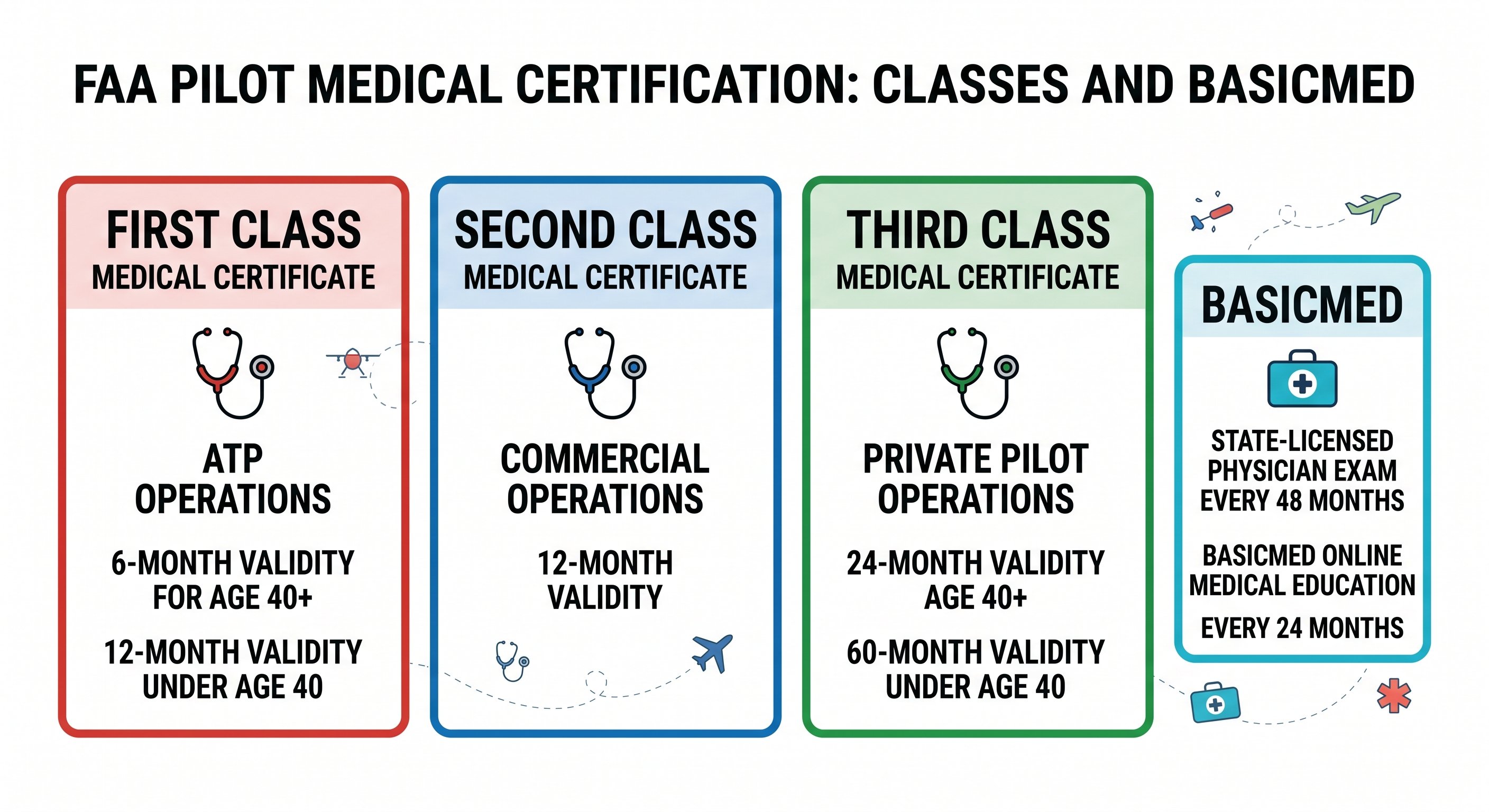
The FAA issues three classes of medical certificate, each with different standards and required for different types of flying. Higher classes require more stringent exams.
Career pilots: get a First Class medical early. If you're planning an airline career, get a First Class exam during initial training — not after. You need to know early if there's anything that would prevent First Class certification. The exam cost is minimal compared to the investment of training.
BasicMed, introduced in 2017, allows eligible pilots to fly without a traditional FAA medical certificate. Instead, you complete a free online medical education course and receive a physical exam from any state-licensed physician — not just an FAA AME.
For recreational pilots, BasicMed has been a game-changer, especially for those with medical histories that make traditional certification difficult or uncertain. If you're flying for fun rather than compensation, BasicMed may be all you ever need.
Vision is the most common concern for aspiring pilots. The good news: glasses and contacts are both fully acceptable for all certificate classes. The standards require corrected vision — what you can see with your glasses on.
| Medical Class | Distant Vision | Near Vision | Intermediate | Color Vision |
|---|---|---|---|---|
| First Class | 20/20 corrected | 20/40 corrected | 20/40 at 32" | Required |
| Second Class | 20/20 corrected | 20/40 corrected | 20/40 at 32" | Required |
| Third Class | 20/40 corrected | 20/40 corrected | 20/40 at 32" | Required |
Color vision testing is required for all classes. The standard is distinguishing aviation signal colors (red, green, white). If you fail the standard Ishihara color plate test, you can take an alternative operational color vision test (OCVT) or medical flight test (MFT) that tests color vision in actual aviation conditions — many pilots with mild color deficiency pass these alternatives.
Both LASIK and PRK are generally acceptable for all FAA medical classes. There is a standard waiting period (typically 6–12 months post-procedure) before FAA certification, and your AME will need documentation of the procedure and outcomes. Contact lenses and glasses remain acceptable throughout training.
The following conditions are either automatically disqualifying or require special issuance (additional documentation and FAA review). This is not an exhaustive list — always consult an AME for your specific situation.
Do not falsify your medical application. Knowingly providing false information on FAA Form 8500-8 is a federal offense and can result in certificate revocation and criminal prosecution. If you have a medical history, disclose it honestly and work with an AME or aviation medical attorney to determine your eligibility.
Consider consulting an Aviation Medical Examiner (AME) before your formal exam if you have any medical concerns. Many AMEs offer informal consultations. The FAA's AOPA Medical Certification Services also provides free case reviews and guidance for pilots with complex medical histories.
This is one of the most misunderstood areas of FAA medical certification. The FAA has made significant progress in recent years recognizing and accommodating mental health treatment.
The general principle: seeking help for mental health does not automatically disqualify you. The FAA is more concerned with stability and treatment outcomes than with the diagnosis itself.
Go to medxpress.faa.gov and fill out FAA Form 8500-8 completely and honestly. Print or save your confirmation number — you'll give it to your AME at the appointment.
Use the FAA's AME locator to find a designated examiner near you. Look for one experienced with your specific medical situation if applicable — experience with pilots matters.
Bring documentation of any conditions you've disclosed. Having records on hand prevents delays and gives the AME context. For straightforward exams, you may not need anything — the AME will advise.
The exam typically takes 30–60 minutes. It includes vision, hearing, blood pressure, and a review of your medical history. For First Class, an EKG is required at age 35+.
If the AME can issue on the spot, you'll receive your certificate immediately. If deferral to the FAA is needed, the process can take weeks to months. This is when an aviation attorney may become valuable.
You can complete ground training and simulator sessions, but you cannot fly solo without a student pilot certificate and a valid medical. Getting your medical early is strongly recommended — don't invest significant money in flight time until you know you're medically eligible.
Usually not. Controlled hypertension on approved medications is acceptable for all three medical classes, provided blood pressure is within acceptable limits at exam time. Your AME will verify which medications are approved — most standard antihypertensives are fine.
Possibly. A single DUI in the distant past (often 5+ years) may not be disqualifying, especially with demonstrated sobriety. Multiple incidents, or incidents combined with a diagnosis of alcohol dependence, are more complex. Special Issuance is possible in many cases. AOPA's medical certification team can provide a free case evaluation.
Deferral means the AME could not issue on the spot and the application was sent to the FAA Aerospace Medical Certification Division. This is not a denial — it's a request for more information or review. The process can take 3–12 months depending on complexity. An aviation attorney is advisable for complex deferral situations.
AOPA's Medical Certification Services offers free consultations for members and pilots with complex medical histories. Many aviation attorneys specializing in FAA medical certification are also available. Never try to navigate a complex Special Issuance case alone.
This guide is for informational purposes only and does not constitute legal or medical advice. FAA medical standards can change. Always verify current requirements at faa.gov and consult a qualified Aviation Medical Examiner for your specific situation.