The FAA minimum vs reality
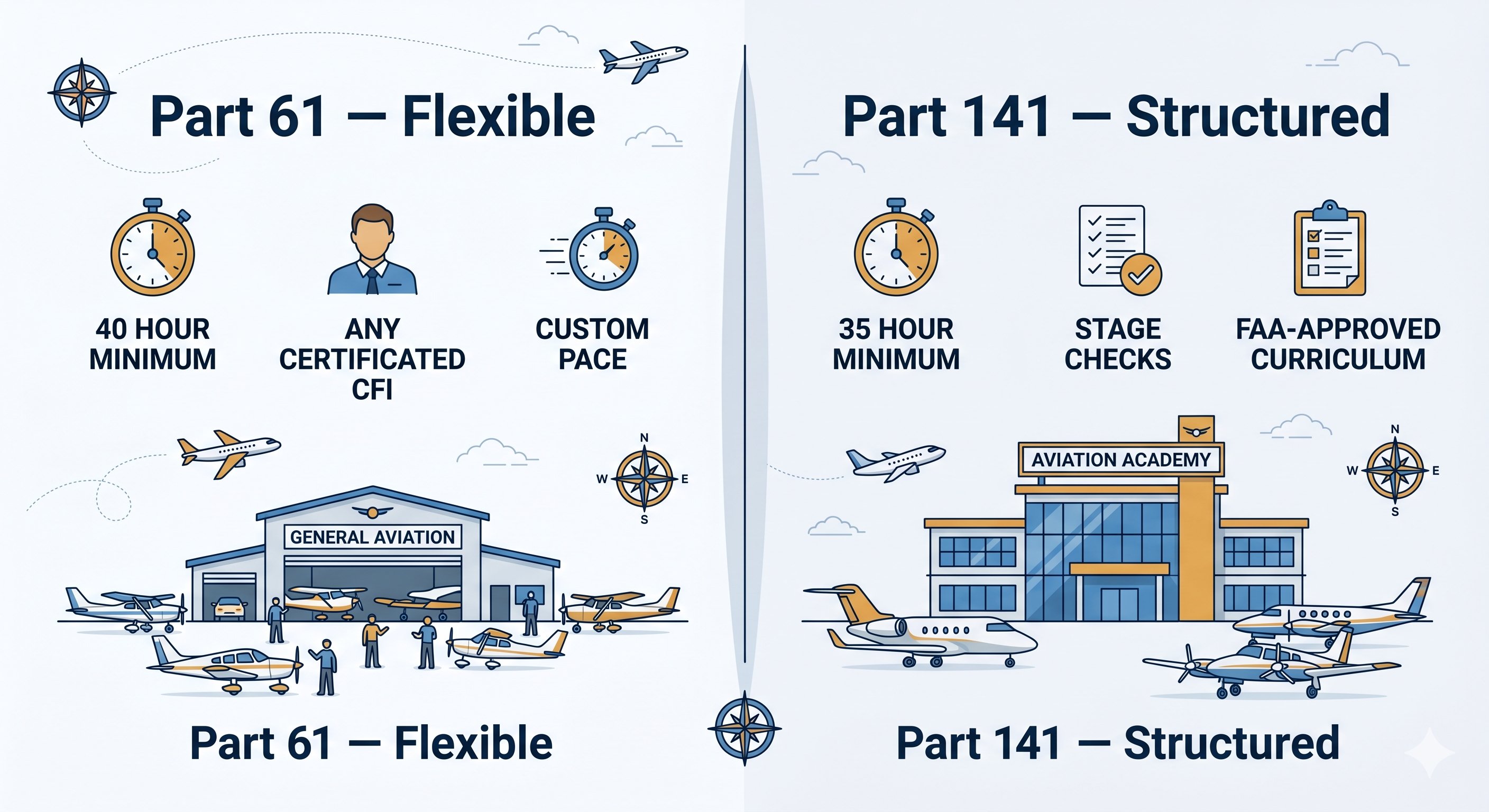
The FAA requires a minimum of 40 flight hours to be eligible for the Private Pilot checkride — but almost nobody finishes in 40 hours. The national average is 60–70 hours, and many students need 70–80. Understanding why the gap exists helps you plan and budget realistically.
The 40-hour minimum was established decades ago when training aircraft were simpler, airspace was less complex, and the ACS (Airman Certification Standards) requirements were less stringent than today. Modern training involves more procedures, more airspace familiarity, and higher standards across all maneuvers. Budget for 65–70 hours and be pleasantly surprised if you finish sooner.
The 40-hour requirement breakdown: 20 hours dual instruction (with a CFI), 10 hours solo, 3 hours cross-country, 3 hours night, 3 hours instrument hood, and 3 hours checkride prep within 60 days. These are minimums — your actual hours will be higher in most categories.
Timeline by training intensity
Full-time accelerated — 3 to 5 months
Students who fly 4–5 days per week at an accelerated school (like ATP Flight School or an aviation university program) can realistically earn a PPL in 3–5 months. This requires treating training like a full-time job — ground school in the morning, flights in the afternoon, studying in the evenings. You'll build momentum, retain information better between lessons, and spend less time re-learning maneuvers that went stale during a long gap.
This path costs more upfront (you're paying for a lot of flight time quickly) but often less total because you finish in fewer hours due to better retention. It's the right choice for career-track pilots who want to reach the airlines as fast as possible.
Part-time structured — 8 to 12 months
Flying 2–3 times per week with a consistent schedule and a dedicated instructor. This is the sweet spot for most working adults who can't do full-time but are serious about finishing. You'll fly often enough to maintain skill between lessons, make steady progress, and finish within a year. Expect 65–75 total hours.
Part-time casual — 12 to 24 months
Flying once a week or less, with gaps for weather, life, and scheduling conflicts. This is where most people land, and where most people struggle. The problem isn't commitment — it's physics. Skills learned in the air deteriorate faster than most students expect. A two-week gap after learning steep turns means spending the first 15 minutes of the next lesson re-establishing what you'd already done. The hours add up, the cost adds up, and the timeline extends.
If this is your situation, the most important thing you can do is fly consistently even when you can't fly frequently. Two shorter flights per week beats one long flight every two weeks for skill retention.
Stop-start training — 2 to 4+ years
Life happens. Jobs change, money gets tight, health issues arise. Pilots who pause training for months at a time often restart almost from scratch — particularly with landings and emergency procedures. This path is still completely achievable, but it requires accepting that restart sessions will feel discouraging and budgeting for the extra hours accordingly.
What speeds up your training
- Flying frequently — 3+ times per week keeps skills sharp between lessons
- A consistent instructor — switching CFIs resets your progress more than people realize
- Strong ground school completion early — students who pass their written test before 20 flight hours progress faster because they understand what they're doing
- Good weather location — Arizona, Nevada, and Florida students build hours faster than Seattle or upstate New York students
- Sim practice between flights — even a basic desktop simulator reinforces procedures and instrument scanning
- Studying before each lesson — briefing yourself on the day's maneuvers before arriving means less ground time and more air time
- Flying with intent — students who actively think about each maneuver during flight progress faster than those who passively do what the CFI says
What slows down your training
- Infrequent flying — the single biggest factor in extended timelines
- Changing instructors mid-training — new CFIs re-examine everything and often require re-demonstrating maneuvers you've already signed off
- Poor weather regions in winter — scheduling becomes impossible during extended IFR periods
- Aircraft availability issues — schools with small fleets and high demand can mean 1–2 week waits for a slot
- Delaying the written test — students who haven't passed their written test by 20–25 hours add ground time to every flight lesson and delay their solo
- Financial gaps — stopping training because of money and restarting 3 months later is enormously costly in re-learning time
The written test — don't let this be your bottleneck
The FAA Private Pilot written knowledge test (PAR) must be passed before your checkride. You need a score of 70% or higher on 60 questions. This is a major bottleneck for students who delay studying for it — your CFI cannot endorse you for the checkride until it's done, and DPEs will ask you about knowledge test topics during the oral exam regardless of your score.
The best approach: complete ground school and pass the written test within your first 20–25 flight hours. See our ground school comparison guide for the best online options. Most students who follow this sequence finish their PPL faster overall because they aren't bottlenecked by the written test in the final stretch.
Solo — the first big milestone
Your first solo flight typically happens between 15–25 hours of dual instruction. There's no FAA-mandated hour requirement for solo — your CFI signs you off when you're ready, which varies significantly by student. Some students solo at 12 hours; others at 30. Neither is a reflection of ultimate potential as a pilot.
Before solo, you need to hold a student pilot certificate (free, from the FAA), pass a solo flight medical (BasicMed or FAA third class), and demonstrate to your CFI that you can consistently fly the traffic pattern, execute normal and crosswind takeoffs and landings, and handle an engine failure on takeoff. Your CFI will endorse your logbook and student certificate for the specific airport where you'll solo.
The cross-country requirement
One of the most time-intensive requirements is the solo cross-country flight — at least 150 nautical miles total with full-stop landings at two points, and one leg of at least 50 nm. This flight is a major confidence milestone and often takes a full day. Weather delays are common and can push this requirement weeks down the calendar. Build buffer time into your planning for this one.
Checkride — the final step
Once your CFI signs off all requirements, you apply for the checkride through IACRA (the FAA's online application system) and schedule with a Designated Pilot Examiner (DPE). DPE availability varies enormously by region — in rural areas you might get a slot within a week; in busy metro areas the wait can be 4–8 weeks. Your checkride prep endorsement is valid for 60 days, so plan accordingly.
The checkride itself is typically 3–4 hours: 1–1.5 hours of oral examination followed by a 1.5–2 hour practical test in the aircraft. Pass, and you walk away a certificated Private Pilot. See our full PPL checkride guide for complete preparation guidance.
Age considerations
You must be at least 16 to solo a powered aircraft and 17 to earn your PPL. There is no upper age limit for a Private Pilot Certificate — pilots in their 50s, 60s, and 70s earn PPLs regularly. The only age-related limitation is the FAA medical: you must hold a valid third-class medical or qualify for BasicMed. Some medical conditions become more common with age, so older student pilots should complete their medical early in training rather than late. See our FAA medical guide for details.
The most important thing you can do right now: Pick a realistic training intensity and commit to it. The students who finish fastest aren't necessarily the most talented — they're the ones who fly consistently, study between lessons, and don't let gaps stretch beyond two weeks. Use our cost estimator to build a budget around your realistic timeline.
Realistic total cost by timeline
Your timeline directly affects your total cost. Here's why: every gap in training means re-learning time, which means extra hours and extra dollars. A student who trains consistently and finishes in 65 hours almost always spends less than a student who trains sporadically and finishes in 85 hours — even though the per-hour rates are identical.
At a national average rate of roughly $200/hr all-in (aircraft + instruction), the difference between 65 and 85 hours is $4,000. Consistent training isn't just faster — it's cheaper. See our flight training cost estimator for a personalized breakdown by region.