Guides Tools Gear Careers Find a CFI Find a School About
Aviation Careers · 2026 Guide
Aviation Careers2026

What Can You Do With a Pilot License?

From your first CFI job to a major airline captain seat — here's the full picture of where a pilot license can take you, what each path pays, and how long it realistically takes.

Aviation career guides

Most student pilots start training with a destination in mind — usually "airline pilot." But aviation offers far more career paths than most people realize, ranging from flight instruction to corporate flying to military service to niche operations like agricultural or aerial survey work. Each path has different hour requirements, timelines, lifestyle tradeoffs, and earning potential.

This guide gives you the honest overview of every major aviation career path — what it takes to get there, what you'll earn along the way, and what life actually looks like once you're doing it.

The pilot career roadmap — from zero to career

Regardless of which career you're targeting, nearly every professional pilot follows a similar early path:

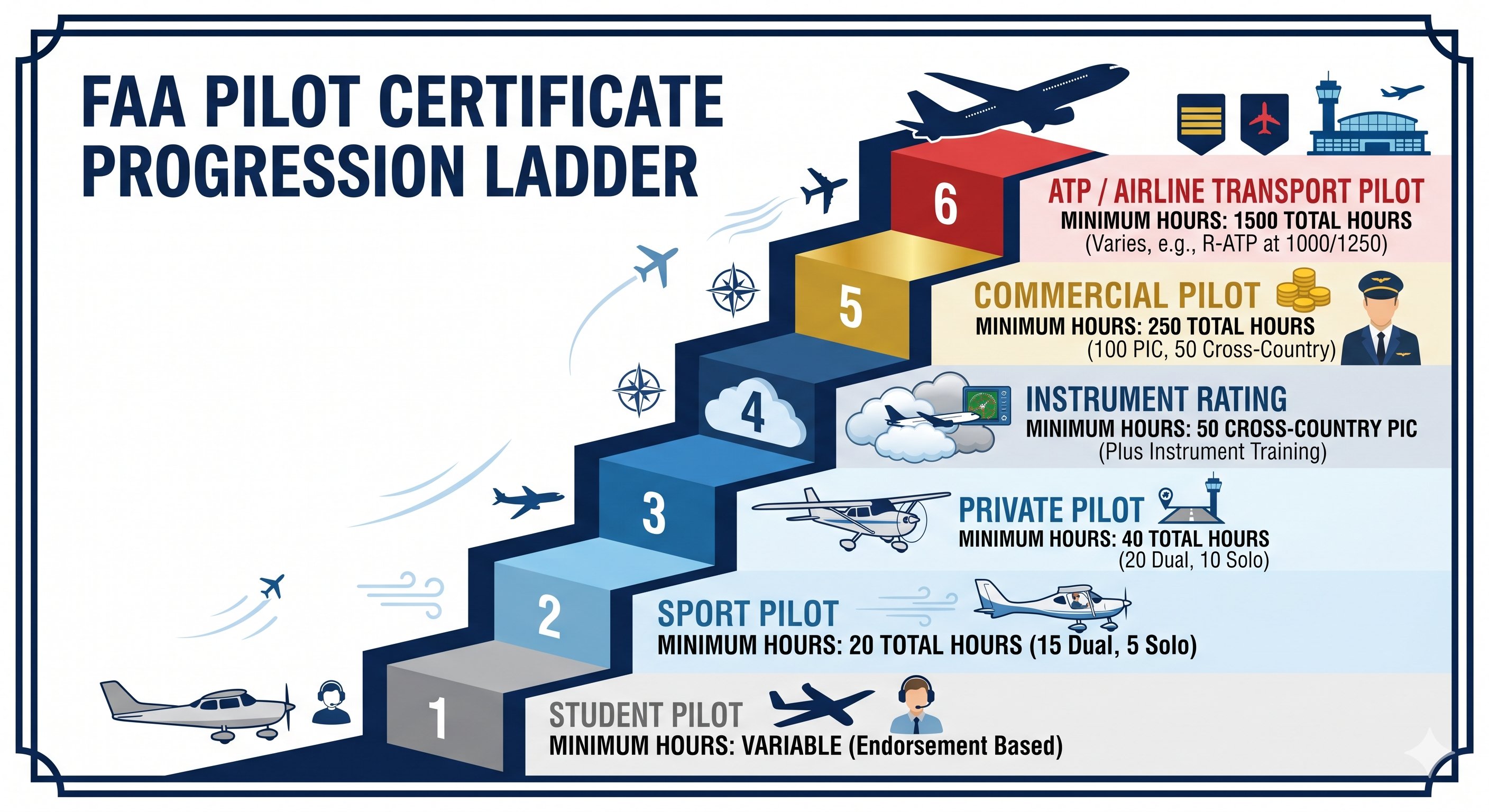
  1. Private Pilot Certificate (PPL) — ~60–80 hours, ~$14,000–$18,000
  2. Instrument Rating (IR) — 50 additional hours, ~$8,000–$12,000
  3. Commercial Pilot Certificate (CPL) — 250 total hours, ~$15,000–$25,000
  4. Multi-Engine Rating — 10–20 hours, ~$3,000–$5,000
  5. CFI / CFII / MEI — teach to build hours, earn while you fly
  6. Build to ATP minimums — 1,500 hours (1,000 with aviation degree, 750 with military)
  7. ATP Certificate — required for airline first officer
ℹ️

Total cost from zero to airline-ready: roughly $80,000–$120,000 at a Part 61 school or $60,000–$90,000 at an accelerated Part 141 program. Scholarships, GI Bill, and airline cadet programs can significantly offset this.

Career paths at a glance

CareerMin HoursEntry SalarySenior SalaryTimeline from zero
Flight Instructor (CFI)250 CPL$40,000–$55,000$70,000+2–3 years
Regional Airline FO1,500 ATP$50,000–$90,000$120,000–$180,0004–6 years
Major Airline FO1,500 ATP$100,000–$130,000$300,000–$500,000+8–15 years
Corporate / Part 91500–1,000$60,000–$80,000$120,000–$200,0003–6 years
Charter / Part 135500–1,200$45,000–$70,000$90,000–$140,0003–5 years
Military PilotMilitary training$50,000–$80,000 + benefits$100,000–$150,000+5–7 years
Agricultural Aviation500+$50,000–$70,000$80,000–$120,0003–5 years

The airline pilot path

The most common destination for career-focused student pilots. Regional airlines hire at 1,500 hours ATP minimums (or 1,000 with an aviation degree). After 2–5 years at a regional, pilots typically upgrade to captain or flow to a major airline through partner agreements.

Major airline captains at United, Delta, American, and Southwest earn $300,000–$500,000+ annually at the top of the pay scale. The path is long but the destination is financially exceptional. Full airline pilot career guide →

Flight instruction — the most common first job

Most commercial pilots build their hours as CFIs. It pays modestly ($40,000–$55,000 to start) but you're getting paid to fly and develop skills. Many pilots spend 1–3 years instructing before moving to charter or regional operations. Full CFI career guide →

Regional airlines

The stepping stone to major airlines for most career pilots. First officer pay has improved dramatically since 2022 — entry-level regional FOs now start at $50,000–$90,000 depending on the carrier, with rapid upgrade times at many regionals. Full regional airline guide →

Corporate aviation

Flying for corporations, executives, and private owners in jets like the Citation, Gulfstream, or Bombardier Challenger. Better lifestyle than airlines (no overnights away from base, consistent schedule) at competitive pay. Highly competitive to enter. Full corporate pilot guide →

Military aviation

The Air Force, Navy, Army, Marines, and Coast Guard all train pilots. Military aviation offers exceptional training, flight hours, and a clear career path — at the cost of a significant service commitment (typically 8–10 years). Many military pilots transition to major airlines with significant advantages. Full military aviation guide →

Other aviation careers worth knowing

Charter / Part 135

On-demand air charter operators fly passengers and cargo under FAA Part 135 rules. Good entry-level opportunity with 500–1,200 hour minimums depending on the operator. Pay ranges widely — from $45,000 for turboprop cargo to $100,000+ for large jet charter.

Agricultural aviation (crop dusting)

Highly specialized, physically demanding, well-paying niche. Agricultural pilots apply pesticides, fertilizers, and seeds from low-altitude aircraft. Entry is through apprenticeship programs. Experienced ag pilots earn $80,000–$150,000+ in season, with some earning more.

Aerial survey and photography

Flying camera-equipped aircraft for mapping, survey, pipeline patrol, and photography. Growing field with crossover into drone operations. Typically 300–500 hours to enter, pays $45,000–$75,000.

Flight dispatcher

Not a flying career, but an aviation career. FAA-licensed dispatchers co-sign every airline flight release alongside the captain. 6-week dispatcher school, ~$40,000 to start, $80,000–$120,000 senior. Good option for those who love aviation but can't or don't want to fly professionally.

Air traffic control (ATC)

FAA controllers manage aircraft separation and traffic flow. Requires passing the AT-SAT test and attending the FAA Academy. Controllers at major facilities earn $100,000–$180,000+. Maximum entry age is 30 for most facilities.

💡

Not sure which path is right for you? The best advice is to get your PPL first and keep flying. Most pilots don't decide their career direction until they're instrument-rated and have spent time around different types of operations. The training you do now applies to every path.

Airline pathway programs — start planning now

Several major airlines now offer structured cadet programs that connect student pilots directly to a career path before they have their PPL. These programs offer mentorship, financial support, and flow-through agreements to the major airline upon meeting ATP requirements.

Aviation career guides