This guide discusses accident causes directly and honestly. That's the point. Pilots who understand accident patterns are better equipped to recognize dangerous situations before they become fatal ones.
The NTSB investigates thousands of general aviation accidents every year. The causes repeat with depressing consistency. The good news: the patterns are well understood, they are not random, and the behaviors that lead to accidents are recognizable in advance. This guide covers what actually kills pilots — not the dramatic scenarios from movies, but the mundane, preventable decisions that end flights badly.
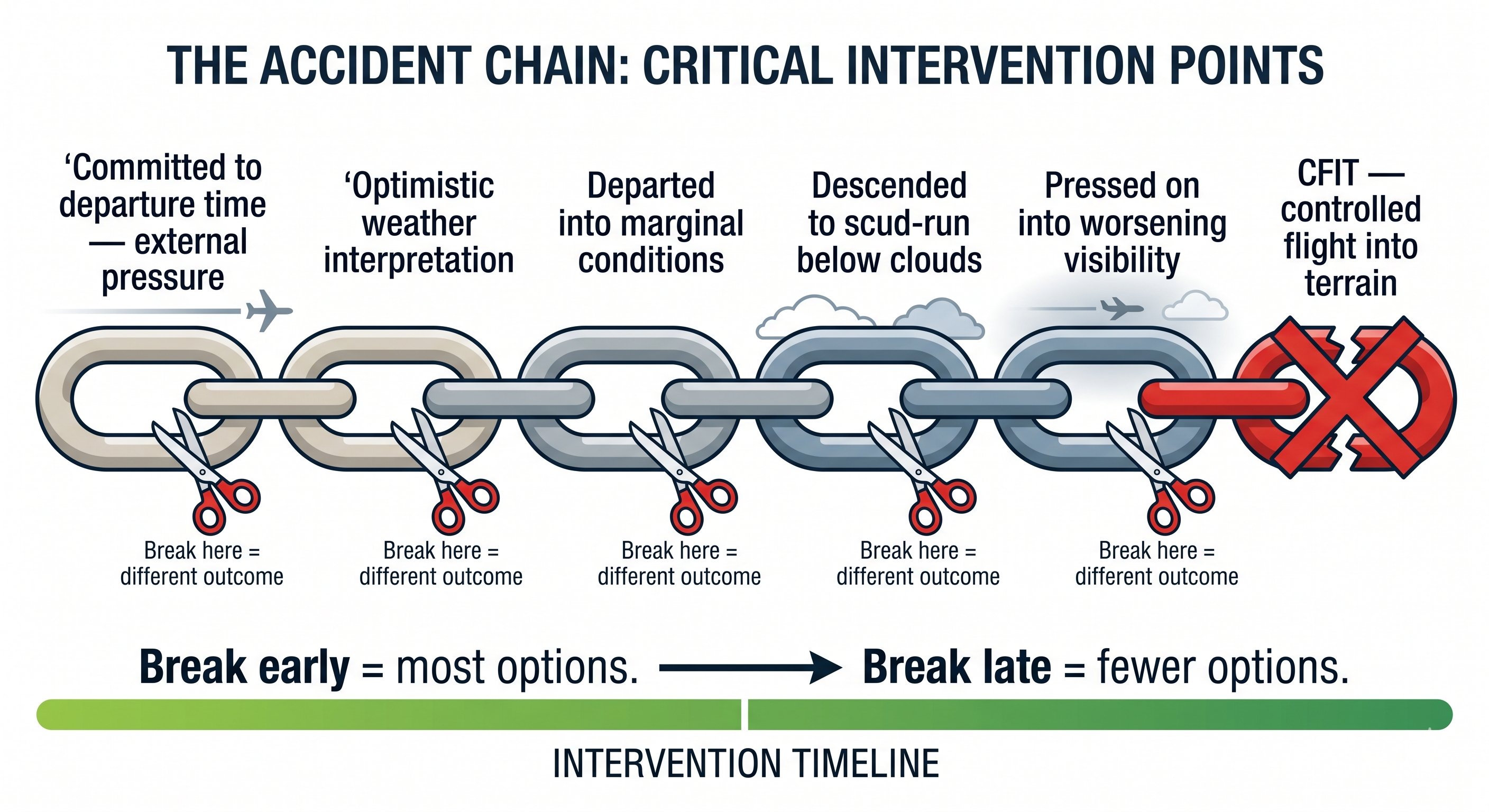
The accident chain — most GA accidents have 3–5 links
The accident chain
Accidents are almost never caused by a single failure. The NTSB consistently finds a chain of three to five smaller links — each one survivable on its own — that combine into a fatal outcome. A tired pilot, a marginal forecast, a passenger in a hurry, a slightly-too-short fuel reserve: no single link is the accident, but in sequence they remove every option until none is left. The lesson is powerful, because breaking any link breaks the chain. You do not have to make the perfect decision. You only have to interrupt the sequence once.
What actually causes the accidents
The great majority of GA accidents — roughly three out of four — are pilot-related rather than mechanical. A handful of causes account for most of the fatalities:
Loss of control in flight (LOC-I)
This is the leading cause of fatal GA accidents. The classic form is a stall/spin at low altitude — most often in the traffic pattern, on the base-to-final turn, or during a go-around. A pilot overshoots final, adds bottom rudder to tighten the turn without adding bank, and skids the aircraft into a cross-controlled stall too low to recover. The defense is simple and lifelong: respect angle of attack, keep the airplane coordinated, and never try to rescue a bad approach with rudder. Go around instead.
Controlled flight into terrain (CFIT) and weather
A flyable aircraft flown into terrain or water, usually in reduced visibility or at night. VFR flight into instrument conditions is the deadliest version and has its own guide — it is worth reading in full.
Fuel management
Two distinct failures, both entirely preventable. Fuel exhaustion is running the tanks dry — almost always from optimistic planning, skipped reserves, or "I can make it." Fuel starvation is having fuel aboard that is not reaching the engine, typically from selecting the wrong tank or mismanaging the fuel selector. Plan conservative reserves, switch tanks deliberately, and treat the fuel gauges as suspect — know your burn rate and your time aloft.
Maneuvering flight
Low-altitude maneuvering — buzzing, low passes, aggressive turns near the ground — produces a high share of fatal accidents because there is no altitude to recover. The temptation is strongest in front of an audience. Resist it.
Most fatal accidents happen close to the ground. Takeoff/initial climb and the approach/landing phase concentrate the risk, because they combine low altitude, high workload, and low airspeed — exactly when there is the least margin to fix a mistake.
The real common denominator: decision-making
Behind the mechanical-sounding causes is almost always a decision. The FAA identifies five hazardous attitudes that precede bad decisions — and each has an antidote you can say to yourself:
Anti-authority ("the rules are for someone else") → Follow the rules; they're usually right.
Impulsivity ("do something quick") → Not so fast — think first.
Invulnerability ("it won't happen to me") → It could happen to me.
Macho ("I can do it") → Taking chances is foolish.
Resignation ("what's the use") → I'm not helpless; I can make a difference.
Two structured tools turn this awareness into habit. IMSAFE is a personal preflight check — Illness, Medication, Stress, Alcohol, Fatigue, Emotion — that asks whether you are fit to fly. PAVE frames the whole risk picture: Pilot, Aircraft, enVironment, External pressures. Run both honestly and the hazardous attitudes have far fewer openings.
How not to become a statistic
The pilots who fly long careers without an accident are not lucky — they are consistent. They set personal minimums and hold the line when conditions are marginal. They use checklists every time, even after a thousand flights. They keep current and seek recurrent training, including stall/spin awareness and a flight review that actually challenges them. They plan generous fuel reserves and divert early. And they treat every flight as a series of go/no-go decisions rather than one irreversible commitment made at the hangar. None of this is dramatic. That is exactly the point — the accidents are mundane, and so are the defenses.
Related reading: VFR Into IMC — The #1 Killer, Weather for Pilots, and the PPL Maneuvers Guide for stall/spin awareness and coordinated flight.