
This is general guidance, not medical or legal advice. The FAA makes individual determinations on medical cases. Always consult an Aviation Medical Examiner (AME) — ideally one who specializes in aviation medicine — before starting training if you have a known medical condition. The rules change and individual circumstances vary significantly.
The FAA medical system intimidates a lot of prospective pilots. The list of potentially disqualifying conditions is long, and the language is dense. But the reality is more nuanced: most common medical conditions that concern student pilots either don't disqualify them at all, or can be managed through a special issuance process. Understanding the system before your first AME visit can save you significant anxiety and potentially your training.
ADHD — Attention Deficit Hyperactivity Disorder
ADHD is one of the most common concerns among younger student pilots. The honest answer: ADHD itself is not automatically disqualifying, but the medications most commonly used to treat it are.
The medication issue
Stimulant medications used to treat ADHD — Adderall, Ritalin, Concerta, Vyvanse, and similar — are on the FAA's disqualifying medications list. You cannot fly on these medications. This is the primary barrier for most ADHD pilots, not the condition itself.
The path forward
Pilots with ADHD who want to fly have two main options. First, discontinue stimulant medication and pursue certification without medication. The FAA requires a washout period (typically 90 days off stimulants) followed by neuropsychological testing to demonstrate that your ADHD does not impair the cognitive functions required for safe flight. This testing is extensive and expensive ($1,500–$3,000+) but many pilots with ADHD pass it successfully and fly without medication.
Second, some non-stimulant ADHD medications (like Strattera/atomoxetine) may be acceptable with FAA review, though this requires individual evaluation. Non-stimulant medications have a shorter FAA track record and outcomes vary.
The key step: consult an Aviation Medical Examiner before stopping any medication. Do not make medication changes without your treating physician involved. And do not start flight training while on disqualifying medications — the FAA can and does deny certificates when they discover undisclosed conditions or medications.
Vision — Glasses and Contact Lenses
This one is simple: glasses and contact lenses do not disqualify you from flying. Millions of certificated pilots wear corrective lenses. The only requirement is that your corrected visual acuity meets the standard for the class of medical you're applying for.
Visual acuity standards
For a Third-Class Medical (required for Private Pilot): 20/40 or better in each eye with or without correction, and 20/40 or better near vision. If you wear glasses or contacts, you must wear them while flying and your medical certificate will be noted "must wear corrective lenses."
If your uncorrected vision is worse than 20/400, you'll need a statement of demonstrated ability (SODA) or the FAA may impose limitations — but this is uncommon and most pilots with standard prescription glasses or contacts sail through their eye exam without any issues.
Color vision
Color vision is tested separately from visual acuity. The standard Ishihara plates test is used by most AMEs. If you fail the plates test, you're not automatically grounded — you can pursue an alternative test called the OCVT (Operational Color Vision Test) or the MFT (Medical Flight Test), which tests your ability to identify aviation-relevant colors (red, green, white) in actual operational conditions. Many pilots who fail the Ishihara plates pass the operational test and fly without limitation. Those who cannot pass may receive a limitation: "Not valid for night flight or by color signal control." This means day-VFR only — still a fully usable certificate for personal flying.
Mental Health — Depression and Anxiety
Mental health is one of the most rapidly evolving areas of FAA medicine, and the picture has improved significantly in recent years.
Depression
Mild to moderate depression is not automatically disqualifying. The FAA has an SSRI policy (since 2010) that allows pilots to fly on four specific antidepressants: fluoxetine (Prozac), sertraline (Zoloft), escitalopram (Lexapro), and citalopram (Celexa). To be approved, you must be stable on the medication for at least 6 months, have no significant side effects, and pass a neuropsychological screening. This pathway has helped thousands of pilots maintain their certificates while treating depression.
Other antidepressants and psychiatric medications require individual FAA review. Conditions requiring hospitalization, significantly affecting judgment, or involving psychosis are more difficult to certify but not always impossible with proper documentation.
Anxiety
Situational anxiety (mild, non-impairing) is not disqualifying. Anxiety disorders requiring medication are more complex — most common anxiolytics (benzodiazepines like Xanax, Ativan, Valium) are disqualifying both the medications and often the condition requiring them. Non-medication-managed anxiety disorders are evaluated individually.
DUI and Legal History
A DUI (or any alcohol/drug-related motor vehicle action) must be reported to the FAA. This is not optional — failing to report is a federal offense that can result in certificate revocation. Here's what actually happens when you report.
Single DUI — more than 5 years ago
Generally not disqualifying for a third-class medical, though full documentation is required and the AME will report it to the FAA. You'll need to provide court records and demonstrate no subsequent alcohol-related issues.
Single DUI — within the past 5 years
Triggers FAA review. You'll likely need to complete a substance abuse evaluation by a qualified professional and demonstrate you don't have a substance use disorder. This is a process, not necessarily a denial.
Multiple DUIs or substance abuse history
Multiple alcohol-related offenses or a documented substance use disorder require a special issuance and significantly more documentation including treatment records, evaluations, and often monitoring requirements. Not impossible but requires expert guidance — use an aviation medical attorney or a HIMS AME (specially trained in substance use cases).
The reporting requirement
Any alcohol or drug-related motor vehicle action must be reported to the FAA Civil Aviation Security Division within 60 days. This is separate from the medical certificate process. Failure to report has ended pilot careers — the cover-up is always worse than the underlying event.
Diabetes
Type 2 diabetes managed by diet and/or oral medications (not insulin) can be compatible with flying with FAA special issuance. Requirements include documented stable blood glucose control, no hypoglycemic episodes, and regular evaluation.
Insulin-dependent diabetes (both Type 1 and insulin-requiring Type 2) was historically disqualifying for all classes of medical, but the FAA began issuing special issuances for Third-Class medicals to insulin-dependent diabetics under specific conditions starting in 2015. The requirements are extensive — glucose monitoring before and during flight, specific glucose ranges, physician oversight — but thousands of insulin-dependent pilots now hold valid medicals.
Heart Conditions
Coronary artery disease, prior heart attacks, arrhythmias, and other cardiac conditions are evaluated individually. Many are certifiable with special issuance after demonstrating stability and treatment. The FAA's cardiac evaluation requirements are detailed and vary significantly by condition severity. A HIMS AME or aviation cardiologist is strongly recommended for any cardiac history.
BasicMed — the alternative to FAA medical certification
For pilots who want to fly light aircraft (under 6,000 lbs, under 250 kts, under 18,000 ft, fewer than 6 seats) for personal flying (not for hire), BasicMed offers an alternative to the traditional FAA medical. Under BasicMed, you visit a state-licensed physician (not an FAA AME) who completes a checklist, and you complete an online course. The disqualifying conditions list under BasicMed is shorter than the FAA standard.
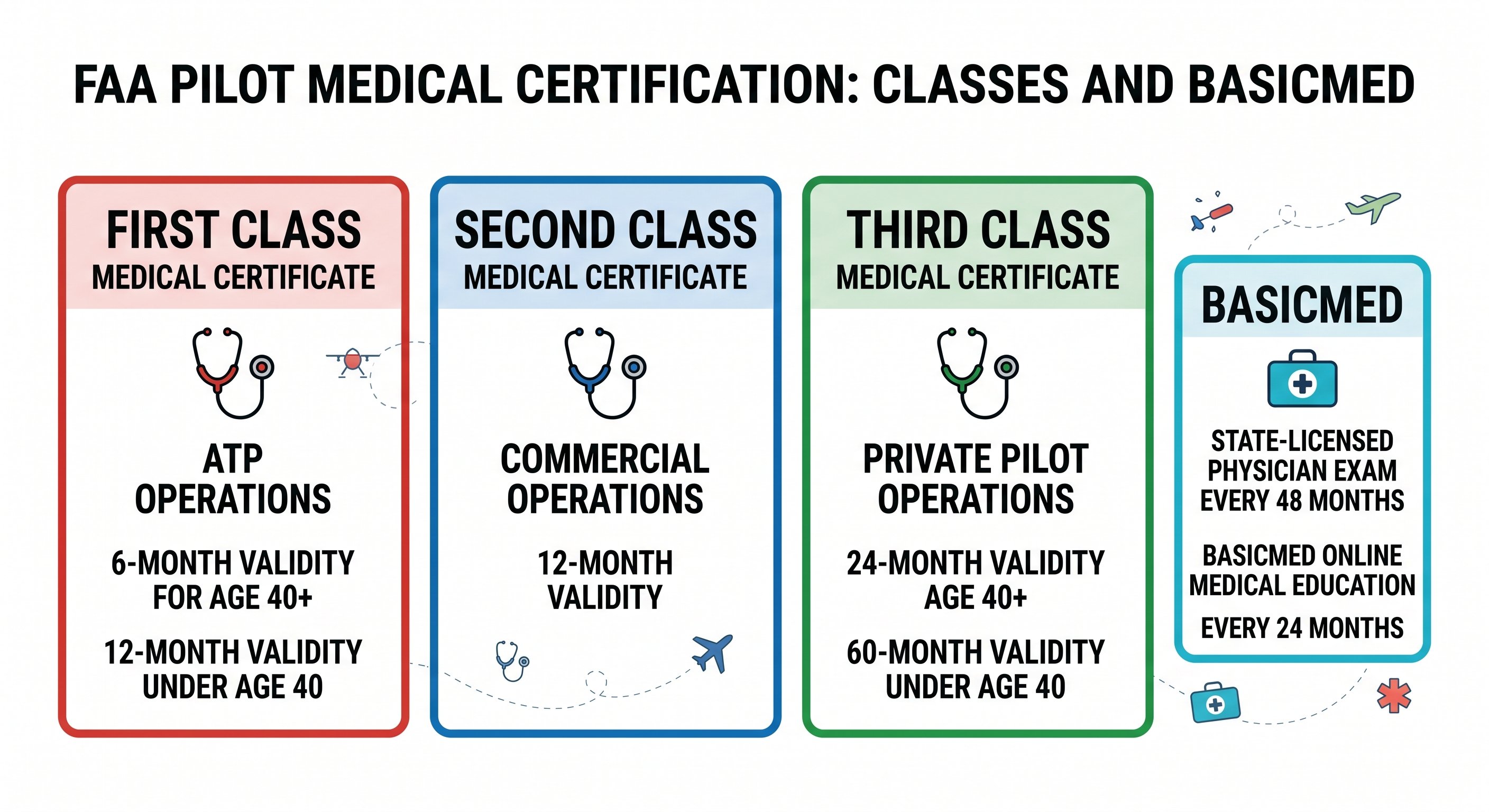
BasicMed doesn't work for everyone — it doesn't allow commercial operations and has aircraft limitations — but for personal flying it's been a game-changer for pilots who couldn't obtain a standard FAA medical.
Sport Pilot — driver's license as medical
If you're willing to fly light sport aircraft only (two seats, limited weight and speed), the Sport Pilot Certificate requires only a valid US driver's license as your "medical." No FAA medical exam required at all. This is the most accessible path for pilots with disqualifying medical conditions who want to fly recreationally.
The most important advice — see a HIMS AME first
If you have any condition that concerns you, the single best thing you can do before starting flight training is schedule a visit with a HIMS AME (Human Intervention Motivation Study Aviation Medical Examiner) — a specially trained AME who handles complex medical cases. A HIMS AME can review your records, tell you honestly what to expect, and help you navigate the special issuance process if needed.
Do not start training and invest $10,000+ before knowing whether you can get medically certified. The medical question should be the first question you answer, not the last. Find a HIMS AME at the FAA's AME locator at faa.gov.
AOPA's Medical Certification Services offers free case evaluations for members with complex medical situations. Their staff are experienced with FAA medical issues and can give you a realistic assessment before you commit to training or spend money on extensive testing. Worth a call if your situation is complicated.