You passed your checkride. You're a Private Pilot. Now what?
The months after earning a PPL are simultaneously the most exciting and most dangerous in a pilot's career. You have freedom and a certificate but limited real-world experience. The accident data is unambiguous: newly certificated private pilots — particularly in the first 100–200 hours after the PPL — are overrepresented in GA accidents. Understanding why and building habits that counter it makes all the difference.
The first few flights — don't rush
Many new private pilots expect to immediately fly everywhere with confidence. What actually happens is more nuanced: the first solo cross-countries feel different without a CFI in the right seat in a way that's hard to predict. Decision-making feels slower. Weather minimums feel closer. This is normal and healthy — it reflects appropriate situational awareness.
Your first flights as a certificated pilot should be local. Return to your home airport area and build confidence in the basic skills. Don't attempt your first long cross-country on the first week. Fly somewhere 50 nm away and back first. Fly at night for the first time before flying a night cross-country. Build in stages.
Staying current — what the FAA requires vs what you should actually do
The FAA's currency requirements for carrying passengers are the legal minimum, not a safety target. Three takeoffs and landings in the preceding 90 days barely keeps reflexes alive. What you should actually do:
- Fly at least twice a month — skills deteriorate faster than most new pilots expect. A three-week gap produces meaningful degradation in flare timing, crosswind handling, and situational awareness.
- Practice landings specifically — don't just fly around. Intentional touch-and-goes and full-stop landings keep the most perishable skill sharp.
- Use our pilot currency checker to track your recency automatically.
- Get a Flight Review (BFR) before it's required — the biennial flight review is required every 24 calendar months, but many experienced pilots do them more frequently as an informal check on their skills. Consider treating it as an annual event.
Building hours — the right way
After the PPL, every pilot faces the question: how do I build hours without spending a fortune? Here's what actually works:
Flying clubs
Flying clubs typically offer aircraft rental at $20–$50/hr less than commercial FBOs for the same aircraft. Joining a flying club requires a membership fee ($500–$2,000 typically) and monthly dues ($50–$150), but if you fly regularly, the savings quickly exceed the costs. Clubs also tend to have better aircraft availability and a community of pilots who can answer questions and share experience. See our flying club vs. renting guide for the full comparison.
Split fuel costs with passengers
Under FAR 61.113, a private pilot may accept payment for shared operating expenses (fuel, oil, airport fees) from passengers on a pro-rata basis — as long as the pilot pays at least their own share. A $200 fuel burn divided among four people costs $50 each. This is completely legal and dramatically reduces per-flight cost for cross-countries. You cannot profit — you must pay at least your fair share.
Fly with purpose
Aimless $100 hamburger flights are enjoyable but don't build skills efficiently. Plan flights with specific learning objectives: practice short field landings at an unfamiliar airport, do a night cross-country to a towered airport you haven't been to, practice diversion calculations en route. Intentional flying builds skills faster than equivalent passive flying time.
Consider a headset rental arrangement
If you're flying rented aircraft regularly, many FBOs will provide headsets with the rental. Owning your own headset pays for itself quickly in comfort and audio quality. See our headset guide for current recommendations.
The flight review (BFR)
Every two years, you must complete a flight review to maintain the privilege of acting as PIC. The flight review consists of at least 1 hour of ground instruction and 1 hour of flight instruction with a CFI who endorses your logbook. There's no checkride-style pass/fail — the CFI simply reviews relevant regulations and demonstrates that you can safely exercise the privileges of your certificate.
Don't dread the flight review. Use it as a genuine learning opportunity. Ask the CFI to demonstrate the maneuvers you're weakest on. Treat it like a free lesson. Pilots who approach the BFR as a chore miss a genuine value-add to their flying.
Your next rating — which one and when?
Instrument Rating (IR)
The instrument rating is the most widely recommended next step for most private pilots. It makes you a more capable and safer pilot in three ways: you can legally fly in IMC (clouds), you develop significantly better scan and control precision, and the training required (50 hours of actual or simulated instrument time) builds a level of aircraft handling that VFR-only flying rarely demands.
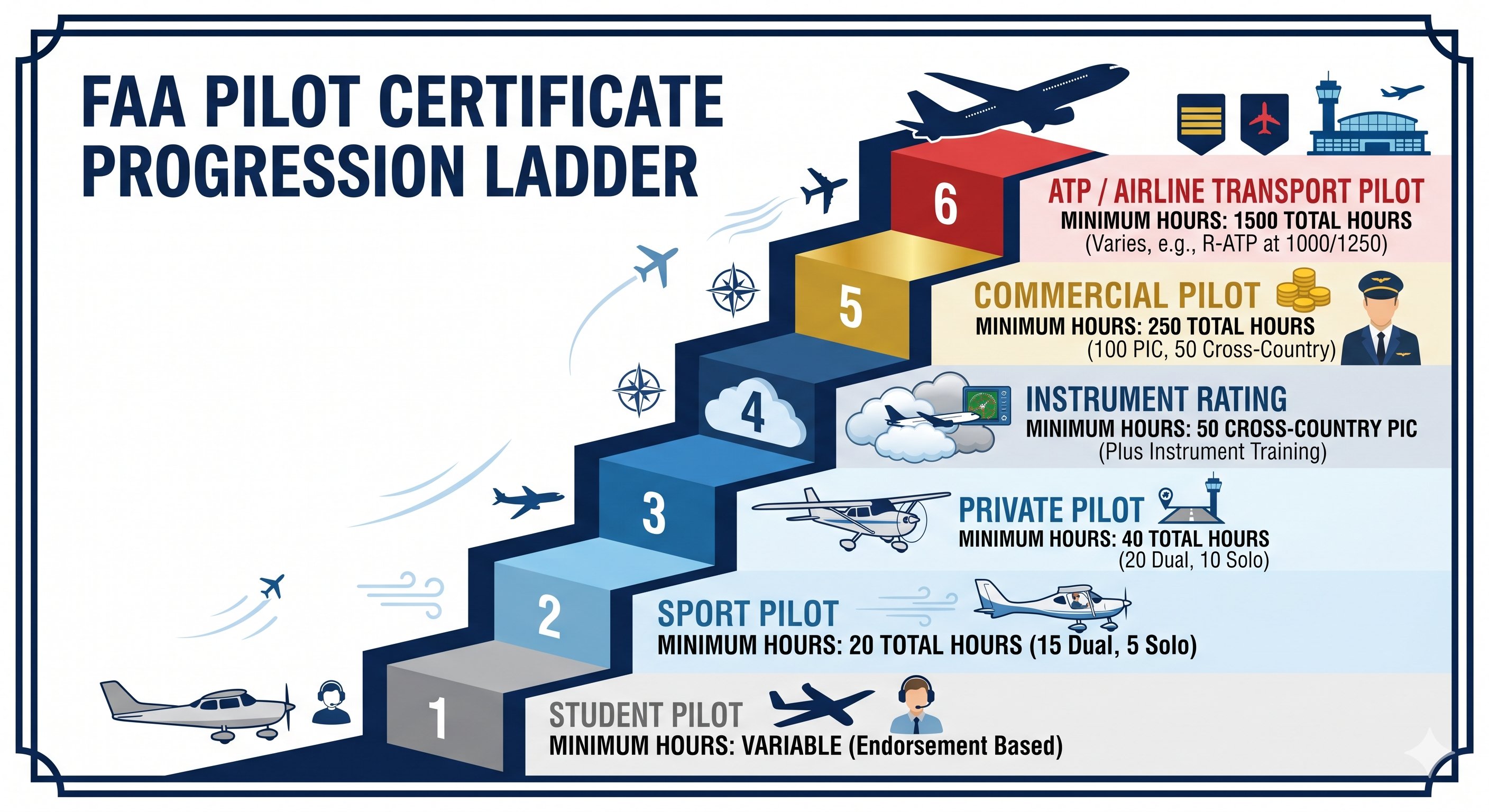
Many pilots pursue the instrument rating within 1–2 years of the PPL, typically starting when they have 100–150 total hours. Cost: approximately $8,000–$12,000 depending on location and how much of the instrument time is actual IMC vs. simulator. See our instrument rating cost guide.
Commercial Pilot Certificate (CPL)
If you're targeting an aviation career, the commercial certificate comes after the instrument rating. Requires 250 total hours, including specific cross-country, night, and PIC time. The CPL opens the door to being paid to fly. See our commercial pilot guide.
Additional ratings worth considering
- Multi-engine rating — if you're heading toward a career, adds value to your certificate. Cost: $3,000–$5,000 for 10–20 hours.
- Seaplane rating — one of the most fun add-ons. A few days of training, costs $1,000–$2,000. Adds a new category to your certificate.
- High-performance and complex endorsements — not separate ratings but required to act as PIC of aircraft with >200 hp (high-performance) or retractable gear/controllable prop (complex). Required for the Commercial and useful for building skills.
- Tailwheel endorsement — not required for most pilots but highly recommended. Tailwheel flying dramatically improves crosswind technique and general flying feel.
The 200-hour plateau
Many pilots report a distinct confidence shift around 200 hours — a sense that flying feels more automatic, decisions come faster, and situational awareness improves. This is real and corresponds roughly to when the basic psychomotor skills become truly automatic rather than conscious.
The danger: this confidence can lead to relaxed standards and more aggressive weather decisions. The accident record shows a second spike in accidents around 200–300 hours for exactly this reason. Stay disciplined with personal minimums even as confidence grows.
Learning from every flight
The pilots who improve fastest after the PPL are those who debrief every flight — even briefly. After landing, spend 5 minutes thinking: what went well? What would I do differently? Was there a moment where I felt less than fully in command of the situation? Honest self-assessment, without ego, compounds into genuine skill improvement in a way that passive flying time doesn't.
Find a mentor pilot. The most valuable resource for a new private pilot isn't a book or a guide — it's a more experienced pilot who will fly with you, answer questions, and call you out when you're making risky decisions. Flying clubs, EAA chapters, and AOPA's mentor pilot program are all good places to find one. Ask directly — most experienced pilots are happy to help.
Resources to keep flying smart
- WINGS Program — FAA's voluntary pilot proficiency program. Earn credit toward your flight review by completing online courses and flight activities. Free at faasafety.gov.
- AOPA Air Safety Institute — free online safety courses covering accident scenarios, weather decision-making, and more. Genuinely valuable and free.
- Aviation Safety Hotline (ASO) — anonymous reporting for safety concerns you observe.
- EAA (Experimental Aircraft Association) — community, fly-ins, Young Eagles program, and a culture of passionate flying. Annual AirVenture in Oshkosh, Wisconsin every summer is a must-attend.