What the E6B does
The E6B is a circular slide rule that solves the core calculations every VFR pilot needs: wind correction angle and true heading, groundspeed, fuel burn, time/speed/distance, density altitude, true airspeed from indicated airspeed, and more. It's been the standard pilot navigation tool since World War II and is still required for the FAA Private Pilot checkride.
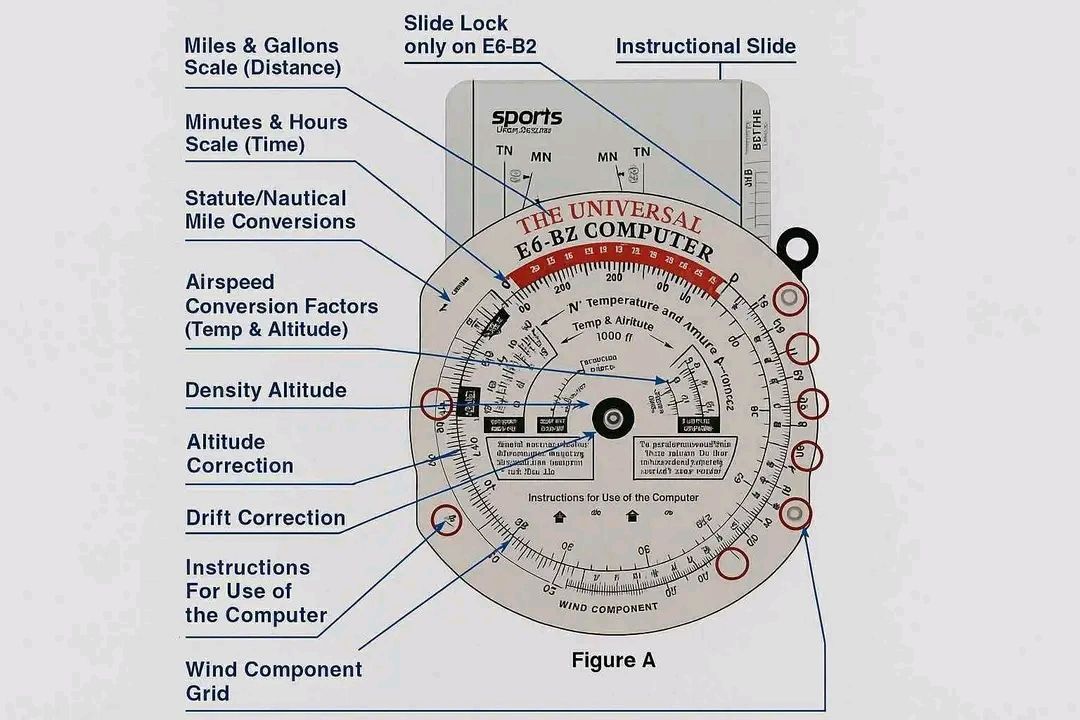
Your DPE will hand you a cross-country problem during the oral exam and expect you to work through it on an E6B. They don't care if you normally use ForeFlight — they want to see you understand the underlying math. Practice with the mechanical version until it's comfortable.
Own a mechanical E6B before your checkride. Some DPEs specifically prohibit electronic calculators on the oral portion. Confirm with your CFI, but always own and practice with the mechanical version regardless.
Mechanical E6B — our pick
- Clear, well-labeled scales — easier to read than many competitors
- Sturdy aluminum construction — won't crack under normal use
- Comprehensive instruction booklet included
- Industry standard — your CFI will know it and can teach it
- Works in any temperature, no batteries, no screens to break
- Learning curve — takes 3–5 hours of practice to get comfortable
- Slower than electronic for complex multi-leg planning
- Easy to make errors if you rush
Electronic E6B — also get this
- Dramatically faster than mechanical for real flight planning
- Built-in functions for all common pilot calculations
- Reduces arithmetic errors on navigation logs
- Approved for FAA written tests
- Battery life measured in months
- Some DPEs may not allow it during oral exam
- Requires batteries
- You won't learn the underlying math as intuitively
Plotter
A plotter is a clear plastic ruler with a protractor used to measure course angles and distances on sectional charts. You'll use it for every cross-country flight plan. It's a $10 item — just buy it.
- Includes both nautical mile and statute mile scales
- Rotating compass rose makes reading course angles easier
- Clear plastic — you can see the chart through it
- Fits in any flight bag or kneeboard pocket
- Can crack if sat on or jammed in a bag
- Markings can be hard to read in low cockpit light
Best value — the ASA Student Pilot Kit
If you're buying all of this anyway, the ASA Student Pilot Kit (~$50) bundles the mechanical E6B, plotter, flight log, and navigation log forms for less than buying them individually. It's the right starting point for most students.
E6B quick reference — what it solves
| Calculation | Mechanical E6B | Electronic CX-3 | ForeFlight |
|---|---|---|---|
| Wind correction angle | ✓ (wind side) | ✓ | ✓ auto |
| Groundspeed | ✓ (wind side) | ✓ | ✓ auto |
| Time/speed/distance | ✓ (calc side) | ✓ | ✓ auto |
| Fuel burn | ✓ (calc side) | ✓ | ✓ auto |
| Density altitude | ✓ (calc side) | ✓ | ✗ |
| True airspeed | ✓ (calc side) | ✓ | ✗ |
| Checkride approved | ✓ always | ✓ usually | ✗ |