The Part 107 Certificate
- What the Part 107 certificate is and who legally needs one
- The complete process to obtain your Remote Pilot Certificate
- How to register your drone with the FAA
- Recurrency requirements and how to keep your certificate current
- When you can fly without a Part 107 certificate
- Penalties for flying without proper certification
Lesson 1 — What Is Part 107?
FAA Part 107, officially titled "Small Unmanned Aircraft Systems," is the federal regulation that governs commercial drone operations in the United States. It went into effect on August 29, 2016, and created a pathway for commercial drone pilots to operate legally without needing a full manned aircraft pilot certificate. Before Part 107, commercial drone operators had to apply for individual exemptions — a slow, expensive process that held back the entire industry.
Part 107 applies to small unmanned aircraft systems (sUAS) — drones weighing less than 55 pounds including payload — operated for non-recreational purposes. "Non-recreational" is broadly interpreted: any flight where you receive compensation, where the drone is used for your business, where footage is sold, or where any commercial benefit exists. Even posting sponsored content on social media qualifies as commercial use under FAA interpretation.
The regulation is codified at 14 CFR Part 107. Understanding the "14 CFR" designation matters: Title 14 of the Code of Federal Regulations is the FAA's authority. When studying for your knowledge test, you'll encounter references to specific FAR (Federal Aviation Regulation) sections — 14 CFR 107.29 covers daylight operations, 107.31 covers visual line of sight, and so on. Knowing how to navigate FAR sections is a tested skill.
A "small unmanned aircraft system" (sUAS) consists of two parts: the small unmanned aircraft (the drone itself) and the equipment necessary for safe and efficient operation, which includes the remote control, ground station software, and any communications links. Both components together constitute the "system."
The Regulatory History
Before Part 107, commercial drone operators in the US operated in a legal gray zone. The FAA claimed authority over all airspace, including the low-altitude airspace where drones operate, but had no specific rules for commercial UAS. Operators needed individual exemptions under Section 333 of the FAA Modernization and Reform Act of 2012 — a process that took months and cost thousands of dollars in legal fees. By 2016, the FAA had granted roughly 5,000 such exemptions, but the process was widely criticized as too slow for a rapidly growing industry.
Part 107 replaced this patchwork system with a single, comprehensive regulation. Its development involved years of notice-and-comment rulemaking, input from industry stakeholders, and coordination with the Department of Transportation and Department of Defense. The final rule was widely praised as a reasonable balance between safety and enabling commercial innovation. Since its implementation, the commercial drone industry has grown from a niche market to a multi-billion dollar sector with applications in construction, agriculture, public safety, real estate, and beyond.
Why the FAA Regulates Drones
The FAA's authority extends to all navigable airspace in the United States, which courts have interpreted broadly to include the low-altitude airspace where drones operate. The primary justification for FAA drone regulation is collision avoidance — drones share airspace with manned aircraft, and a collision between a drone and a manned aircraft could be catastrophic. Secondary justifications include security (drones near critical infrastructure or VIPs), privacy (drones with cameras over private property), and noise nuisance in populated areas.
The FAA does not regulate privacy — that's left to state and local governments. Several states have enacted drone privacy laws limiting where drones can fly or what they can photograph. Understanding both federal (FAA) and state/local restrictions is part of operating legally in any jurisdiction. Federal airspace rules preempt local airspace restrictions (cities cannot ban all drone flight in their airspace), but states can regulate land-based activities like taking off and landing from private property without the owner's permission.
Lesson 2 — Who Needs Part 107?
You need a Part 107 Remote Pilot Certificate if you fly a drone commercially — meaning any flight that provides a business benefit, earns compensation, or supports a commercial activity. This includes real estate photography, construction site surveys, agricultural mapping, film and video production, infrastructure inspection, and even indirectly commercial activities like building a portfolio to attract clients.
You do NOT need Part 107 for purely recreational flying. The FAA defines recreational flight as flying solely for fun or personal enjoyment, not connected to any business purpose. Recreational flyers operate under a separate set of rules established by the FAA Reauthorization Act of 2018, which requires registration of drones over 0.55 pounds, compliance with community-based safety guidelines, and avoidance of restricted airspace — but does not require the Part 107 knowledge test or certificate.
The line between recreational and commercial can be blurry. The FAA has been clear that dual-purpose flights — flying recreationally but also capturing footage you later use for a business purpose — are considered commercial. When in doubt, fly with your Part 107 certificate. The certificate doesn't restrict what you can do; it only adds permission for commercial activity.
Posting drone footage to YouTube, even without monetization, can be considered commercial if the channel builds your brand or supports a business. Flying for a non-profit organization still requires Part 107. Government employees flying drones in their official capacity may need a Certificate of Authorization (COA) rather than Part 107.
Gray Area Cases and FAA Interpretations
The FAA has issued several interpretive documents clarifying what constitutes commercial use. In 2014, the FAA ruled that a real estate photographer using a drone for paid listings required a commercial authorization even before Part 107 existed. Since Part 107, the FAA has consistently interpreted "commercial" broadly. A drone pilot flying for a non-profit, flying to build a portfolio with intent to attract paying clients, or flying to test equipment for potential future commercial applications is operating commercially.
Flying for a government agency is another gray area. Federal government employees using drones for official purposes typically need a Certificate of Authorization (COA) rather than Part 107. State and local government employees may operate under Part 107 or a COA depending on the nature of the operation. Fire departments, law enforcement, and emergency management agencies increasingly use drones under specialized authorizations. If you're operating drones for a government employer, verify which authorization framework applies.
The TRUST Test for Recreational Flyers
Recreational drone pilots are required to complete The Recreational UAS Safety Test (TRUST) — a free, online safety course offered through FAA-approved organizations. TRUST is not the Part 107 knowledge test — it's a simpler recreational safety course with no passing score requirement. Recreational flyers who pass TRUST receive a completion certificate they must carry during flight.
If you hold a Part 107 certificate, you are not required to also complete TRUST — your Part 107 certification supersedes the recreational requirement. However, you must operate under Part 107 rules (not recreational rules) for all flights where a commercial purpose exists. You cannot selectively apply recreational rules to avoid Part 107 requirements on the same equipment that you use commercially.
Lesson 3 — How to Get Certified
Obtaining your Part 107 Remote Pilot Certificate involves five steps: passing a knowledge test, applying through IACRA, receiving your certificate, and keeping it current. The entire process typically takes 4–6 weeks from study start to certificate in hand.
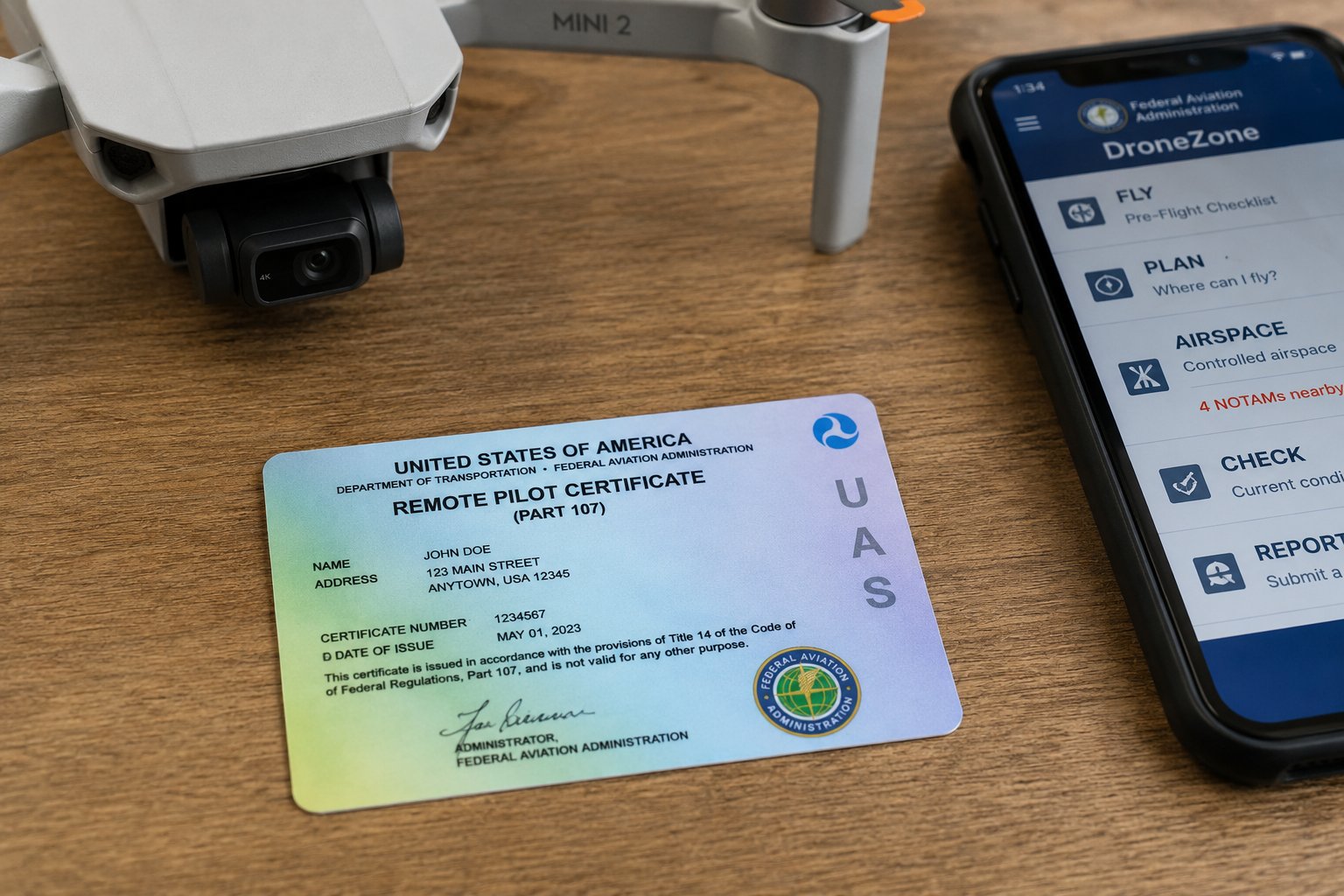
The FAA Remote Pilot Certificate (Part 107) — your legal authorization to fly commercially
Step 1 — Study. The FAA Part 107 knowledge test covers airspace classification, weather, regulations, loading and performance, and crew resource management. This ground school covers all tested topics. Most candidates study for 15–40 hours depending on prior aviation knowledge. With no prior background, plan for 30+ hours of focused study.
Step 2 — Schedule and take the test. The test is administered at FAA-approved testing centers (PSI and CATS testing centers) nationwide. The fee is approximately $175. You must be at least 16 years old and able to read, write, speak, and understand English. Bring government-issued photo ID. The test consists of 60 questions with a 2-hour time limit. A passing score is 70% (42 of 60 correct). You receive your score immediately upon completion.
Step 3 — Apply via IACRA. Within 48 hours of passing, log into the FAA's Integrated Airman Certification and Rating Application system at iacra.faa.gov. Create an account, complete an application for "Remote Pilot Certificate with sUAS Rating," and enter your test ID number. A Transportation Security Administration (TSA) background check is conducted automatically — this typically takes a few days to a few weeks.
Step 4 — Receive your temporary certificate. Once TSA clears you, a TSA-stamped document is available in your IACRA account. This temporary certificate is valid for 120 days and allows you to operate legally while your permanent plastic certificate is mailed.
Step 5 — Receive your permanent certificate. The permanent Remote Pilot Certificate arrives by mail, typically 6–8 weeks after TSA clearance. It does not expire — but you must complete recurrent training to keep it active.
Testing Center Experience
The Part 107 knowledge test is administered at PSI and CATS testing centers — the same network of facilities used for other professional licensing exams. Find a testing center at faa.psiexams.com. You'll need to register and pay the testing fee (approximately $175) before scheduling. Testing centers are found in most metropolitan areas, and some are located within flight schools and aviation facilities.
On test day, bring government-issued photo ID. You're not permitted to bring study materials, phones, or notes. The testing center provides a basic calculator. The test format is multiple choice with some questions using sectional chart excerpts or other visual aids — the testing center provides a printed "Airmen Knowledge Testing Supplement" with the visual references needed to answer these questions. Familiarize yourself with sectional chart reading before test day.
If you fail, you must wait 14 calendar days before retesting and pay the full fee again. There's no limit on the number of retakes, but each costs $175. A passing score is valid for 24 calendar months from the test date — apply through IACRA within that window. Most candidates who study adequately pass on the first attempt.
Existing Pilot Certificates and Part 107
If you hold a current Part 61 pilot certificate (private, commercial, or ATP) with a current flight review, you may qualify to take an online training course instead of the in-person knowledge test for initial Part 107 certification. This pathway recognizes that certificated pilots already have substantial airspace and regulatory knowledge. The online course is available at faasafety.gov and is free.
However, for the knowledge test recurrency requirement, certificated pilots and non-pilots have the same obligation — complete the recurrent training at faasafety.gov every 24 months. The initial shortcut does not permanently exempt certificated pilots from recurrency requirements.
| Step | Action | Timeline |
|---|---|---|
| 1 | Study for knowledge test | 2–6 weeks |
| 2 | Take test at testing center ($175) | 1 day |
| 3 | Apply via IACRA within 48 hours | Same day |
| 4 | TSA background check | Days to weeks |
| 5 | Temporary certificate available in IACRA | After TSA clearance |
| 6 | Permanent certificate mailed | 6–8 weeks |
Lesson 4 — Drone Registration
Separate from the Part 107 certificate, the FAA requires registration of drones that weigh more than 0.55 pounds (250 grams) and less than 55 pounds. This includes virtually all consumer and commercial drones. Registration is done at faadronezone.faa.gov and costs $5 per aircraft. The registration is valid for 3 years.
The registration number (format: FA3XXXXXXX) must be marked on the drone's exterior in a place that is readily accessible during preflight inspection — typically on the battery compartment, landing gear, or fuselage. The number must be legible and permanently affixed (sticker, engraving, or permanent marker). Flying an unregistered drone that requires registration is a civil penalty of up to $27,500 and a criminal penalty of up to $250,000 and/or imprisonment.
Commercial operators registering under Part 107 get one registration that covers all their drones. Recreational flyers using the recreational registration system register each drone separately. If you already have a recreational registration, you need to re-register under Part 107 for commercial operations — they are separate registration systems.
As of September 16, 2023, most drones must broadcast Remote ID — an electronic identification signal similar to an aircraft transponder. Remote ID transmits the drone's location, altitude, speed, and the operator's location. Drones manufactured after this date must have built-in Remote ID. Older drones can comply by adding a Remote ID broadcast module. Drones without Remote ID can only be flown at FAA-recognized identification areas (FRIAs).
What Registration Covers
FAA drone registration is specific to the aircraft, not the pilot or the operation. Each drone is registered separately (recreational system) or under a single registration covering multiple aircraft (Part 107 commercial system). The registration certificate (or digital copy on your phone) and the aircraft with its registration number must match during any FAA inspection.
Registration does not cover operations — it simply identifies the aircraft and its owner. A registered drone can still violate airspace rules, Part 107 operating requirements, or other regulations. Registration is a starting point for accountability, not a general authorization to fly. Think of it like vehicle registration — your registered car can still be ticketed for traffic violations.
International Operations
Operating a US-registered drone in another country requires compliance with that country's drone regulations in addition to maintaining FAA compliance. Many countries require separate registration, advance permits, and may prohibit certain operations entirely. Before international operations, research the destination country's civil aviation authority (CAA) requirements. Organizations like the FAA's international counterparts (EASA in Europe, CAAC in China, CASA in Australia) publish their UAS regulations publicly.
Bringing a drone into another country may also require customs declarations and documentation. Commercial drone equipment crossing international borders can be subject to temporary import/export restrictions. Professional operators doing international work typically work with a local aviation attorney or aviation logistics specialist to navigate these requirements. Attempting to operate without proper authorization in a foreign country can result in equipment confiscation, fines, and legal consequences under local law.
Lesson 5 — Recurrency Requirements
A Part 107 Remote Pilot Certificate does not expire, but your authorization to exercise the privileges of the certificate does require periodic recurrency. As of April 6, 2021, the FAA replaced the previous 24-month knowledge test recurrency requirement with a free online recurrent training course hosted on the FAA Safety Team website (faasafety.gov).
You must complete the recurrent training every 24 calendar months to remain current. The training takes approximately 1–2 hours and covers regulatory updates, safety enhancements, and operational considerations. Upon completion, you receive a completion certificate that you should retain in your records. There is no test — just the training course itself. Failure to complete recurrent training means you are not current to operate as remote pilot in command (RPIC) under Part 107.
Keep records of your recurrent training completion. The FAA may request documentation during a ramp check or investigation. Your logbook (yes, drone pilots should keep logbooks) should record flight time, location, purpose, and any incident or anomaly. While not legally required, a logbook demonstrates professionalism and is invaluable if you ever need to defend a decision or document your experience for insurance purposes.
What the Recurrent Training Covers
The FAA's recurrent training module at faasafety.gov is designed to be completed in 1-2 hours. It covers: regulatory updates since the initial certification, remote ID requirements and compliance, updates to airspace authorization processes, new waiver categories and how to apply, safety management system principles, and operational risk management. The training is updated periodically as regulations change — completing it also keeps you current on the most significant regulatory developments.
The training does not require a specific passing score — you work through the modules and receive a completion certificate upon finishing. This certificate should be retained in your records. If the FAA audits your operation or investigates an incident, being able to demonstrate current recurrent training status is important. Some clients, insurance carriers, and liability waivers explicitly require current Part 107 certification including recurrent training completion.
Logbook Best Practices
While no logbook is legally required for Part 107 operations, maintaining a detailed flight log is professional practice that has tangible benefits. Insurance companies increasingly request flight logs for underwriting and claims. Professional clients appreciate the documentation as evidence of an organized, safety-conscious operator. If the FAA investigates an incident, a well-maintained logbook demonstrates operational discipline and can support your account of the event.
A basic drone logbook entry should include: date, location (address or GPS coordinates), purpose of the flight, drone make/model and registration number, battery used and cycle count, flight duration, weather conditions, airspace class and any authorizations used, crew members present, and any anomalies or incidents. Apps like DroneBase, Kittyhawk, and Aloft include logbook functionality. A simple spreadsheet works equally well — the format matters less than consistency.
Lesson 6 — Consequences of Flying Without Certification
Flying a drone commercially without a Part 107 certificate, or violating Part 107 operating rules, carries serious consequences. Civil penalties range from $1,100 to $27,500 per violation for non-criminal cases. Criminal penalties for reckless operation or deliberate violations can reach $250,000 in fines and imprisonment. The FAA has actively prosecuted cases, particularly where commercial drone operators caused safety incidents or flew in restricted airspace.
Beyond federal penalties, flying without proper certification can void your insurance coverage, expose you to civil liability in accidents, and permanently damage your professional reputation. In regulated industries like film production or real estate, clients increasingly require proof of Part 107 certification before hiring drone operators. The certification is a business credential as much as a safety requirement.
The FAA's UAS reporting system allows anyone to report unlicensed or unsafe drone operations. The FAA investigates reports and has issued thousands of enforcement actions. If you're flying commercially — even occasionally, even for small amounts — get your certificate first.
Real Enforcement Cases
The FAA has prosecuted numerous cases against unlicensed commercial drone operators. Notable cases include a Connecticut operator fined $182,000 for multiple violations including operating without authorization and near airports. A New York operator faced criminal charges for flying a drone over Times Square during New Year's Eve — a prohibited area with active TFRs. Multiple real estate photographers have faced cease-and-desist orders and civil penalties for flying commercially without Part 107 authorization.
The FAA's enforcement leverage extends beyond fines. The agency can issue cease-and-desist orders, permanently bar individuals from obtaining future FAA authorizations, and refer egregious cases to the Department of Justice for criminal prosecution. Companies that knowingly direct unlicensed operators are also liable — not just the pilot. FAA enforcement actions are public record and searchable online, meaning a violation can permanently damage a professional's reputation in an industry where references and track record matter.
Insurance Implications
Flying commercially without Part 107 certification typically voids any drone insurance policy. Aviation insurance policies for commercial drone operators universally require the operator to comply with all applicable laws and regulations — operating without certification is a breach of that requirement. An uninsured commercial drone operator who causes property damage or injury faces personal liability that can be financially devastating.
Drone liability insurance is available through specialized aviation underwriters and increasingly through general commercial insurers. Premiums vary based on drone value, operation type, altitude, area of operation, and the operator's experience and safety record. Annual policies covering third-party liability start at a few hundred dollars for simple operations. The investment is trivial compared to the potential liability exposure of an uninsured incident.