Crew Resource Management & Safety
- What CRM is and why it applies to drone operations
- Risk assessment frameworks used in aviation
- Hazardous attitudes and how to recognize them in yourself
- The IMSAFE checklist for pilot fitness
- Visual observer roles and responsibilities
- Lost link procedures and emergency planning
- Crew communication and task management
Lesson 1 — What Is Crew Resource Management?
Crew Resource Management (CRM) originated in commercial aviation after accident investigations repeatedly found that crashes weren't caused by pilot ignorance of procedures, but by failures in communication, decision-making, and teamwork. CRM is the effective use of all available resources — people, information, equipment — to achieve safe flight operations. For Part 107 pilots, CRM applies even when you're operating alone.
In drone operations, CRM encompasses: pre-mission planning, briefing crew members (visual observers, ground assistants), managing distractions, recognizing when workload is too high, communicating clearly under pressure, and making conservative go/no-go decisions. The principles were developed for multi-crew airline cockpits but apply equally to any safety-critical operation where human factors can cause accidents.
CRM Applied to Single-Operator Drone Flights
In a single-pilot/single-operator drone mission, CRM might seem irrelevant — there's no crew to manage. But the principles apply in several ways: managing your own workload (task saturation is a real risk when flying complex missions), using checklists as resources (a tool that performs consistently better than memory), treating your flight planning data as crew members (weather briefing, airspace check, battery status — each has information you must incorporate), and managing the "mission mindset" that can cause you to push through warning signs in pursuit of completing the job.
The most insidious CRM failure in solo drone operations is task saturation — the state where you're managing so many simultaneous demands that critical items get missed. Flying a complex mapping mission in marginal weather near a busy airport with a challenging battery situation creates high task saturation. Professional operators recognize when workload is approaching limits and simplify the situation proactively — land to address the battery situation, move to a simpler flight pattern, communicate with ATC to ensure coordination — rather than trying to manage everything simultaneously.
Safety Culture in Commercial Operations
Organizations with strong safety cultures treat safety violations and near-misses as learning opportunities rather than failures to hide. A drone company where pilots feel safe reporting a decision that almost went wrong — and discussing what should have been done differently — learns and improves. A company where pilots fear punishment for honest reporting repeats the same mistakes. If you operate a commercial drone business with employees or contractors, fostering a "just culture" where honest reporting is rewarded and blame is proportionate to intent is both ethical and practical.
Lesson 2 — Hazardous Attitudes
Aviation psychology identifies five hazardous attitudes that lead pilots to make poor decisions. Recognizing these in yourself — before they cause an incident — is a core CRM skill. The FAA tests knowledge of these attitudes by name on the Part 107 exam.
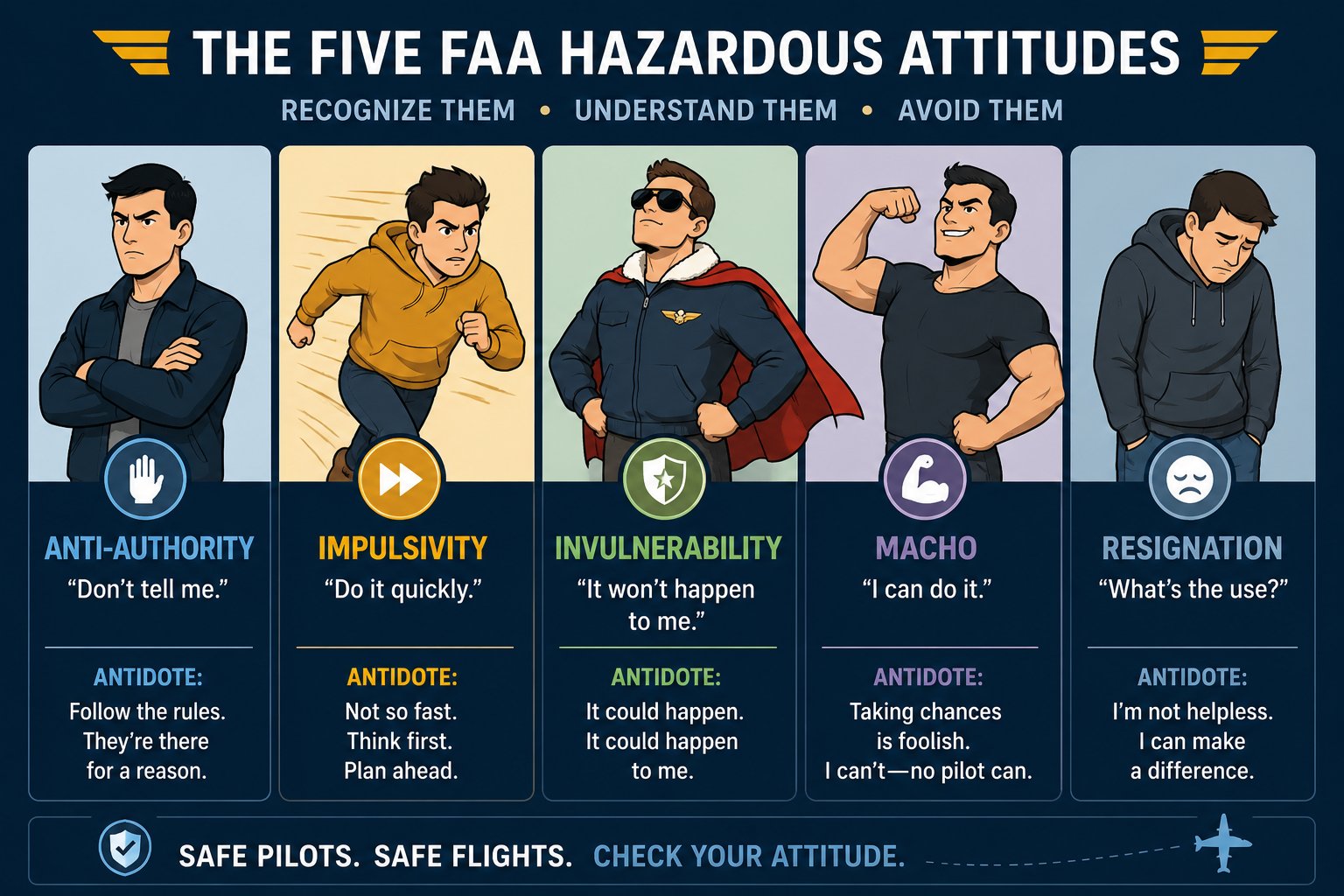
The five FAA hazardous attitudes — recognize and apply the antidote before they lead to an accident
| Attitude | Thought Pattern | Antidote |
|---|---|---|
| Anti-authority | "Don't tell me what to do. Rules are for other people." | "Follow the rules — they are usually right." |
| Impulsivity | "Do something — anything — right now!" | "Not so fast. Think first." |
| Invulnerability | "It won't happen to me." | "It could happen to me." |
| Macho | "I can handle this. Watch me." | "Taking chances is foolish." |
| Resignation | "What's the use? There's nothing I can do." | "I'm not helpless — I can make a difference." |
Most drone accidents involve at least one hazardous attitude. A pilot who presses on into marginal weather despite a nagging doubt (invulnerability + macho) and who ignores the low battery warning because "it'll be fine for one more pass" (impulsivity) is exhibiting the exact pattern that causes preventable incidents. The antidote to each attitude is a specific counter-thought — practice them until they become automatic.
Attitude Recognition in Real Scenarios
Identifying hazardous attitudes in abstract is easier than catching them in yourself during actual operations. Consider these scenarios and the attitudes they represent: "The client is already set up and ready — I'll just do this quick shot even though the battery is at 18%." (Impulsivity and Macho — acting immediately without adequate reserve.) "I've flown here a hundred times, I don't need to check NOTAMs." (Anti-authority — dismissing systematic safety procedures.) "The forecast shows marginal conditions but it looks fine out here — everyone else would push through this." (Invulnerability and peer pressure combined.)
The key to applying the antidotes is internalizing them as reflexes rather than deliberate thought. When the impulsive thought "just go for it" arises, the trained response "not so fast, think first" should surface automatically. This level of internalization requires practice — run through hazardous attitude scenarios mentally before flights where you know external pressures will be high. Pre-exposure to the scenarios makes recognition more automatic during actual operations.
Attitude and Decision-Making Under Stress
Stress significantly affects decision-making and increases vulnerability to hazardous attitudes. Under high stress — time pressure, client watching, expensive equipment at risk — pilots are more likely to engage impulsively, dismiss safety concerns (macho), or feel helpless (resignation). Recognizing stress as a decision-making impairment — similar to fatigue or distraction — helps you manage it. High-stress moments are when you most need to slow down, follow the checklist, and apply the hazardous attitude antidotes deliberately.
Lesson 3 — Risk Assessment Frameworks
Formal risk assessment before every flight separates professional operators from those who "just fly." The FAA promotes several risk assessment frameworks for general aviation that apply equally to drone operations.
PAVE checklist: A pre-flight risk assessment framework.
- Pilot — Is the pilot current, competent, and fit for this mission? Any currency gaps, unfamiliar equipment, or stress factors?
- Aircraft — Is the aircraft airworthy, appropriate for this mission, and properly configured?
- enVironment — What are the weather, airspace, terrain, and operational environment risks?
- External pressures — Are there schedule, client, or financial pressures pushing toward a go decision despite marginal conditions?
3P model: Perceive, Process, Perform. Perceive hazards → Process their risk → Perform the best available action. This model supports continuous in-flight risk management — not just pre-flight planning.
The IMSAFE-PAVE Combined Pre-Flight Assessment
Many professional operators combine IMSAFE and PAVE into a single integrated pre-flight risk assessment. Start with IMSAFE (pilot fitness), then proceed through PAVE (overall mission risk). If any IMSAFE item raises a concern, it immediately affects the "Pilot" component of PAVE. A pilot who identifies fatigue through IMSAFE should factor that into the overall risk calculation — marginal weather that would normally be acceptable becomes unacceptable when the pilot is fatigued, because the reserve decision-making capacity needed to handle unexpected complications is already degraded.
The 5P model is an extension used in more complex operations: Plan (the original plan and its assumptions), Plane (aircraft condition and configuration), Pilot (fitness and qualifications), Passengers/People (non-participating persons affected by the operation), and Programming (automation, settings, authorizations). The 5P model works well for commercial drone operations where the "passengers" concept translates to bystanders and clients, and "programming" covers LAANC authorizations, RTH settings, and flight automation configurations.
Quantitative Risk Assessment for Commercial Operations
For high-stakes commercial operations, some operators use numerical risk scoring. Each risk factor (weather, airspace complexity, payload criticality, site congestion, pilot currency) receives a numerical score based on severity and probability. Total scores above a threshold require additional mitigation before proceeding. While the specific numbers are less important than the consistent process, quantitative approaches force systematic consideration of all risk factors rather than holistic "gut feel" assessments that can be biased by optimism or pressure.
Lesson 4 — IMSAFE Checklist
The IMSAFE checklist evaluates pilot fitness before flight. Unlike aircraft airworthiness, pilot fitness is entirely self-assessed — no one else can determine if you're fit to fly. The checklist:
Medications of Specific Concern
Several medication categories deserve specific attention for drone pilots. Antihistamines: Even "non-drowsy" formulations like loratadine (Claritin) and cetirizine (Zyrtec) can cause drowsiness in some individuals and have been associated with impaired cognitive performance in aviation studies. The sedating antihistamines (diphenhydramine — Benadryl, doxylamine — Unisom) are clearly disqualifying for drone operation. Decongestants: Pseudoephedrine can cause anxiety, elevated heart rate, and impaired judgment — not appropriate for flight. Muscle relaxants and sleep aids: Any medications in these categories should preclude drone operation until fully metabolized.
The FAA's "I'm Safe" guidance for manned pilots applies directly to Part 107: when in doubt about a medication's effects on performance, don't fly until you understand the medication's impact and it has fully cleared your system. The general rule — don't fly while taking any medication that you wouldn't take if you were driving a commercial vehicle — provides useful practical guidance.
Fatigue Management for Professional Operators
Commercial drone operators often work irregular hours — early morning golden hour shoots, late afternoon clients, multi-day projects with overnight travel. Cumulative fatigue builds across days and is poorly self-assessed — tired pilots consistently underestimate their level of impairment. Developing a schedule that protects adequate sleep before critical operations, limiting consecutive days of demanding work, and using objective fatigue indicators (reaction time apps, simple cognitive tests) rather than subjective "I feel fine" assessments supports better fatigue management. The FAA's fatigue guidance for manned pilots, while not directly applicable to Part 107, provides a useful framework for professional drone operators managing their own schedules.
- Illness — Any illness, even a cold? Congestion can affect judgment and, for manned pilots, middle ear pressure. Medications for illness may cause impairment.
- Medication — Any medications? Many over-the-counter drugs cause drowsiness, impaired judgment, or other side effects. Even "non-drowsy" antihistamines can impair performance.
- Stress — High stress from work, finances, relationships, or personal issues impairs decision-making and attention. Stress is cumulative — it doesn't stop at the flight line.
- Alcohol — No alcohol within 8 hours ("8 hours bottle to throttle" for manned aviation; FAA recommends even longer). Part 107 prohibits operating a drone while impaired by alcohol.
- Fatigue — Fatigue is as impairing as intoxication. Sleep-deprived pilots miss cues, react slowly, and make poor decisions. If you're tired, don't fly.
- Emotion — Extreme emotion (grief, anger, excitement) impairs judgment. A pilot who just received bad news or just had a major argument should wait before flying.
Lesson 5 — Visual Observer Roles
A Visual Observer (VO) is a person who assists the RPIC by maintaining visual contact with the drone. The RPIC can operate FPV with a VO maintaining unaided visual line of sight. The VO can also extend effective situational awareness — watching for traffic from one direction while the RPIC focuses on the mission.
The RPIC and VO must be able to communicate at all times — face to face or via radio. Clear briefings before the flight establish roles: who watches for aircraft, who monitors battery, who watches for ground hazards, and most importantly, who has authority to call "abort." The RPIC retains final authority, but a well-briefed VO who speaks up about an approaching aircraft can prevent an incident the RPIC didn't see.
Important: having a VO does not allow operations beyond visual line of sight (BVLOS). The VO must maintain visual contact with the drone. BVLOS requires a specific FAA waiver regardless of crew configuration.
VO Training and Briefing
A visual observer who is not properly briefed is a liability rather than an asset. Before every flight with a VO, conduct a formal crew briefing that covers: the mission profile (where the drone will fly, at what altitude, for how long), the VO's specific responsibilities (primary sector to scan, what to watch for, how to communicate alerts), emergency procedures (what to do if the pilot becomes incapacitated, who has authority to call abort), communication protocol (what radio channel, what code words), and the priority hierarchy (safety > mission completion, always).
The VO briefing doesn't need to be long — 3-5 minutes is typically sufficient. But it must cover the essential elements that define the VO's role clearly enough that the VO can function effectively without further instruction during the operation. An unbriefed VO may hesitate to speak up about what appears to be an incoming aircraft because they're uncertain if it's a concern or if the RPIC has already seen it. A briefed VO knows their primary scan sector, knows the code word for "immediate concern" versus "heads up," and knows their authority to call for an immediate landing if necessary.
Multiple Crew Operations
Complex commercial drone operations — film productions, large-area surveys, infrastructure inspections with multiple aircraft — may involve multiple crew members: RPIC, VO(s), payload operator, safety officer, and operations coordinator. Each role requires clear authority and responsibility definitions, especially regarding who can terminate the operation and under what circumstances. The aviation CRM principle of crew hierarchy — clear chain of command with everyone empowered to speak up about safety — applies directly to these multi-person drone crews.
Lesson 6 — Lost Link Procedures and Emergency Planning
A "lost link" event occurs when the control link between the remote controller and drone is interrupted. This is one of the most common drone emergencies. Pre-flight emergency planning — before you're in the situation — is the key to handling it well.
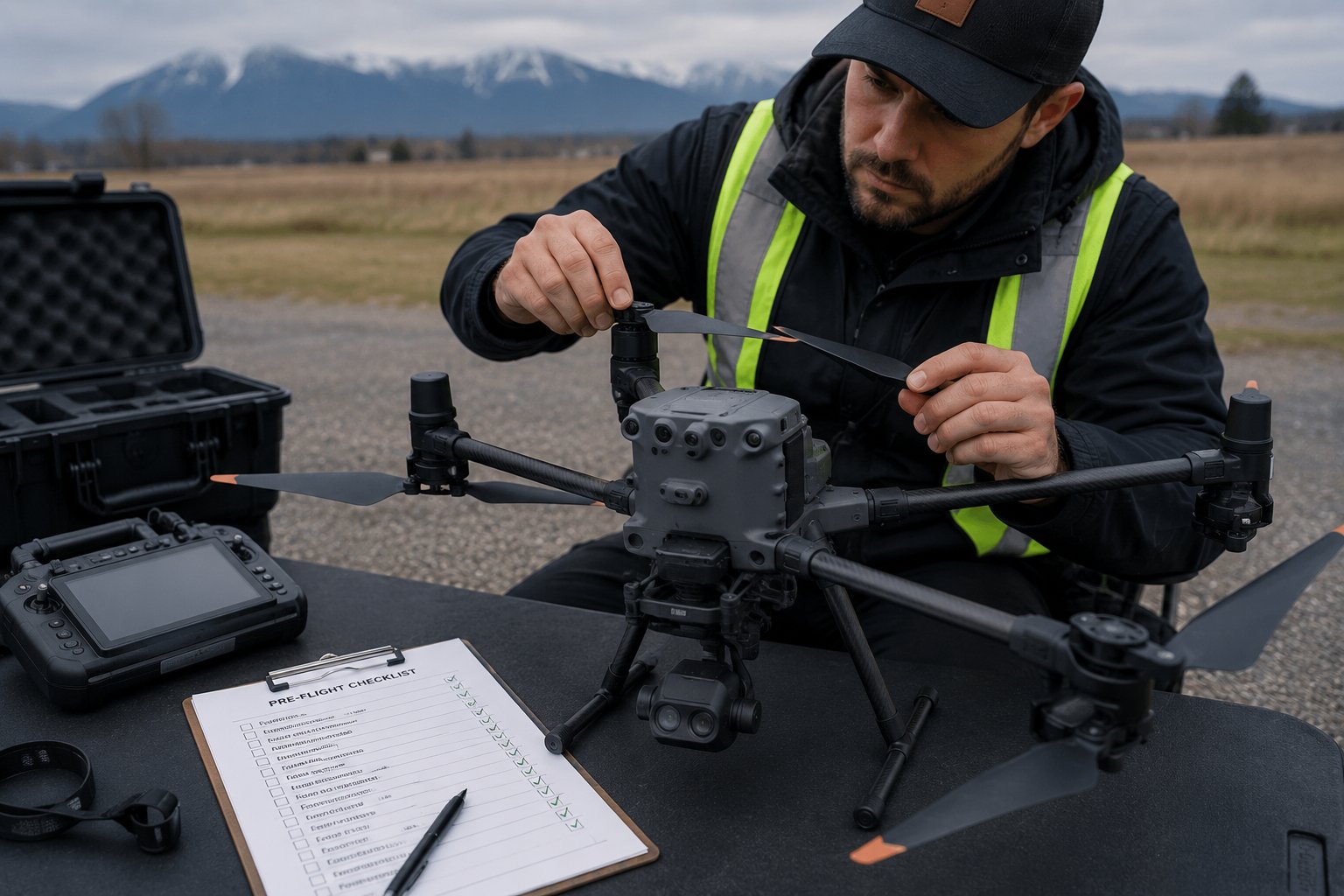
Professional drone operator conducting pre-flight inspection — every flight starts with a checklist
Before every flight, know: What will your drone do if link is lost? (RTH, hover, land?) Is your RTH altitude set correctly for this environment? Where will the drone land if RTH brings it back? Is that area clear of people and obstacles? These questions must be answered before takeoff, not during a lost link event.
Common causes of lost link: flying behind large structures that block radio signals, interference from other radio frequency sources, flying at extreme range, and flying in areas with significant radio frequency congestion. Flying in an arc rather than directly away maximizes the chance of maintaining link by keeping the controller antenna broadly aimed at the aircraft.
Signal Optimization During Operations
Controller antenna orientation significantly affects link quality and range. Most drone controllers use directional antennas that transmit and receive most strongly perpendicular to the flat face of the antenna. Pointing the antenna flat face directly at the drone provides maximum signal; pointing the antenna edge-on to the drone minimizes it. As your drone moves, adjust antenna orientation to maximize signal strength — most apps display signal quality in real time, allowing you to optimize antenna position as the drone moves.
Sources of radio frequency interference that can cause lost link events include: other drones or controllers operating on the same frequency band (2.4GHz and 5.8GHz), WiFi access points (same frequency bands), microwave ovens (2.4GHz), other radio equipment, and physical obstructions between controller and drone. In environments with high RF interference (urban areas, event venues with many WiFi networks, industrial facilities), switching to the less-congested frequency band (5.8GHz typically has less congestion than 2.4GHz in urban areas) may improve link reliability.
Emergency Landing Site Planning
Emergency landing site planning requires thinking through the mission profile segment by segment. For each phase of flight — takeoff/climb, transit to operating area, operating pattern, return transit, approach and landing — identify the best available emergency landing option if RTH isn't possible or appropriate. Map these mentally or on a site diagram before flight. The mental process of thinking through "what would I do if I lost control right now?" at each point in the mission builds the situational awareness that makes emergencies manageable when they occur.
Communicate emergency landing zones to your crew. If the RPIC becomes incapacitated — injury, medical event, equipment failure affecting the controller — a briefed VO or crew member should know the emergency landing options and be able to guide the RPIC or initiate RTH procedures. This level of crew briefing distinguishes professional commercial operations from casual flying.