FAA Regulations — The Rules That Govern Every Flight
FAA regulations are the legal framework of US aviation. The written test draws more questions from regulations than almost any other category. This module covers every regulation you need to know — not just what the rules say, but why they exist, what the specific numbers are, and how to apply them to real scenarios.
- Explain the difference between FARs (legally binding) and the AIM (advisory)
- State passenger-carrying and night currency requirements with specific timeframes
- List all required aircraft documents and inspection intervals from memory
- Apply VFR cruising altitude rules to any magnetic course
- Explain right-of-way priority order and converging aircraft rules
- State the alcohol regulations including the 8-hour rule and 0.04% BAC limit
- Calculate fuel reserve requirements for day and night VFR flights
Lesson 1 — The Regulatory Structure
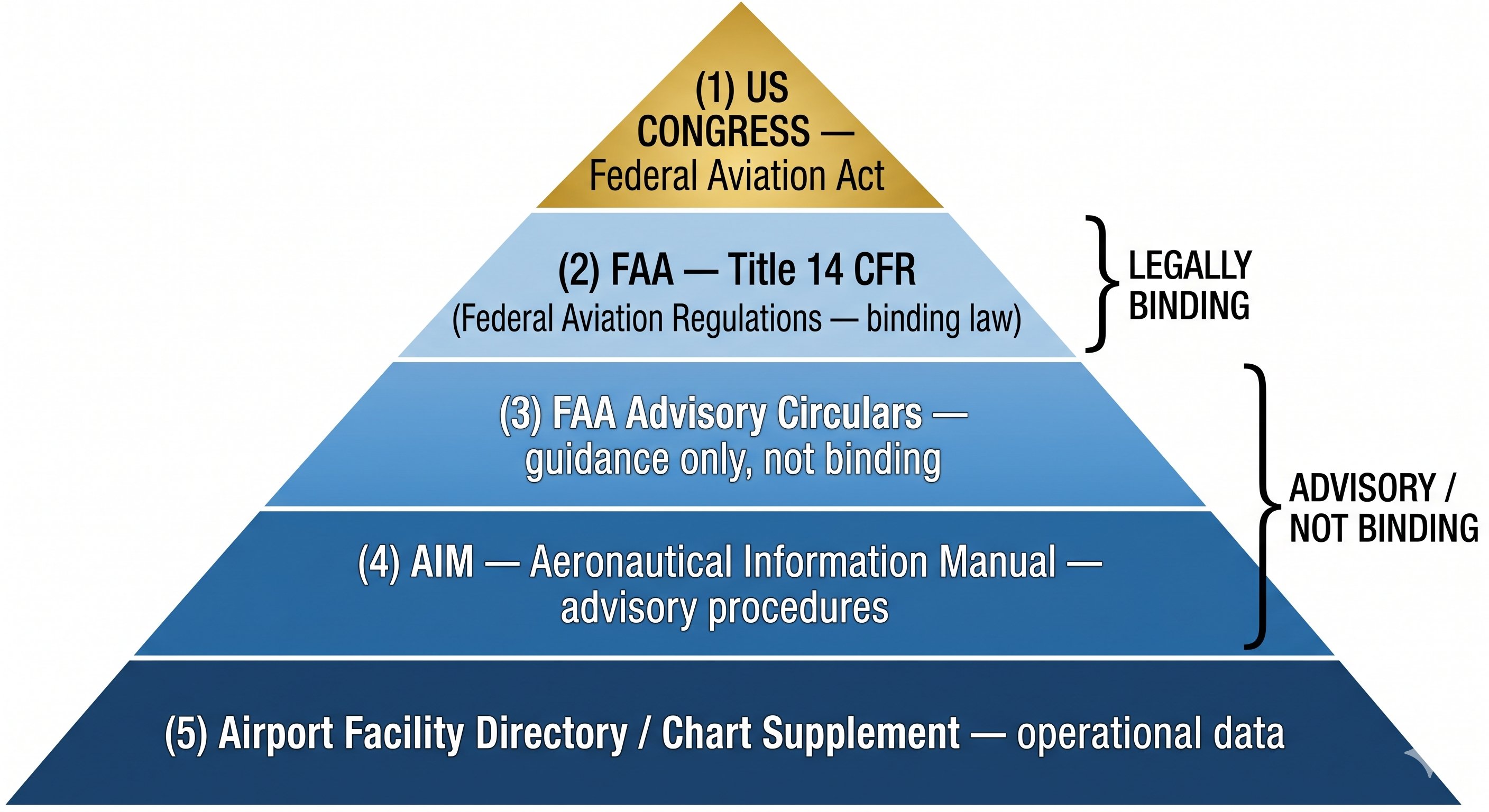
US aviation is governed by a hierarchy of authority that every pilot must understand. At the top is Congress, which passes the Federal Aviation Act. The FAA (Federal Aviation Administration), an agency of the Department of Transportation, implements that law through Federal Aviation Regulations (FARs) — formally published as Title 14 of the Code of Federal Regulations (14 CFR). These are the law. Violating an FAR can result in certificate action, civil penalties, or criminal prosecution.
Separate from the FARs is the Aeronautical Information Manual (AIM). The AIM explains how the National Airspace System works, recommends procedures, and provides explanatory information. Crucially, the AIM is not regulatory — it carries no legal authority. When the AIM recommends something and a FAR requires something different, the FAR governs. This distinction appears on the written test and is important in practice: following AIM guidance doesn't substitute for FAR compliance.
The key regulatory parts for private pilots
| Part | Title | What it covers |
|---|---|---|
| Part 61 | Certification of Pilots | Certificate requirements, ratings, training rules, currency, logbook requirements |
| Part 91 | General Operating Rules | VFR/IFR rules, speed limits, right-of-way, fuel requirements, equipment requirements |
| Part 43 | Maintenance | Inspection requirements, who can perform maintenance, return to service procedures |
| Part 71 | Airspace Designation | Definition and boundaries of all airspace classes |
| Part 39 | Airworthiness Directives | Mandatory safety-of-flight fixes required by the FAA |
How to find the actual regulation — eCFR and the AIM
When you hear "FAR 91.155" or "FAR 61.57," you need to know where to find the actual rule. The FARs are published in Title 14 of the Code of Federal Regulations (14 CFR). The FAA refers to them as "14 CFR Part XX" in official publications; the aviation industry calls them "FARs" (Federal Aviation Regulations). They're the same thing — two ways to reference the same federal rules.
The official source: eCFR.gov — the Electronic Code of Federal Regulations, updated in real time as regulations change. Bookmark it. When you need to look up a rule for a flight question, eCFR has the authoritative current text. The FAA also publishes the Aeronautical Information Manual (AIM), which is not legally binding but explains the regulations and recommended procedures in plain English. The AIM is the "how-to" guide; the FARs are the "must-do" requirements.
The key Parts of the FARs every pilot must know
Part 61 — Certification: Pilots, Flight Instructors, Ground Instructors. This is where training requirements, currency rules, and certificate privileges live. FAR 61.57 (currency), FAR 61.109 (private pilot hour requirements), FAR 61.3 (required documents) — all Part 61.
Part 91 — General Operating and Flight Rules. This governs how you fly once you have a certificate — airspace rules, equipment requirements, right-of-way, altitude rules, fuel requirements, preflight obligations. When a controller or DPE references a rule about how to fly, it's almost certainly Part 91.
Part 43 — Maintenance, Preventive Maintenance, Rebuilding and Alteration. Who can work on aircraft and what they can do. Relevant to pilots because FAR 43 defines what preventive maintenance a certificated pilot may perform on their own aircraft without an A&P mechanic.
Part 39 — Airworthiness Directives. ADs are mandatory maintenance requirements issued when an unsafe condition is found in an aircraft type. The aircraft owner/operator must comply with all applicable ADs before flight.
Advisory Circulars (ACs): Not regulations — they are FAA guidance documents explaining how to comply with regulations or recommending best practices. Compliance is voluntary unless referenced by a regulation. AC 00-6 (Aviation Weather) and AC 00-45 (Aviation Weather Services) are two heavily-referenced ACs for pilots.
Enforcement and the FAA Compliance Philosophy
Not every regulatory slip ends in a certificate suspension. Since 2015, the FAA has operated under a Compliance Philosophy that favors education and corrective training over punishment for unintentional, non-reckless deviations — provided the pilot is forthcoming. Enforcement action (certificate suspension or revocation) is reserved for intentional violations, reckless conduct, or a pattern of repeat deviations.
Two programs matter here. The Aviation Safety Reporting System (ASRS), run by NASA rather than the FAA, lets pilots self-report an incident confidentially. Filing an ASRS report within 10 days of an incident generally provides immunity from a certificate suspension for an unintentional violation — it does not erase the violation, but it waives the penalty. The FAA also runs its own voluntary disclosure channels for similar self-reported corrections. Neither program protects against intentional or reckless violations, and neither is a substitute for flying within the regulations in the first place — but knowing they exist matters if you ever find yourself unsure whether to report a deviation.
If the FAA does pursue formal enforcement, the pilot has the right to appeal to the NTSB (National Transportation Safety Board), which hears appeals of FAA certificate actions independently of the agency that issued them.
Lesson 2 — Pilot Currency (FAR 61.57)
A pilot certificate never expires. But currency — the recency of experience required to exercise certificate privileges — must be maintained independently. This distinction is critical: an expired medical makes you non-current to fly as PIC; it doesn't revoke your certificate. Letting currency lapse is very different from losing your certificate. See all FAA certificates and ratings →
Passenger-carrying currency — FAR 61.57(a)
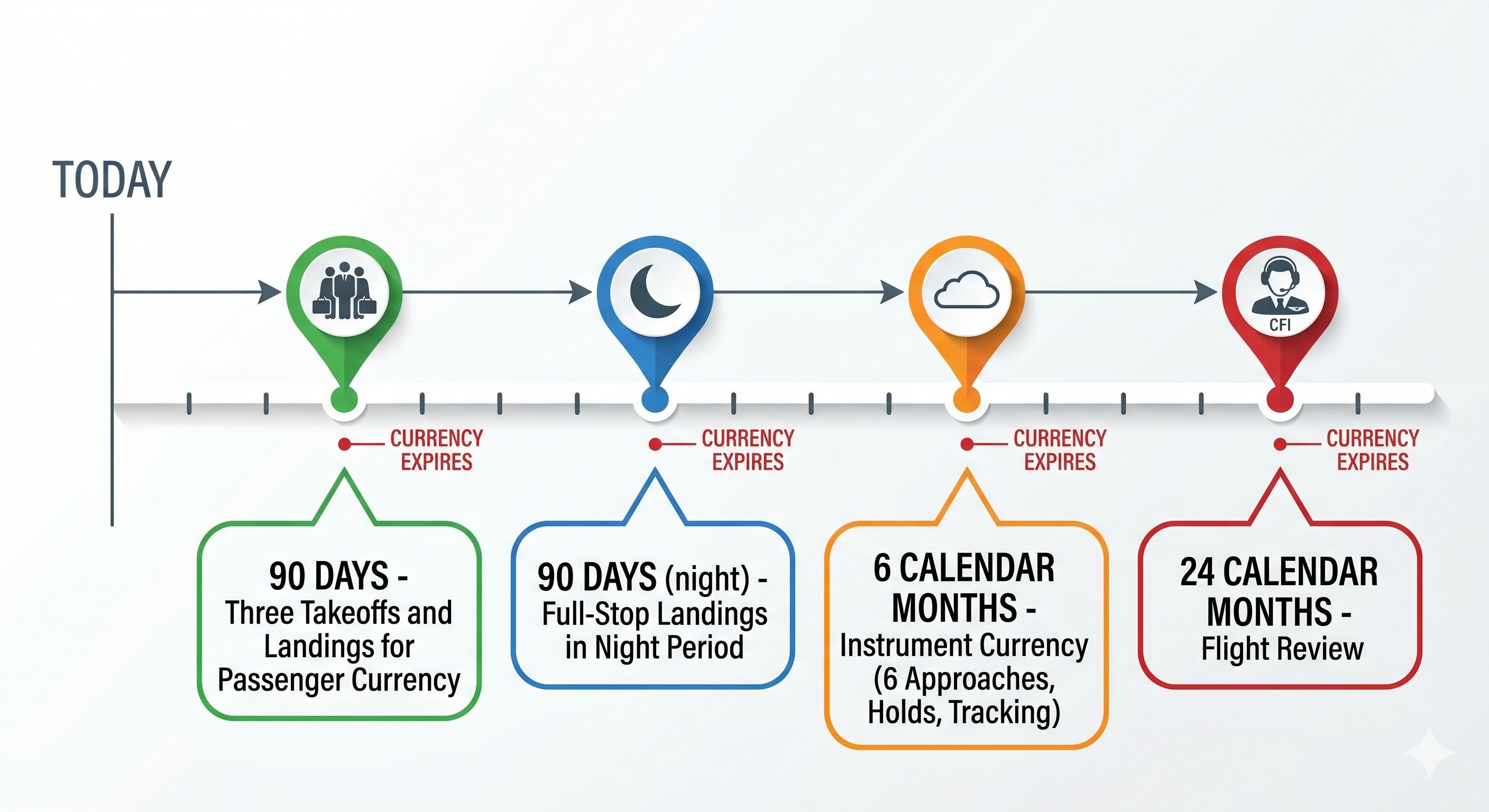
To act as PIC and carry passengers, you must have made at least 3 takeoffs and 3 landings within the preceding 90 days in an aircraft of the same category, class, and type (if type rated). This means: to carry a passenger in a single-engine land airplane, you need 3 takeoffs and 3 landings in a single-engine land airplane within the past 90 days.
Scenario: Your last 3 landings were in a multi-engine airplane 60 days ago. Today you want to take a friend flying in your Cessna 172.
Answer: You are NOT current to carry a passenger. The 3 landings must be in the same category (airplane ✓) and class (single-engine land ✗ — you flew multi-engine). You need to fly the 172 solo first to re-establish currency before taking passengers.
Night passenger currency — FAR 61.57(b)
To carry passengers at night, those 3 required takeoffs and landings must meet additional criteria: they must be full-stop landings (not touch-and-goes) and they must occur during the night period — the time beginning 1 hour after sunset and ending 1 hour before sunrise. Touch-and-go landings at night do not satisfy this requirement.
Night currency trap: Many pilots maintain daytime passenger currency with touch-and-go landings, but these don't count for night currency. You could be fully current to fly solo at night, current to carry day passengers, but NOT current to carry passengers at night — because you haven't done 3 full-stop night landings in the past 90 days. Verify each requirement separately.
Flight review — FAR 61.56
Every pilot must complete a flight review at least once every 24 calendar months. The review consists of a minimum of 1 hour of ground training and 1 hour of flight training with a certificated flight instructor. There is no pass/fail — the CFI reviews to their satisfaction and endorses the logbook. If the CFI is not satisfied, they simply don't endorse — no formal failure is recorded.
Calendar months run to the end of the month. If your flight review was completed any day in March 2023, it remains valid until March 31, 2025. This extra-month grace is a common source of confusion — and a common written test question.
A successful checkride for a certificate or rating counts as a flight review. So does completion of certain FAA-approved safety programs (Wings). You do not need a separate flight review if you complete a checkride within the 24-month window.
Instrument currency — FAR 61.57(c)
To act as PIC under IFR or in less than 3 statute miles visibility, within the preceding 6 calendar months you must have logged: at least 6 instrument approaches, holding procedures, and intercepting/tracking courses. If instrument currency lapses, an Instrument Proficiency Check (IPC) with a CFII or DPE is required before acting as PIC in IMC.
Currency vs. proficiency — the critical distinction
Currency is a legal standard — meet the minimum requirements of FAR 61.57 and you're current. Proficiency is a safety standard — you're actually capable of flying the aircraft safely. These are not the same thing, and confusing them kills pilots.
A pilot who does three touch-and-goes to a full stop in 89 days is legally current for passenger-carrying. A pilot who hasn't flown for 85 days and did three rushed landings in deteriorating weather is also legally current. The certificate makes no distinction. You are responsible for making an honest proficiency assessment before carrying passengers, before flying at night, before flying into complex airspace.
AOPA and the FAA recommend that pilots conduct a flight review with a CFI more often than the required every 24 calendar months — especially after any extended break from flying. A simple self-assessment: if you wouldn't feel comfortable doing a power-off 180 to an unmarked spot on the runway right now, you're not proficient for challenging situations even if you're current.
Night currency — exactly what counts
To carry passengers at night, you need 3 takeoffs and 3 landings to a full stop during the period beginning 1 hour after sunset and ending 1 hour before sunrise, within the preceding 90 days. Several important nuances:
- "To a full stop" means exactly that. Touch-and-goes don't count for night currency (unlike day currency, where they do count).
- The night window is 1 hour after sunset to 1 hour before sunrise — not just when it's dark. Civil twilight is not "night" for currency purposes.
- You can build night currency in the daytime if you operate within the legal night window — the 90-day window is about calendar time, not about flying in darkness per se. A 2 AM landing is night for currency; a 7 PM landing in summer may not be.
- The currency does not expire at midnight on day 90 — it expires after the 90th day has fully passed.
What the flight review actually requires
The flight review (formerly the Biennial Flight Review or BFR) requires a minimum of 1 hour of ground instruction and 1 hour of flight instruction. But the regulation says "at least" — the actual content and duration are at the CFI's discretion. The CFI reviews the areas of operation and flight maneuvers necessary to determine that the pilot can safely exercise the privileges of the certificate. If the CFI determines you need more than 1+1, they'll require it — there's no right to a minimum-duration review.
The flight review is not a checkride. The CFI does not issue a pass/fail. If the review isn't completed satisfactorily, the CFI simply doesn't sign it off — no logbook entry is made. You're not failed; you just don't have a current review. Some pilots spread the flight review over multiple flights if the CFI identifies significant proficiency gaps to address.
Lesson 3 — Required Aircraft Documents and Inspections
Required documents — AROW
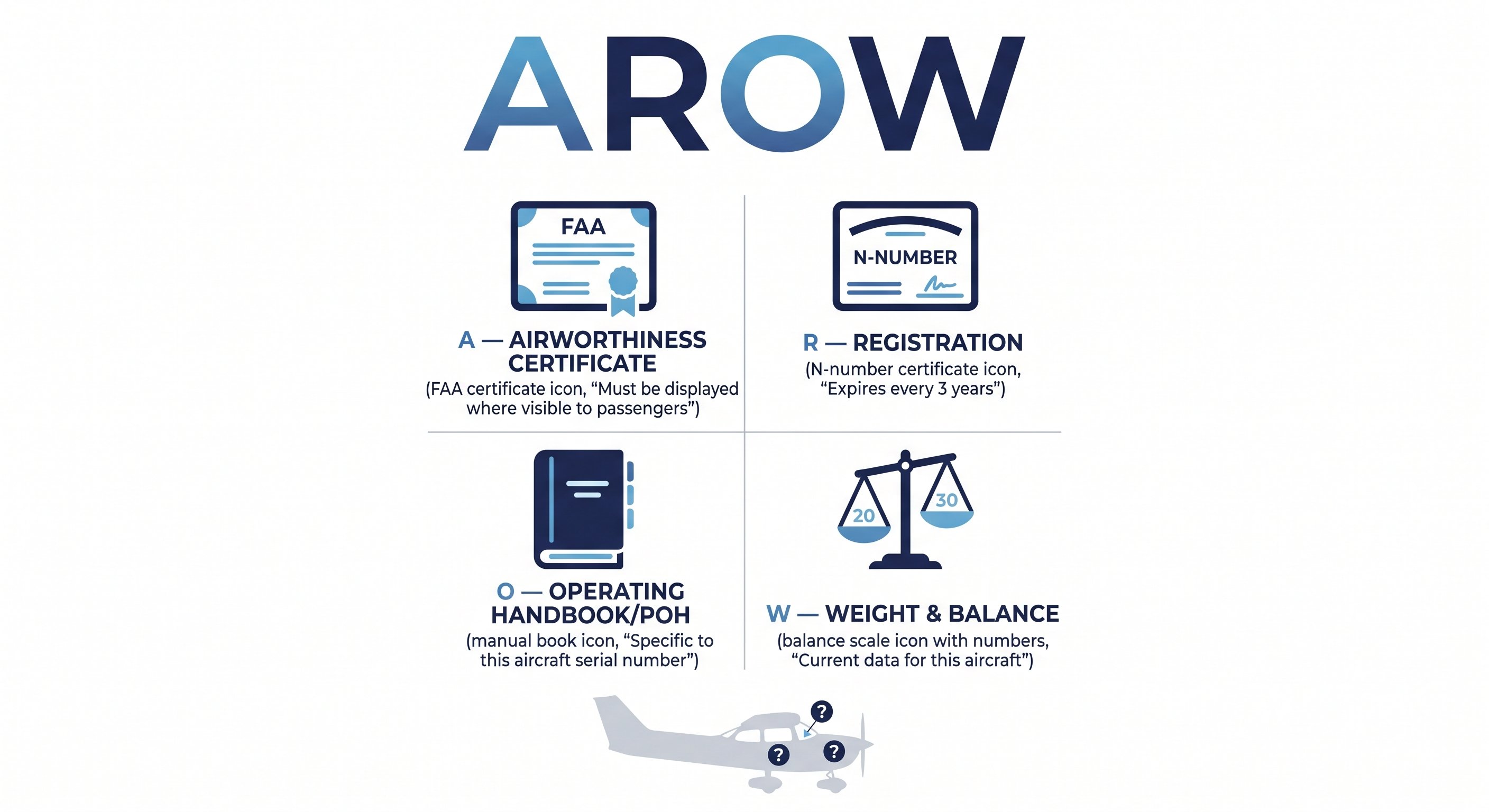
Four documents must be on board for every flight. The mnemonic AROW makes them easy to remember:
| Letter | Document | Details |
|---|---|---|
| A | Airworthiness Certificate | Issued when aircraft first certificated. No expiration date — but must be displayed where visible to passengers. Aircraft must remain airworthy to operate under it. |
| R | Registration Certificate | FAA registration. Expires every 3 years — must be renewed. Must match the aircraft N-number. Keep a copy in the aircraft; original may be kept in a safe. |
| O | Operating Handbook (POH/AFM) | The FAA-approved Pilot's Operating Handbook or Airplane Flight Manual for that specific aircraft serial number. A generic POH of the same model is not sufficient. |
| W | Weight and Balance | Current weight and balance data for the specific aircraft, reflecting any modifications. Must account for the actual empty weight, not a generic fleet average. |
Required inspections — AVIATES
| Letter | Inspection | Interval | Applies to |
|---|---|---|---|
| A | Annual inspection | Every 12 calendar months | All aircraft not operated for hire |
| V | VOR accuracy check | Every 30 days | IFR operations only (not required for VFR) |
| I | 100-hour inspection | Every 100 flight hours | Aircraft used for hire or flight instruction for hire |
| A | Altimeter/static system | Every 24 calendar months | IFR operations only |
| T | Transponder | Every 24 calendar months | Any controlled airspace (required under FAR 91.413) |
| E | ELT | Per manufacturer schedule; battery expires per label | All aircraft (except gliders and some others) |
| S | Static system | Every 24 calendar months | IFR operations (combined with altimeter check) |
100-hour vs Annual — the key difference: The 100-hour inspection is required in addition to the annual for aircraft used to carry persons for compensation or hire, or to provide flight instruction for hire when the aircraft is provided by the school. A rental Cessna at a flight school needs both. Your personally-owned aircraft flown for personal use needs only the annual. The 100-hour may be overflown by up to 10 hours for the purpose of flying to a maintenance facility — but the next 100-hour interval is calculated from where it should have been, not from where it actually was performed.
What each AROW document actually is — and what happens if it's missing
The four required documents (AROW) must be on board the aircraft for every flight. Each one has a specific regulatory basis and a specific consequence if missing:
Airworthiness Certificate (A): Issued by the FAA when the aircraft first meets type certificate standards. Has no expiration date — it's valid as long as the aircraft is maintained in an airworthy condition and all ADs are complied with. It must be displayed where visible to passengers (typically in the instrument panel or on the cockpit wall). If it's missing: the aircraft is not legal to fly. Period. The airworthiness certificate is the FAA's statement that the aircraft design meets safety standards.
Registration (R): Issued by the FAA Aircraft Registry. Valid for 3 years. Shows the aircraft's legal owner. The N-number (tail number) must match the registration. If the registration is expired, the aircraft is technically not registered. Fly with an expired registration and you're in violation of FAR 91.203. Keep a calendar reminder — registration renewal is straightforward but easy to miss.
Operating limitations (O): For certificated aircraft, this is the FAA-approved Pilot's Operating Handbook (POH) or Airplane Flight Manual (AFM). It must be specific to that aircraft — not a generic POH for the same model. The operating limitations include the approved flight envelope, placards, and procedures. For experimental aircraft, operating limitations are a separate FAA document.
Weight and balance data (W): The current, aircraft-specific weight and balance documentation. This changes whenever equipment is added or removed from the aircraft. The original W&B from the type certificate does not apply if modifications have been made. Verify that the W&B data on board reflects the aircraft's actual current configuration.
The inspection intervals — what "annual" actually means
Aircraft must receive an annual inspection every 12 calendar months under FAR 91.409. "Calendar months" means the inspection is due at the end of the same month next year — an annual completed January 15 is valid through January 31 of the following year (the end of the 12th calendar month). The aircraft cannot be operated after that date until the annual is completed.
The 100-hour inspection requirement applies only when the aircraft is used for flight instruction for hire or when used for hire. A private pilot flying their own aircraft for personal travel needs only the annual inspection. A flight school renting aircraft to students needs both — the 100-hour inspection after every 100 hours of operation, plus the annual.
The ELT (Emergency Locator Transmitter) has its own inspection requirement: every 12 months, the ELT must be inspected. The battery must be replaced when its useful life has expired or when the ELT has been used for more than 1 cumulative hour. Check the battery expiration placard on the ELT during preflight.
Lesson 4 — VFR Cruising Altitudes
When flying more than 3,000 feet above the surface on a VFR cross-country, FAR 91.159 specifies which altitudes you must use based on your magnetic course. This rule applies equally to all VFR aircraft and exists to provide altitude separation between VFR and IFR traffic (which uses even thousands of feet) and between eastbound and westbound VFR traffic.
VFR cruising altitude scenarios:
Q: Magnetic course 075° (eastbound). What VFR altitudes are appropriate?
A: Odd thousands + 500: 3,500 · 5,500 · 7,500 · 9,500 ft MSL. Choose based on airspace, terrain, and clouds.
Q: Magnetic course 215° (westbound). What altitude is correct?
A: Even thousands + 500: 4,500 · 6,500 · 8,500 ft MSL — not 5,000 (that's IFR westbound) and not 5,500 (that's VFR eastbound).
Note: This rule applies when flying more than 3,000 ft above the surface. Below that altitude — or in the traffic pattern — no specific cruising altitude is required.
Why the rule exists — the traffic separation logic
FAR 91.159 requires specific cruising altitudes for VFR flight above 3,000 feet AGL to provide predictable altitude separation between aircraft flying in different directions. IFR traffic uses even thousands of feet (6,000, 8,000, 10,000 ft MSL). VFR traffic flying east uses odd thousands plus 500 feet (7,500, 9,500 ft MSL), and VFR traffic flying west uses even thousands plus 500 feet (6,500, 8,500 ft MSL). The "+500" ensures VFR aircraft are always 500 feet away from IFR altitudes — reducing the chance of a VFR/IFR conflict.
Applying the rule in the cockpit
The rule uses magnetic course — not magnetic heading (which includes wind correction). Your magnetic course is the direction from your departure point to your destination on the chart. If you're flying from Salt Lake City (KSLC) to Grand Junction (KGJT), your course is approximately 090° (east). Flying east = magnetic course 0° through 179° = odd thousands plus 500: 5,500 / 7,500 / 9,500 / 11,500 ft MSL (subject to terrain clearance and airspace requirements).
Flying west (180° through 359° magnetic course): even thousands plus 500 = 6,500 / 8,500 / 10,500 ft MSL. A direct westbound flight from KGJT to KSLC would use 8,500 ft for a reasonable mountain-crossing altitude.
Common exam trap: the rule says "more than 3,000 feet above the surface" — not 3,000 feet MSL. If you're flying over terrain at 6,500 ft MSL and your altitude is 7,500 ft MSL, you're only 1,000 feet above the surface — the rule doesn't apply. The rule applies only when you're more than 3,000 feet AGL, anywhere in the flight.
The VFR cruising rule in the real cockpit — practical application
Filing the right cruising altitude on a VFR cross-country takes 30 seconds of planning and prevents confusion with IFR traffic. Here's the workflow:
Draw your course line on the chart (or let your EFB draw it). Note the magnetic course — your EFB shows this directly. Confirm you'll be above 3,000 ft AGL for the relevant portion. Then select your altitude: magnetic course 000°–179° (east) = odd thousands + 500; magnetic course 180°–359° (west) = even thousands + 500. Simple.
The most common mistake: confusing magnetic course with magnetic heading. Course is the straight-line direction from departure to destination. Heading is the direction the nose is actually pointing (which includes wind correction). Use course to determine the required altitude band — not heading.
At cruise, maintain that altitude within the ACS tolerance of ±100 feet. This isn't just a checkride standard — it matters operationally. An IFR aircraft descending through your altitude on an IFR clearance is expecting VFR traffic to be at VFR altitudes. If you're at 8,000 ft MSL (an even IFR altitude) flying eastbound instead of 7,500 ft, you're where someone else is supposed to be.
Lesson 5 — Right-of-Way Rules (FAR 91.113)
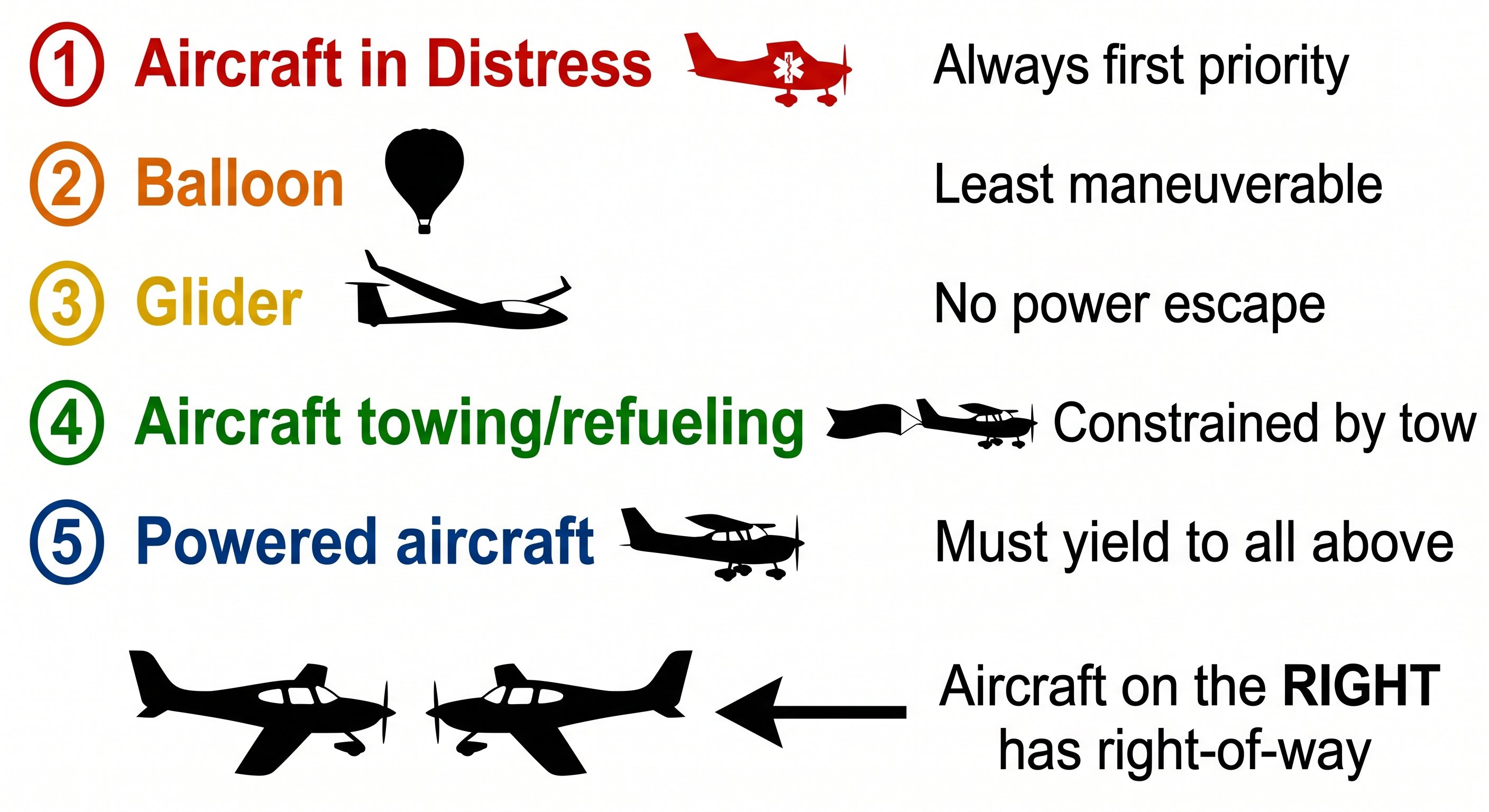
Right-of-way rules determine which aircraft has priority when two aircraft are converging or otherwise in conflict. These rules are based on maneuverability — less maneuverable aircraft have priority because they have the least ability to avoid conflict.
The priority order
| Priority | Aircraft / Situation | Why |
|---|---|---|
| 1st | Aircraft in distress | Emergency — absolute right of way over all |
| 2nd | Balloon | Least maneuverable — cannot deviate |
| 3rd | Glider | Cannot adjust speed or initiate powered escape |
| 4th | Aircraft towing or refueling | Constrained by the towed object |
| 5th | Engine-driven aircraft | Most maneuverable — must yield to all above |
Converging aircraft — the most tested scenario
When two aircraft are converging at approximately the same altitude and neither is in distress or in a higher-priority category, the aircraft on the right has the right of way. The aircraft on the left must yield — give way to the aircraft on your right. This is the same as maritime collision avoidance rules and produces orderly traffic flow.
Converging scenario — common exam question:
Aircraft A is flying north. Aircraft B is approaching from the west on a converging course. Both are at the same altitude. Who has right of way?
From Aircraft A's perspective: Aircraft B is approaching from A's right side. Therefore Aircraft B has the right of way — Aircraft A must yield (turn right, climb, descend, or slow to pass behind B).
Key: identify the relative position (left or right) from each aircraft's perspective. The aircraft that sees the other to its right has right of way.
Head-on, overtaking, and landing
Head-on: Both aircraft must turn right. No exceptions — both pilots turn right to pass left-to-left of each other, creating a consistent separation standard.
Overtaking: The aircraft being overtaken has right of way. The overtaking aircraft passes to the right of the slower aircraft. This applies in the air and on the runway — a faster aircraft overtaking a slower one must give way.
Landing: Aircraft on final approach or landing have right of way over aircraft in flight and on the ground. However, you may not cut in front of another aircraft that is on final to force them to go around. An aircraft that is lower on final has right of way over one that is higher.
Right-of-way in practice — what you actually do in the traffic pattern
The right-of-way priority order (balloons/gliders → airships → aircraft towing → powered aircraft) applies in en-route flight. In the traffic pattern and near airports, the practical rules are slightly different and more nuanced.
Converging aircraft: When two aircraft are approaching each other at roughly the same altitude, each shall turn right. This applies to head-on approaches and is required (not optional). The result: both aircraft pass left of each other — like driving on a road.
Overtaking: The overtaking aircraft must pass to the right of (give way to) the aircraft being overtaken — the left side of the other aircraft. The overtaken aircraft has right-of-way, but neither aircraft should turn toward the other.
Landing priority: Aircraft on final approach or landing generally have right-of-way over aircraft in flight or on the ground. But at a busy non-towered airport with multiple aircraft in the pattern, this requires judgment — an aircraft turning base does not have absolute right-of-way over one already established on final.
See-and-avoid — the VFR collision avoidance system
VFR flight depends entirely on see-and-avoid as the primary traffic separation system. Understanding its limitations is safety-critical: see-and-avoid only works if you're actually looking outside, the other aircraft is visible, and closure rates are low enough to allow reaction time.
The human eye has a blind spot directly ahead (the foveal fixation zone), and another directly behind. Traffic that's directly ahead in your 12 o'clock position is the hardest to see because it produces no apparent movement against the background — it just grows larger until it hits you. A midair collision at 250 knots combined closure speed takes less than 12 seconds from a 2-mile visual range — 12 seconds to see, recognize, decide, and maneuver.
Practical see-and-avoid techniques: scan in segments (move your eyes in 10-degree blocks, pausing briefly in each to allow the eye to focus). Look in the traffic areas — aircraft join patterns from a 45-degree entry to midfield downwind, so scan that quadrant carefully. Use traffic advisories (flight following) when available — ATC radar can see traffic you can't. Traffic alert devices (ADS-B In, TCAS) provide a significant safety margin when combined with visual scanning — but they're supplements to the visual scan, not replacements for it.
Lesson 6 — Speed Limits, Minimum Altitudes, and Alcohol
Speed limits — FAR 91.117
| Location | Speed Limit | Notes |
|---|---|---|
| Below 10,000 ft MSL (general) | 250 KIAS maximum | Applies everywhere below 10,000 ft |
| Within Class B airspace | 200 KIAS maximum | Also applies below the floor of a Class B shelf |
| Within 4 nm of Class C or D primary airport, below 2,500 AGL | 200 KIAS maximum | Even if not in the Class C or D itself |
Minimum safe altitudes — FAR 91.119
There is no regulation that specifies a single "minimum altitude for VFR flight" — instead, FAR 91.119 establishes minimums based on what is below you:
- Congested areas (cities, towns, settlements, open-air assemblies of persons): at least 1,000 ft above the highest obstacle within a 2,000 ft horizontal radius. This means if there's a 400 ft building in the city below, you need to be at least 1,400 ft AGL over it.
- Other than congested areas: at least 500 ft above the surface. Over open water or sparsely populated areas: not closer than 500 ft to any person, vessel, vehicle, or structure.
- Anywhere: not at an altitude that prevents an emergency landing without undue hazard to persons or property on the surface if a power unit fails.
Alcohol regulations — FAR 91.17
FAR 91.17 is unambiguous and strictly enforced. No person may act as a crewmember of a civil aircraft while:
- Within 8 hours after consuming alcohol ("bottle to throttle")
- Under the influence of alcohol, regardless of time elapsed
- With a blood alcohol concentration of 0.04% or more
- Using any drug that adversely affects safety of flight
The 8-hour rule is the legal minimum. The aviation industry standard is 12–24 hours. Alcohol remains in the system and impairs performance at levels well below 0.04% BAC. The "I feel fine" test is not reliable — alcohol specifically impairs the self-assessment of impairment. A pilot who believes they are fine after 3 drinks is demonstrating the effect of alcohol, not the absence of it.
Drug regulations and medications: FAR 91.17 also prohibits flying while using any drug that adversely affects the pilot's faculties. This includes prescription medications, over-the-counter drugs, and substances not traditionally classified as "drugs." Many common OTC medications — antihistamines (Benadryl, Claritin), decongestants (Sudafed), sleep aids, and even some pain relievers — impair pilot performance measurably. The standard: if the drug affects how you feel, it may affect how you fly. Consult an AME or the FAA's AMCS medication database before flying on any medication.
Minimum safe altitudes — the rules and their rationale
FAR 91.119 establishes minimum safe altitudes — the floor below which you cannot legally fly except when necessary for takeoff or landing. The rule has three tiers:
Anywhere: You must maintain an altitude sufficient to allow an emergency landing without undue hazard to persons or property on the surface in the event of engine failure. This is the baseline — always have an emergency landing option. This means: don't fly over terrain where a forced landing would kill someone on the ground.
Over congested areas (cities, towns, settlements, or open air assemblies of people): At least 1,000 feet above the highest obstacle within 2,000 feet horizontally. Flying over a city or outdoor concert at 1,200 ft MSL when there are buildings at 300 ft MSL puts you only 900 ft above the obstacle — a violation. The 1,000-foot buffer requires clearing the highest obstacle, not just the average obstacle.
Everywhere else (non-congested areas): At least 500 feet above the surface, except over open water or sparsely populated areas where no hazard to persons or property on the surface exists, in which case you must remain clear of any persons, vessels, vehicles, or structures.
Alcohol and drugs — the actual rule and its implications
The FAA's alcohol rule has three separate provisions, all of which must be satisfied:
- 8 hours: You cannot act as a crewmember within 8 hours of consuming alcohol. This is the "bottle to throttle" rule. 8 hours is a minimum — not a guarantee of sobriety.
- 0.04% BAC: You cannot act as a crewmember with a blood alcohol concentration of 0.04% or more. This is half the legal driving limit in most states — and it can still be present 8+ hours after drinking, depending on how much was consumed.
- Under the influence: You cannot fly while under the influence of alcohol, even if more than 8 hours have passed and your BAC is below 0.04%. "Under the influence" means any impairment — including hangover effects like dehydration, headache, and reduced cognitive function.
The practical rule: don't drink the night before flying if you have any uncertainty about being fully sharp the next morning. Alcohol affects sleep quality significantly — even 2–3 drinks the night before can produce a measurable performance deficit 12+ hours later. When in doubt, wait. No flight is worth compromising safety over.
Lesson 7 — Fuel Requirements and Preflight Obligations
VFR fuel requirements — FAR 91.151
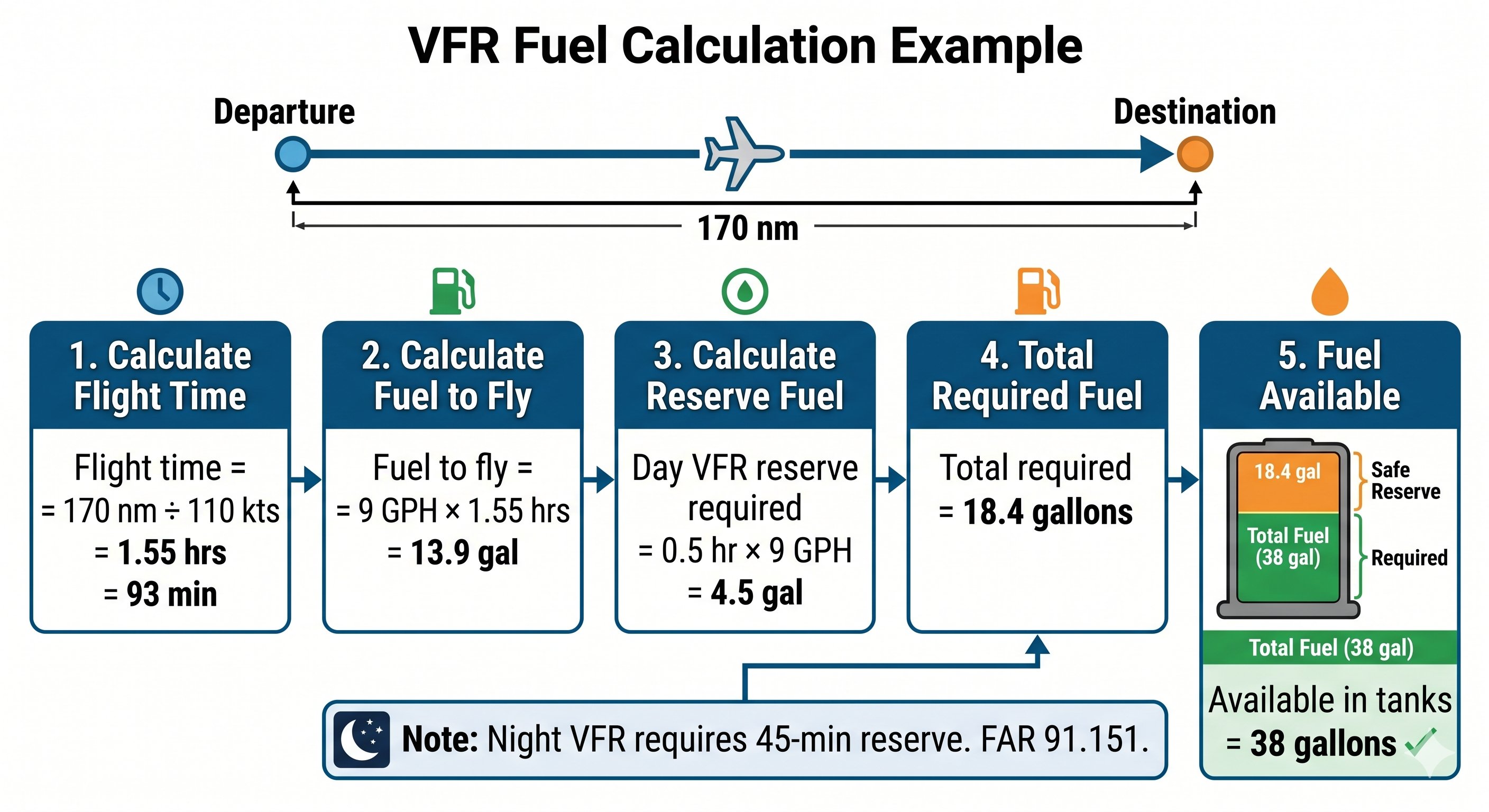
Before beginning any flight, the PIC must ensure the aircraft carries enough fuel to fly to the first point of intended landing plus a required reserve:
- Day VFR: fuel to destination + 30 minutes at normal cruising speed
- Night VFR: fuel to destination + 45 minutes at normal cruising speed
Fuel planning worked example:
Day VFR flight. Distance to destination: 180 nm. Groundspeed: 110 kts. Fuel burn: 9 GPH. Usable fuel on board: 38 gallons.
Flight time: 180 ÷ 110 = 1.64 hours = 98 minutes
Enroute fuel: 9 × 1.64 = 14.7 gallons
Required reserve: 30 min = 0.5 hr × 9 GPH = 4.5 gallons
Total required: 14.7 + 4.5 = 19.2 gallons
Available: 38 gallons ✓ — legal to depart with significant margin
Best practice: Plan to land with at least 1 hour of fuel rather than the 30-minute legal minimum. Weather diversions, headwinds stronger than forecast, and ATC delays consume reserves quickly.
Preflight action requirements — FAR 91.103
Before every flight, the PIC must "become familiar with all available information concerning that flight." This is a broad legal obligation — not just checking weather. For IFR or cross-country flights, FAR 91.103 specifically requires review of:
- Weather reports and forecasts
- Fuel requirements
- Alternatives available if the planned flight cannot be completed
- Any known traffic delays reported by ATC
- Runway lengths at airports of intended use
- Takeoff and landing distance data for current conditions
For local VFR flights, the requirement is less specific — but the principle remains. You must be informed about conditions relevant to your flight. Flying into deteriorating weather you knew about at departure and ignored does not create a regulatory defense.
- FARs are law (legally binding). AIM is advisory (recommended practices only). When they conflict, FARs govern.
- Passenger currency: 3 takeoffs/landings in preceding 90 days, same category, class, and type.
- Night passenger currency: those 3 must be full-stop landings during the night period (1 hr after sunset to 1 hr before sunrise).
- Flight review: every 24 calendar months — 1 hr ground + 1 hr flight. Valid to end of month 24. Checkride satisfies this requirement.
- AROW required documents on board. Airworthiness certificate displayed where visible to passengers.
- Annual: 12 calendar months, all aircraft. 100-hour: aircraft used for hire/instruction for hire (in addition to annual).
- VFR cruising altitude: East (0–179°) = odd thousands + 500. West (180–359°) = even thousands + 500. Applies above 3,000 ft AGL.
- Right-of-way priority: distress > balloon > glider > towing > powered. Converging: yield to your right. Head-on: both turn right.
- Alcohol: 8-hour bottle-to-throttle (minimum), no influence, BAC below 0.04%. Industry standard: 12–24 hours.
- Fuel: day VFR = destination + 30 min. Night VFR = destination + 45 min. These are legal minimums — not best practice.
Lesson 8 — NOTAMs, TFRs, and Preflight Planning Requirements
A NOTAM (Notice to Air Missions) is a time-critical notice containing information essential to personnel concerned with flight operations that is not known sufficiently in advance to be publicized by other means. Checking NOTAMs before every flight is a regulatory requirement under FAR 91.103 — a pilot must become familiar with all available information concerning the flight, including NOTAMs.
NOTAM types
NOTAM (D) — the most common type. Covers airport and airspace conditions: closed runways, taxiways, navaids out of service, construction, cranes, obstacles, and temporary airspace changes. These are distributed through the FAA's NOTAM system and available on 1800wxbrief.com, ForeFlight, or the FAA NOTAM search tool at notams.aim.faa.gov.
FDC NOTAMs — Flight Data Center NOTAMs issued by the FAA for changes to IFR procedures, chart corrections, and regulatory matters. Less relevant for VFR flight but may affect instrument approaches at your destination.
Pointer NOTAMs — direct pilots to other NOTAMs of importance. Appear in briefings to flag associated related NOTAMs.
Temporary Flight Restrictions (TFRs)
A TFR is a regulatory action that temporarily restricts certain aircraft from operating in a defined area, issued under FAR Part 91 by the FAA. Violating a TFR is a serious violation — it can result in certificate suspension, civil penalties, and in some cases interception by military aircraft.
Common TFR types and their characteristics:
The only way to reliably check for TFRs is a standard weather briefing from 1800wxbrief.com or the FSS. Phone apps may show TFRs but are not official sources. POTUS TFRs can be issued with very little notice and do not always appear immediately on all sources — another reason to get a briefing close to departure time.
FAR 91.103 — Preflight action requirements
Before any flight, FAR 91.103 requires the pilot in command to become familiar with all available information concerning that flight. For a flight not in the vicinity of an airport, this specifically includes: weather reports and forecasts, fuel requirements, alternatives if the flight cannot be completed as planned, and any known traffic delays. This is the regulatory basis for the preflight briefing requirement — it's not just good practice, it's the law.
Finding NOTAMs before every flight — the workflow
NOTAMs are available through the FAA's NOTAM system at notams.aim.faa.gov, through 1800wxbrief.com (Standard Briefing includes all NOTAMs for your route), through ForeFlight, Garmin Pilot, and other EFBs. The key is: NOTAMs must be part of every preflight — they're not optional, they're required by FAR 91.103.
The most critical NOTAMs for VFR pilots to check:
- Runway/taxiway closures: A closed runway at your destination changes your landing options. Always check.
- NAVAID outages: VOR or ILS out of service. Less critical for VFR but affects IFR alternates.
- TFRs: Check specifically for TFRs — FAA NOTAM Search at notams.aim.faa.gov has a TFR filter. Presidential TFRs can appear with very little notice and change rapidly.
- Airport-specific NOTAMs: Tower out of service, GPS approach not available, parachute operations in area, aerial work in progress.
Checking for Presidential TFRs — the most dangerous NOTAM
Presidential TFRs are serious. Violations result in immediate interception by military aircraft, loss of certificate, civil penalties, and potential criminal charges depending on circumstances. The inner ring (typically 10 nm) is an absolute no-fly zone — no exceptions for VFR pilots. The outer ring (typically 30 nm) requires an ATC clearance, transponder, and two-way communication.
The danger is unpredictability. Presidential movements aren't announced publicly for security reasons. A TFR can be issued for an airport with 1–2 hours' notice. The president's schedule changes. A TFR valid during your planned departure time may not exist when you last checked NOTAMs 4 hours before flight — and a new one may have appeared since.
Best practice: get a standard weather briefing from 1800wxbrief.com within 1 hour of departure, specifically request TFR information, and verify on the FAA's NOTAM tool directly. The briefer's TFR report is the gold standard — it includes real-time FAA data and the briefer can flag new TFRs that might not yet appear in app databases.