How Flight Training Works — The Roadmap From Day One to Certificate
Before your first lesson, you should understand exactly how the FAA's certification system works, what each step requires, what it costs, and what the training process actually looks like. This module answers the questions every new student has — and many never think to ask until they're already partway through training.
- Describe the FAA pilot certificate ladder from Student through ATP
- Explain the key differences between Part 61 and Part 141 training programs
- Identify which medical certificate is required for each class of operation
- State the FAR 61.109 aeronautical experience requirements for the Private Pilot certificate
- Describe what the practical test (checkride) involves and what the DPE evaluates
- Explain logbook requirements and why accurate record-keeping matters
- Set realistic expectations for training cost, timeline, and the solo milestone
Lesson 1 — The FAA Pilot Certificate Ladder
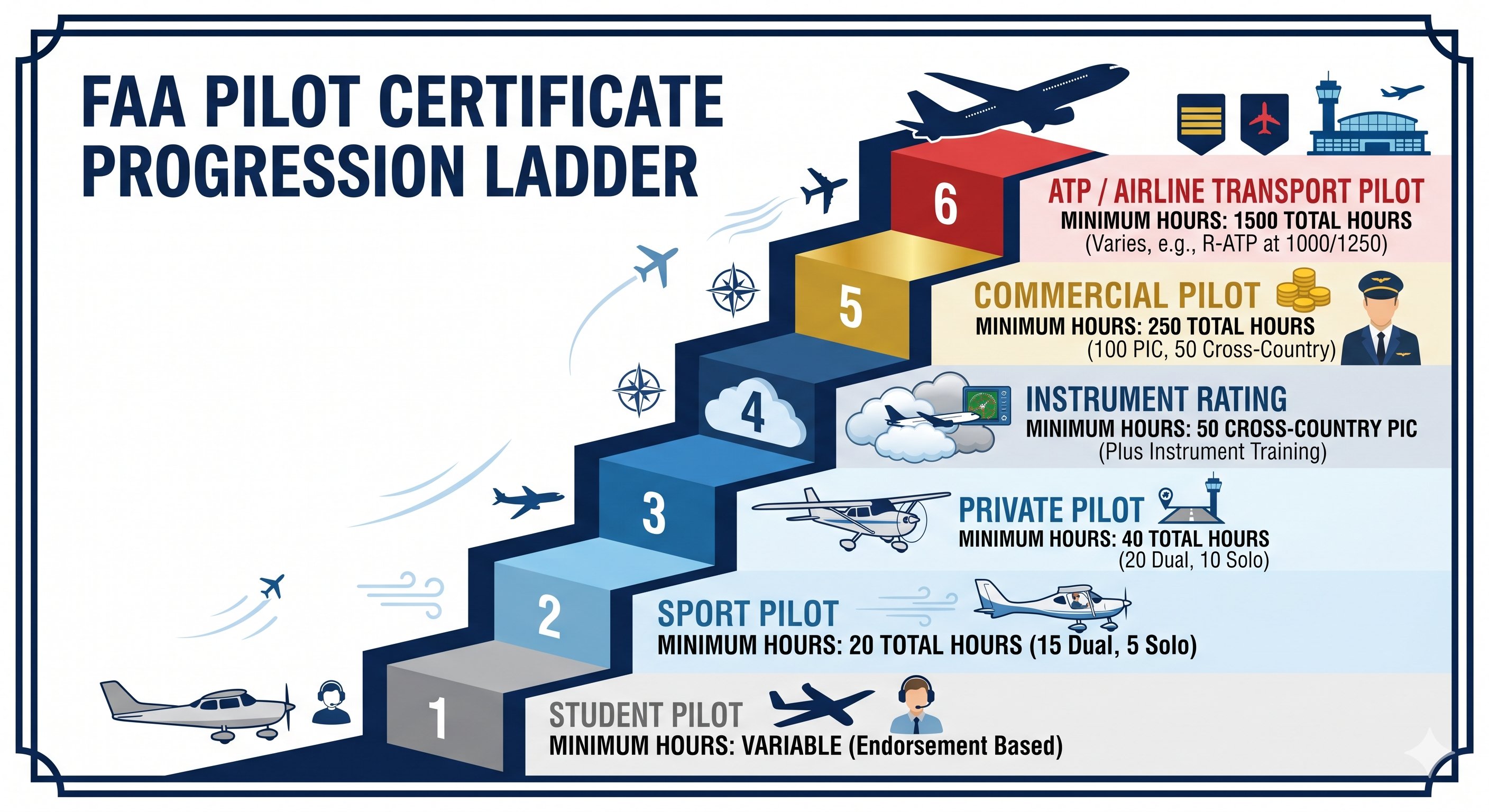
The FAA issues pilot certificates in a progression — each level builds on the previous and unlocks new privileges. You don't skip levels; you earn each one in order. Understanding the full ladder before you start helps you plan where you're going and why each step matters.
Student Pilot Certificate
The Student Pilot Certificate is your first official FAA document. It is required before you can fly solo (alone, without an instructor on board). You apply through IACRA (the FAA's Integrated Airman Certification and Rating Application system) or on paper, and your CFI verifies your identity and eligibility. The Student Pilot Certificate does not expire — but the solo endorsement your CFI adds to your logbook does: 90 days for single-engine aircraft. You are not authorized to carry passengers or fly cross-country solo until your CFI provides additional specific endorsements.
Sport Pilot Certificate
The Sport Pilot is a limited certificate allowing flight in Light Sport Aircraft (LSA) — small, simple aircraft with a maximum takeoff weight of 1,320 lbs, maximum airspeed of 120 knots, and single-engine configuration. No medical certificate is required — a valid driver's license serves as evidence of medical fitness. Sport pilots may fly in Class B, C, D, E, and G airspace with appropriate training and endorsements — they may NOT fly in Class A airspace. Operations are limited to daytime and within the US. For many recreational pilots who want simple, inexpensive flying, the Sport Pilot is an ideal endpoint. For anyone interested in heavier aircraft, night flying, cross-country travel, or a career path, it is a stepping stone.
Private Pilot Certificate
The Private Pilot Certificate (PPL) is the full general aviation license — the goal of this course. A private pilot can fly any aircraft they are rated for, carry passengers, fly at night, fly cross-country, and fly in most airspace. Private pilots may not be compensated for flying (with limited exceptions such as sharing costs pro-rata with passengers). The PPL is the foundation of all advanced certificates and ratings.
Instrument Rating (IR)
The Instrument Rating is an add-on to the Private Pilot Certificate (not a separate certificate). It authorizes flight in instrument meteorological conditions (IMC) — inside clouds, in low visibility, on instruments alone. The IR is arguably the single most important upgrade to pilot safety — it opens up weather options, increases cross-country flexibility, and dramatically expands the conditions you can safely handle. Minimum 50 hours of cross-country PIC time and 40 hours of actual or simulated instrument time are required.
Commercial Pilot Certificate
The Commercial Pilot Certificate authorizes compensation for flying. A commercial pilot can be paid to fly — as a charter pilot, flight instructor, banner tow pilot, aerial survey pilot, and so on. The Commercial certificate requires higher standards than the Private: 250 total flight hours (Part 61), more complex maneuvers, and a higher-performance aircraft checkout. Most commercial pilots also have an Instrument Rating before pursuing commercial operations.
Flight Instructor Certificate (CFI/CFII/MEI)
The Certified Flight Instructor certificate authorizes teaching. CFI = single-engine instruction. CFII = instrument instruction. MEI = multi-engine instruction. Many commercial pilots build hours toward an Airline career by instructing. Flight instructing is one of the most effective paths to the experience levels required for airline hiring.
Airline Transport Pilot (ATP)
The ATP is the highest pilot certificate — required to serve as PIC of an airline. Minimum age 23 (21 for restricted ATP), minimum 1,500 total flight hours (1,000 for military, 1,250 for Bachelor's degree aviation program). The ATP is a multi-year project requiring Commercial, Instrument Rating, and substantial flight experience.
Where are you in the ladder? This course prepares you for the Private Pilot Knowledge Test — the written exam required before your checkride. After passing the knowledge test, you complete your flight training and take the practical test (checkride) with a DPE. Pass the checkride and you hold a Private Pilot Certificate.
What each certificate actually means in practice
Understanding the ladder matters beyond just knowing the names. Each certificate represents a specific set of privileges and limitations that shape what you can do — and what you can't — on any given flight. Here's how each level plays out in the real world:
Student Pilot: You are legal to fly solo in specific aircraft and specific areas once your CFI provides endorsements. Those endorsements are specific — if your CFI endorses you to solo at your home airport in a Cessna 172, that endorsement does not automatically let you solo at another airport or in a different aircraft. Every new solo environment requires a new endorsement review.
Sport Pilot: The sport pilot category often gets overlooked, but it's an excellent option for pilots who want to fly recreationally, stay local, and keep costs low. Light Sport Aircraft are significantly cheaper to rent and operate than certified training aircraft. The tradeoff: no night flying, no flying above 10,000 ft MSL (or 2,000 ft AGL, whichever is higher), and no Class A airspace. If you ever want to fly IFR or pursue a career, you'll need to upgrade.
Private Pilot: This is the first real freedom. You can take friends and family up, fly cross-country, fly at night, and operate in virtually all airspace classes. The main restriction is compensation — you can share fuel costs with passengers pro-rata, but you cannot be paid to fly them. Private pilots routinely fly trips that commercial airlines would make impractical: personal travel between small airports, weekend getaways, business trips that save hours of driving.
Instrument Rating: This is the upgrade that experienced pilots almost universally say changed everything. With an instrument rating, weather that would ground a VFR-only pilot becomes manageable. You can file IFR, fly in clouds, land in low visibility conditions (with appropriate equipment and training). The instrument rating doesn't make all weather flyable — convective activity, severe icing, and many conditions remain absolute no-gos — but it dramatically expands your utility and safety margins.
Most students don't solo until 15–20 hours and don't finish the certificate until 65–80 hours — despite the FAA's 40-hour minimum. Training frequency matters enormously: students flying 3–4 times per week progress at roughly twice the pace of students flying once a week. Skills degrade between lessons when gaps are too long, forcing instructors to spend time reviewing rather than building.
TSA citizenship requirements
If you are not a U.S. citizen or U.S. national, federal law requires you to receive TSA approval before beginning flight training. This is not optional, and it applies even to recreational training — not just commercial or instrument training. The process involves submitting fingerprints, identifying documents, and biographical information to the TSA's AFSP (Alien Flight Student Program). Approval can take several weeks. Flight schools that train non-citizens without TSA approval face significant penalties. Plan ahead: if this applies to you, initiate AFSP well before your first lesson.
What happens if you stop training partway through?
Life happens. Pilots take breaks, change schools, or pause training for months or years. Here's what matters if that happens: your Student Pilot Certificate doesn't expire. Your logged flight hours remain valid indefinitely. Your solo endorsements expire (90 days), so you'll need a flight review and new endorsements before soloing again after a long break. If you've already passed the written knowledge test, your score is valid for 24 calendar months — if you don't take the checkride within that window, you'll need to retest. CFIs must also re-endorse your logbook for the checkride if more than 60 days have passed since your last endorsement.
Lesson 2 — Part 61 vs. Part 141 Training
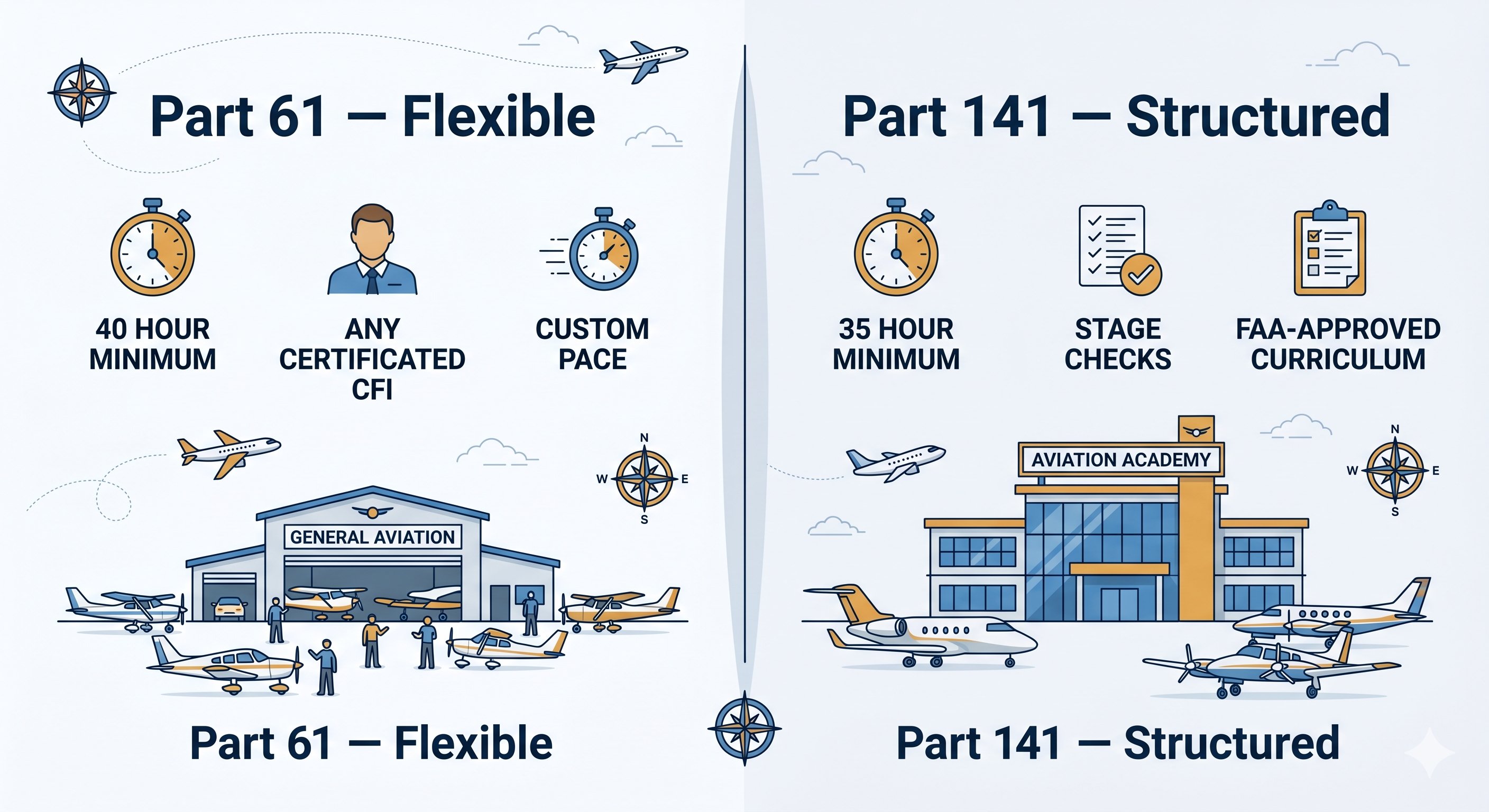
FAA regulations provide two different frameworks under which flight training may be conducted. Part 61 is the default; Part 141 is an approved structured alternative. The difference affects minimum hour requirements, curriculum structure, and flexibility. See our full Part 61 vs 141 comparison →
Part 61 — the flexible standard
Part 61 sets the minimum standards for pilot certification without prescribing a specific curriculum. The FAR specifies what aeronautical experience must be logged (covered in Lesson 5 below) but does not dictate the order, pace, or specific lesson content. Training under Part 61 can be with any FAA-certificated flight instructor — the CFI designs the training to meet the student's needs.
Who Part 61 works for: Students who train at independent flight schools, with a private CFI, or who have irregular schedules that make structured curriculum difficult. Part 61 is also the framework for people who already have some experience or who are training alongside work and other commitments. The national average for a Private Pilot certificate under Part 61 is approximately 65–70 hours — well above the 40-hour regulatory minimum, which reflects real-world learning rates.
Part 141 — the approved curriculum path
Part 141 schools operate under an FAA-approved training course outline (TCO) — a specific, stage-by-stage curriculum that has been submitted to and approved by the FAA. Part 141 schools must maintain records, conduct stage checks, and demonstrate training effectiveness. The reward for this structure: reduced minimum hour requirements. Under Part 141, the Private Pilot minimum is 35 hours (vs 40 under Part 61), and the cross-country minimum is specifically structured into the course.
Who Part 141 works for: Students at aviation universities and larger structured flight academies. The reduced minimums matter most for students going professional — they reduce the total hours needed for Commercial and ATP at the end of the pipeline. For a recreational Private Pilot student, the practical difference between 141 and 61 is small — most students take 60+ hours regardless of which path they're on.
Which should you choose? For most recreational private pilot students, Part 61 with a good local CFI or established flight school is the right choice. The flexibility, lower overhead costs, and ability to train at your own pace typically outweigh the theoretical hour savings of Part 141. If you're planning a professional career in aviation, a Part 141 program at an aviation university may make sense for the structured professional pipeline.
Which should you choose — and why it matters more than you think
The Part 61 vs. 141 decision is one of the first real choices a student pilot makes, and most people make it without fully understanding the tradeoffs. Here's a practical breakdown:
If you're training for fun or personal travel: Part 61 at a small local flight school is almost always the right choice. The flexibility allows you to train around a job and family schedule. You don't need to follow a rigid curriculum sequence. Your CFI can spend more time on areas where you need extra work rather than checking boxes. The minimum hours are higher on paper (40 vs. 35), but in practice most students at both types of schools finish in 65–80 hours anyway.
If you're pursuing a career in aviation: Part 141 schools, especially those with FAA-approved courses that lead to degree programs or military cooperation, offer structured accelerated pathways. Many university aviation programs are Part 141. Airlines and military programs prefer (and sometimes require) structured training documentation. The 35-hour minimum is also relevant if you're in a well-structured accelerated program and tracking closely to minimums.
The hidden factor — instructor consistency: More important than Part 61 vs. 141 is having the same CFI for the majority of your training. Switching instructors frequently resets your progress significantly — each new CFI has different standards, different ways of explaining concepts, and needs time to assess where you actually are. At busy Part 141 schools with high instructor turnover, you may actually progress slower than at a small Part 61 operation with a dedicated CFI who knows you well.
Stage checks and checkpoints in Part 141
Part 141 schools use stage checks — internal evaluations conducted by a check instructor (not your primary CFI) at defined points in the curriculum. These stage checks simulate the checkride experience and ensure students meet standards before progressing to the next phase. If you fail a stage check, you complete additional training before retaking it. This built-in quality control is one of the genuine advantages of Part 141 — students don't drift through training without accountability checkpoints. If you're at a Part 61 school, consider asking your CFI to conduct periodic mock oral exams and flight evaluations to replicate this structure.
Lesson 3 — FAA Medical Certificates
Most powered aircraft operations require a valid FAA medical certificate issued by an Aviation Medical Examiner (AME). There are three classes of medical certificate, each authorizing different operations and requiring different examination standards.
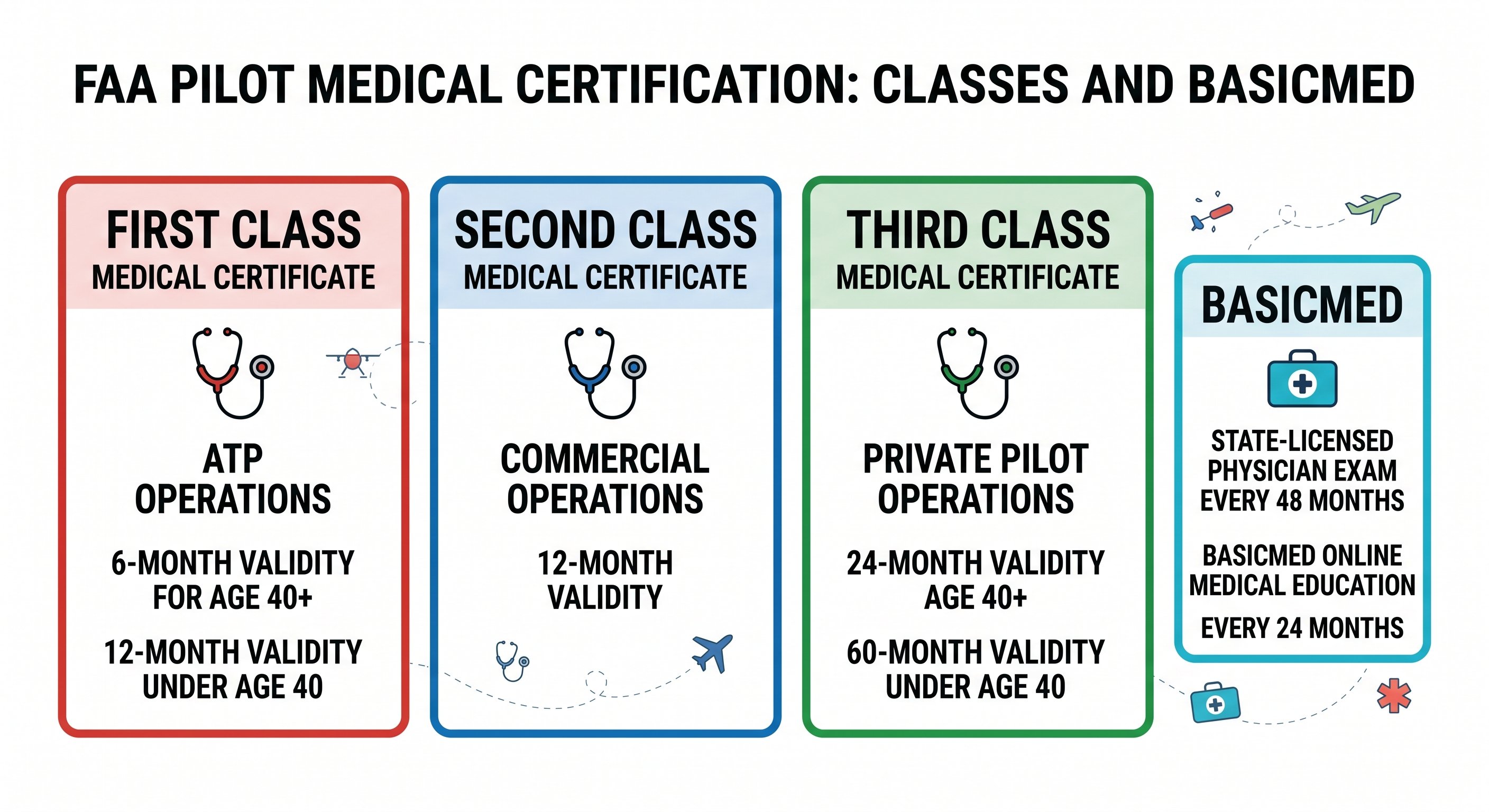
| Class | Required for | Under 40 validity | 40 and over validity |
|---|---|---|---|
| First Class | Airline Transport Pilot operations (flying as captain of an airliner) | 12 months | 6 months |
| Second Class | Commercial Pilot operations (being paid to fly) | 12 months | 12 months |
| Third Class | Private Pilot, Recreational, and Student Pilot operations | 60 months (5 years) | 24 months |
A higher-class medical covers all lower-class privileges. A First Class medical authorizes all commercial and private operations. When the First Class medical expires, it downgrades to Second Class, then Third Class, rather than becoming entirely invalid — the vision and other standards for the lower class remain valid for longer.
BasicMed — the alternative to a third class medical
Since 2017, pilots who have held an FAA medical certificate at any point since July 15, 2006 may alternatively qualify under BasicMed — a simplified medical certification allowing eligible pilots with a valid driver's license to fly without a traditional FAA medical certificate, provided they complete an online medical education course every 24 months and receive a comprehensive physical examination from any state-licensed physician every 48 months. BasicMed has aircraft and operational limitations: maximum 6 occupants, maximum 6,000 lbs MTOW, maximum 250 kts IAS, below 18,000 ft MSL, not for compensation. For most recreational pilots, BasicMed is a convenient option that avoids the traditional AME examination process.
To use BasicMed: complete a physical exam with any state-licensed physician (not necessarily an AME), complete the FAA online medical education course (free, approximately 2 hours), and have the physician complete the CMEC (Comprehensive Medical Examination Checklist). There's no FAA review or approval process — you keep the documentation and fly. BasicMed does not work for commercial operations or operations requiring a first or second class medical.
What conditions affect FAA medical certification?
The FAA's medical standards are extensive. Many conditions that might concern pilots are actually certifiable with proper documentation — including controlled hypertension, diabetes (with limitations), history of kidney stones, corrected vision, and many others. The key: do not assume a condition is disqualifying without checking. The FAA's AMCS database and aviation medical advisors can assess specific situations. Conditions that are typically disqualifying include: uncorrectable distant vision worse than 20/200, active angina, bipolar disorder, personality disorder (severe), epilepsy, and substance dependence.
Get your medical before investing in training. Some students spend thousands of dollars on flight training before discovering a medical condition that prevents certification. Visit an AME early — before committing to significant training costs. Many AMEs offer informal pre-application assessments to help you understand your situation before the official exam.
What the AME actually evaluates
An Aviation Medical Examination is not the same as a general physical. AMEs are physicians who have been specifically trained and designated by the FAA to evaluate pilots. They assess conditions that affect flying safety — not general health. The examination includes vision testing (corrected and uncorrected acuity), hearing testing, blood pressure, cardiovascular assessment, urinalysis, and a review of your medical history. The AME also reviews your MEDXPRESS submission — the online form you complete before the appointment — which asks about conditions, medications, and medical history going back years.
The most important practical advice: complete MEDXPRESS honestly and thoroughly before your appointment. The FAA has access to Medicare, Social Security disability, and other federal medical databases. Omitting a condition that appears in those records is a federal offense under 18 U.S.C. §1001 — false statements to federal agencies. Conditions that might seem disqualifying are often manageable with proper documentation; hiding them is not.
Don't show up to your AME appointment before doing MEDXPRESS — the AME cannot legally begin the exam without a confirmed MEDXPRESS submission. Don't take any over-the-counter medications that might affect alertness (antihistamines, sleep aids, decongestants) within 48 hours of your exam — AMEs look for signs of medication effects. Don't assume a condition is automatically disqualifying — the FAA has Special Issuance authorizations for hundreds of conditions including diabetes, certain heart conditions, mental health history, and more.
What to do if your medical is denied or deferred
If your AME defers your application to the FAA for further review, or if the FAA denies your medical, don't panic and don't give up. The Special Issuance process exists precisely for this — thousands of pilots fly with conditions that initially appear disqualifying. An aviation medical attorney or AOPA's medical certification services can guide you through the process. Many denials are reversed with proper documentation. The key is acting quickly and working with professionals who understand the FAA medical system.
Lesson 4 — FAR 61.109: The Hour Requirements
FAR 61.109 specifies the minimum aeronautical experience required for the Private Pilot Certificate (airplane, single-engine land). These are minimums — most students require significantly more time in each category before they are actually ready for the checkride.
| Requirement | Minimum Hours | Notes |
|---|---|---|
| Total flight time | 40 hours | At least 20 dual instruction, at least 10 solo. National average: 65–75 hrs. |
| Dual flight instruction | 20 hours | With a certificated flight instructor. Includes all training maneuvers. |
| Solo flight time | 10 hours | Includes solo cross-country and pattern work requirements below. |
| Solo cross-country | 5 hours | Including one solo XC of 150 nm total distance, landing at 3+ points, one leg of 50+ nm. |
| Night flight | 3 hours dual | Including 1 night cross-country of 100+ nm and 10 takeoffs and full-stop landings. |
| Instrument training | 3 hours | In actual or simulated instrument conditions, within 2 calendar months of checkride. |
| Test prep with CFI | 3 hours | With a CFI specifically preparing for the practical test, within 2 calendar months of checkride. |
Why 65–75 hours instead of 40? The 40-hour minimum was established in the 1950s. Modern airspace, communication, and navigation technology have made the cockpit more complex — not simpler. Additionally, training schedules are interrupted by weather, aircraft availability, and student availability. Each interruption produces some relearning. The realistic planning number is 55–75 hours for a self-funded recreational student training at a typical pace of 1–2 lessons per week. Students who train intensively (4–5 hours per week) often reach checkride readiness faster and with fewer total hours because skills don't decay between sessions.
What each hour category is actually building
The hour requirements in FAR 61.109 aren't arbitrary — each category is building a specific capability. Understanding the purpose helps you train more intentionally:
40 total hours (20 dual, 10 solo minimum): The total hours build overall time in the cockpit — pattern recognition, situational awareness, and the physical coordination that only develops through repetition. The split between dual and solo reflects that learning happens best when you're challenged by an instructor AND when you're responsible entirely on your own.
3 hours cross-country instruction: Cross-country flight — defined as flight to a point more than 50 nautical miles from the origin — teaches navigation, airspace planning, weather decision-making, and fuel management at a scale that local pattern work never develops. These 3 hours are a minimum; most students do much more cross-country flying before the checkride.
3 hours night instruction: Night flying is legally and operationally different from day flight. Depth perception changes. Illusions multiply. Runway environments look completely different. The 3 hours of night instruction (including 10 night takeoffs and landings to a full stop) ensure you have baseline night competence before earning the certificate.
3 hours instrument instruction: These are the most important safety hours in the entire requirement. You will fly with reference to instruments only — under a view-limiting device (foggles) — for at least 3 hours. The purpose: if you accidentally enter IMC (clouds, fog, or low visibility) after the checkride, you need enough instrument flying experience to maintain control and get back to visual conditions without losing the airplane. VFR pilots who encounter IMC and panic kill themselves in seconds. These 3 hours are the difference.
3 hours in preparation for the practical test: Your CFI is required to log 3 hours of test-prep instruction within 60 days before the checkride. This is the polish phase — flying the ACS maneuvers to standards, practicing oral question answers, and making sure you're genuinely ready rather than just feeling ready.
5 hours solo cross-country time: Including one cross-country flight of at least 150 nautical miles total distance with full-stop landings at a minimum of three points, one of which must be more than 50 nm from the departure point. This solo cross-country requirement is the capstone of your solo training — you plan it yourself, fly it yourself, and navigate it yourself. It's genuinely one of the most memorable experiences in flight training.
The FAA minimum is 40 hours. The national average to certificate issuance is approximately 67 hours. This gap exists because learning to fly is not linear — some lessons require many repetitions, weather causes gaps that degrade skills, and individual aptitude varies widely. Budget for 65–75 hours when estimating training cost. If you finish in 50, great. If you need 85, that's also normal.
Lesson 5 — Solo: The Most Important Milestone
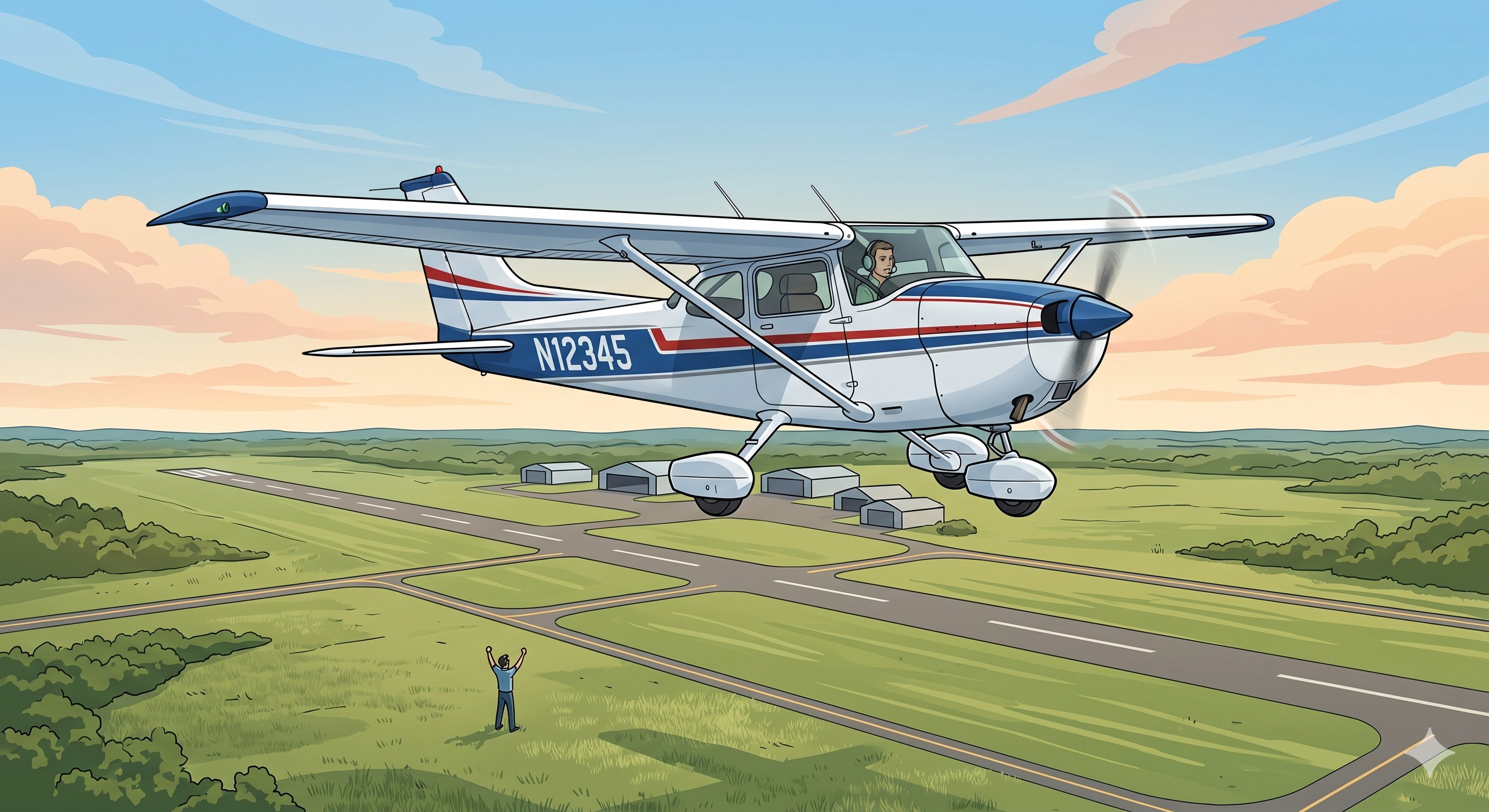
The first solo flight — three takeoffs and three landings alone, without an instructor — is the defining milestone of private pilot training. Every pilot remembers exactly when and where it happened. Most students solo between 10 and 20 hours, though there is wide variation based on training frequency, aircraft type, and student aptitude. Read our first solo guide →
What solo requires
Before you solo, your CFI must determine that you can safely perform the maneuvers listed in FAR 61.87 — the regulation governing student pilot solo flights. These include: preflight inspection, normal and crosswind takeoffs and landings, go-arounds, stall awareness and recovery, emergency procedures, and basic airport traffic pattern operations. Your CFI endorses your logbook on the day of your first solo, certifying you have demonstrated competency in these areas. The endorsement is valid 90 days.
What the solo feels like
The aircraft is noticeably different when the instructor's weight is removed — lighter, more responsive, climbing faster. Many students describe a sudden, intense clarity of focus that they've never experienced in training flights. The workload is the same; the psychological context is entirely different. Most students say the solo flight lasts only 15–20 minutes (three patterns and landings), and that it feels simultaneously like it lasted 5 seconds and 2 hours.
After solo — the cross-country phase
After solo, training shifts to cross-country operations. Solo cross-country flights are where students develop true navigational independence — planning a route, flying it without the instructor, and landing at an unfamiliar airport alone. The 150 nm solo cross-country required by FAR 61.109 is typically the flight students cite as their biggest confidence builder before the checkride.
What actually happens in the pattern on solo day
Your CFI doesn't just step out of the plane and wave you off. Solo readiness is evaluated carefully over the lessons leading up to it. In the last few sessions before solo, your CFI is watching for specific things: Can you consistently make stabilized approaches? Are your power-off stalls confident and coordinated? Can you manage the radio without fixating on it? Do you make good go-around decisions without prompting? Do you stay ahead of the airplane in the pattern?
On solo day, your CFI typically does a few practice laps with you to assess the conditions that day — wind, traffic, your mental state — before endorsing the logbook and stepping out. You'll typically do three full-stop landings. The first time you push the throttle forward alone, the airplane climbs noticeably faster (no instructor weight) and more steeply than you're used to. This surprises almost every student. Fly the numbers; the airplane handles the rest.
Endorsements required for solo flight
Before any solo flight, FAR 61.87 requires your CFI to provide training in specific maneuver areas and endorse your logbook certifying you're proficient. For each new solo environment — a different airport, a different aircraft type — you need a new endorsement review. The endorsements required are:
- Pre-solo knowledge test endorsement — you must pass a written test covering local regulations and the aircraft's POH (Pilot's Operating Handbook). Your CFI writes and grades this test and endorses your logbook after you pass.
- Pre-solo flight training endorsement — certifying you've received the training in FAR 61.87(d) maneuver areas (stalls, steep turns, emergency procedures, etc.) and are proficient to fly solo.
- 90-day solo endorsement — your CFI's endorsement authorizing you to fly solo in the specific make and model. This expires after 90 days — if you don't solo within that window, your CFI must re-evaluate and re-endorse.
- Solo cross-country endorsement — a separate endorsement for each planned solo cross-country flight, or a general endorsement for flight within a defined area.
The solo cross-country — your first real flight as PIC
The 150-nautical-mile solo cross-country is one of the pivotal experiences of private pilot training. You'll plan the route yourself — selecting waypoints, computing headings, calculating fuel burn, checking weather, filing a flight plan — and then execute it alone. There is no safety net. If weather deteriorates en route, you make the divert decision. If you get confused about your position, you sort it out. The skills that matter most aren't stick-and-rudder — they're judgment, planning, and the ability to stay calm and methodical when things don't go exactly as planned.
Most students who have struggled with confidence find that completing the solo cross-country is the turning point. Something changes when you navigate 50+ miles from home and land at a strange airport entirely on your own. You know you can fly.
Lesson 6 — The Practical Test (Checkride)
The FAA practical test — universally called the checkride — is administered by a Designated Pilot Examiner (DPE) authorized by the FAA to conduct tests and issue certificates. DPEs are experienced pilots who have been vetted and authorized to act on behalf of the FAA. They are not employed by the FAA, but their decisions on certificate issuance carry the same legal weight as an FAA inspector's.
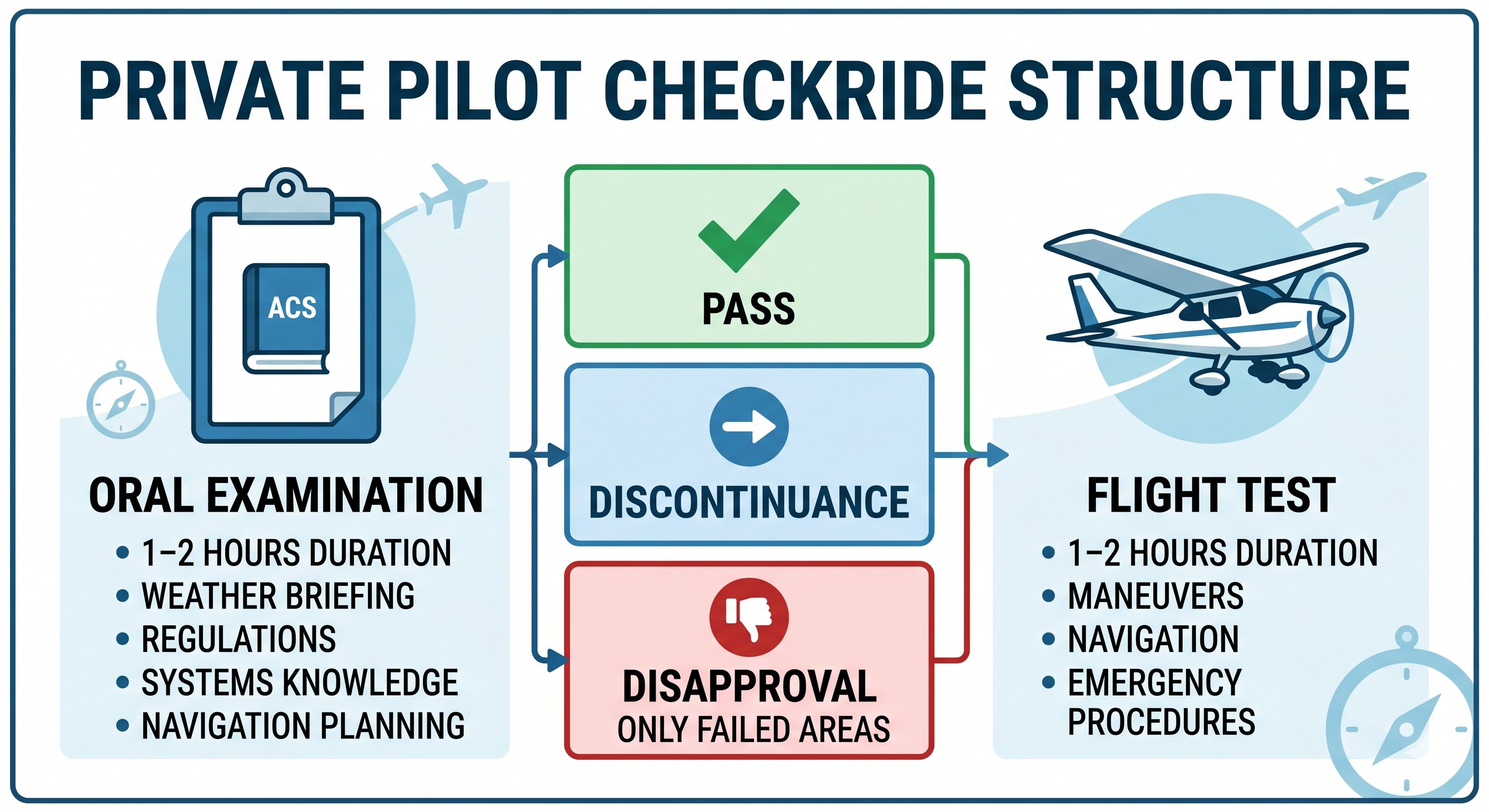
Structure of the checkride
The checkride has two parts conducted the same day: See our complete checkride guide →
Oral examination: Typically 1–2 hours. The DPE evaluates your knowledge across all areas of the Airman Certification Standards (ACS). This is not a fill-in-the-blank test — it is a conversation. The DPE may start with a cross-country flight plan you've prepared, then branch into any topic covered in the ACS. They are looking for understanding, not memorization. If you don't know an answer, say so and describe where you would find it — that's acceptable. Guessing incorrectly is worse than admitting uncertainty.
Flight test: Typically 1–2 hours. The DPE evaluates your ability to perform the maneuvers specified in the ACS to the published standards. You fly the aircraft as PIC — the DPE is a passenger. Make all PIC decisions, including go-around decisions, weather go/no-go, and any safety-of-flight calls. The DPE expects you to act as PIC, not wait for their direction.
Possible outcomes
Pass: The DPE issues a temporary certificate on the spot (the permanent certificate arrives by mail in 2–3 weeks). You are a licensed private pilot.
Discontinuance: The test cannot be completed due to weather, aircraft issue, or other circumstance outside your control. No failure recorded. You may complete the test another day, retesting only the incomplete portions.
Disapproval (Notice of Disapproval): You failed one or more areas. The DPE issues a Notice of Disapproval specifying exactly which areas were unsatisfactory. You receive additional instruction in those areas, obtain a CFI endorsement certifying you are now competent, and retest — only on the failed areas, not the entire test.
Checkride pass rates: Approximately 80% of Private Pilot applicants pass on the first attempt. The 20% who don't typically fail one or two specific areas — most commonly short-field performance, VOR navigation, or an oral knowledge gap — not the entire test. A disapproval is not the end; it is a specific instruction directive. Most applicants who receive a disapproval pass their retest within 2–3 weeks.
The oral exam — what it actually tests
The oral portion of the checkride is typically 1.5–2.5 hours and precedes the flight. DPEs are not trying to trip you up or fail you — they are trying to determine whether you have the aeronautical knowledge to be a safe, competent private pilot. The best DPEs conduct the oral like a conversation between two pilots, not an interrogation.
The DPE will present scenarios and ask you to work through them. "You're planning a VFR cross-country to [airport 90 miles away] tomorrow morning. Walk me through how you'd go about planning that flight." This question unfolds into weather briefing, NOTAM checking, weight and balance, fuel planning, alternate airport selection, airspace along the route, and communication requirements — and the DPE will follow threads wherever your answers lead. Strong candidates show connected, practical knowledge. Weak candidates show memorized answers that fall apart when the DPE asks "why?"
The flight portion — ACS tolerances and what DPEs watch for
The flight portion tests your ability to fly the ACS (Airman Certification Standards) maneuvers to published tolerances. These tolerances are specific — for example, steep turns must maintain altitude within ±100 feet, airspeed within ±10 knots, and roll out within ±10 degrees of the entry heading. The DPE is not just checking whether you can do the maneuvers; they're evaluating how you fly throughout the flight, including:
- Aeronautical decision making — do you make sound go/no-go and in-flight decisions?
- Situational awareness — are you always ahead of the aircraft, or are you constantly catching up?
- Cockpit resource management — do you use checklists, instruments, and available resources appropriately?
- Risk management — do you identify and mitigate risks proactively?
- Aircraft control — are your inputs smooth and coordinated, or rough and reactive?
Discontinuances and failures — what actually happens
If a checkride is stopped before completion, it's either a discontinuance (not the applicant's fault — weather, DPE emergency, aircraft issue) or a notice of disapproval (a failure). A discontinuance means you return on another day and complete only the remaining portions; you don't redo what was already passed. A failure means you receive a Notice of Disapproval, debrief with the DPE, receive additional training from your CFI on the failed areas, get a new endorsement, and return to retake only the failed portions. A checkride failure is not the end of the world — many excellent pilots have failed a checkride. The key is to take it seriously, do the additional training, and return better prepared.
What you receive at the end
If you pass, the DPE issues a temporary airman certificate on the spot — a single-page document that serves as your legal pilot certificate immediately. Your permanent plastic certificate arrives by mail within a few weeks from the FAA. Keep both safe. The DPE also completes the IACRA record, which means your certificate is in the FAA database within hours. You are now a certificated private pilot — you can legally fly passengers the same day.
Lesson 7 — Logbooks and Record-Keeping
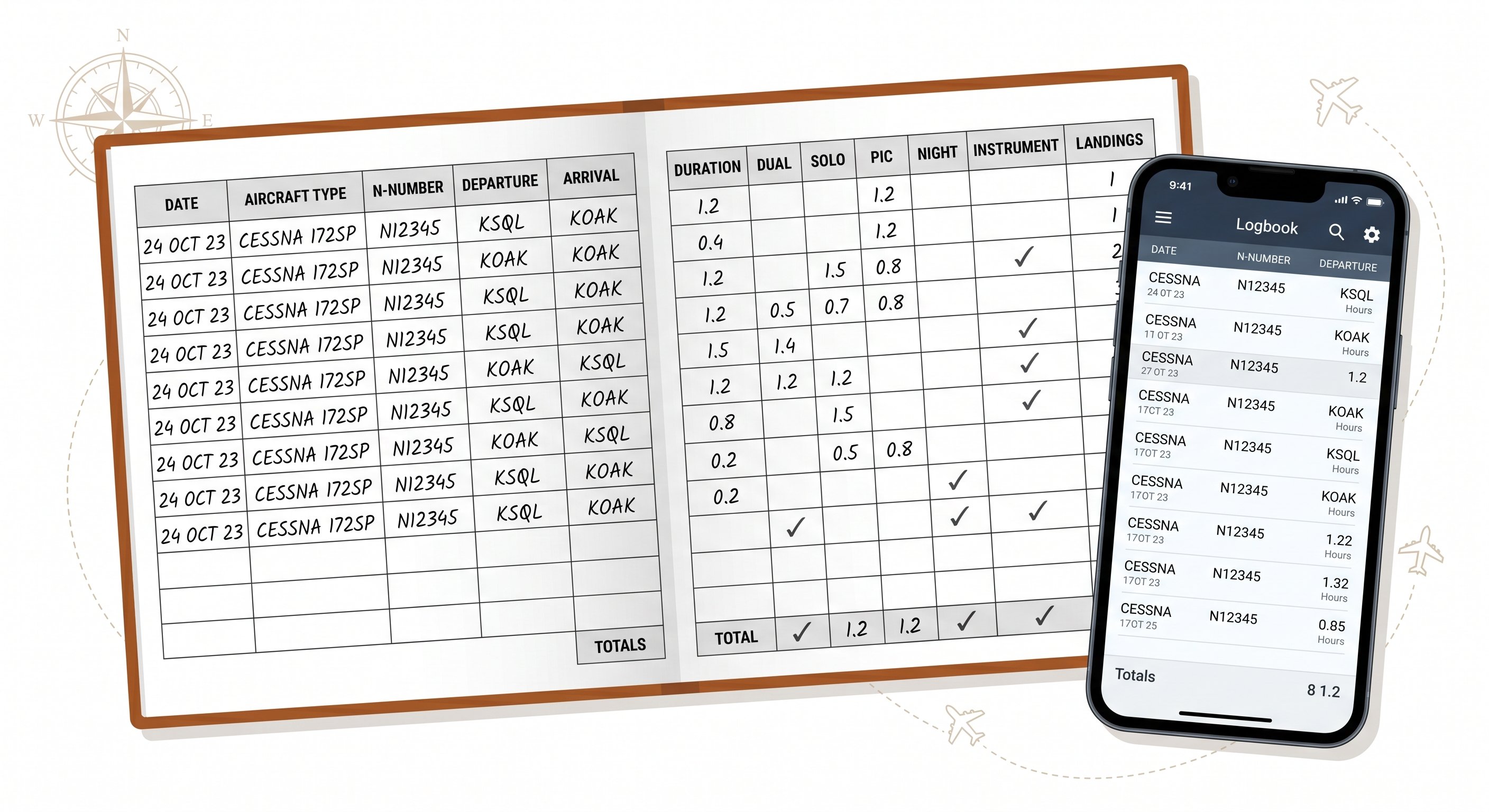
Your logbook is the official record of your flight experience. The FAA doesn't specify the exact format — paper, digital, or a combination — but you must be able to produce records showing compliance with training and currency requirements. Inaccurate logbook entries are a regulatory violation. Falsifying logbook entries to misrepresent experience is certificate fraud.
What must be logged
FAR 61.51 specifies what must be recorded for each flight used to meet training or currency requirements. Required entries: date, aircraft type and ID, points of departure and arrival, type of pilot experience (dual, solo, PIC, SIC), conditions (day, night, actual IMC, simulated IMC), and flight duration. Instrument approaches, holds, and cross-country flights have additional required data.
PIC time — a common source of confusion
Students are often confused about when they can log PIC time. FAR 61.51(e) specifies who may log PIC: a certificated pilot who is the sole manipulator of the controls of an aircraft for which they are rated. Student pilots may log PIC time when flying solo — even before they hold any certificate. Student pilots may ALSO log PIC time during dual instruction when they are the sole manipulator of the controls (FAR 61.51(e)(1)). Both the student AND the CFI may log PIC simultaneously for the same flight time — the CFI logs it as "acting PIC" (responsible for the flight); the student logs it as "sole manipulator." This dual logging is legal and expected. The distinction matters on the written test.
Digital vs. paper logbooks
The FAA accepts both. Popular digital options include ForeFlight Logbook, LogTen Pro, Garmin Pilot, and MyFlightbook (free). Digital logbooks offer automatic totaling, currency tracking, easy backup, and search capability. The practical advice from experienced pilots: keep both. Use digital as your primary, but have a paper backup or periodic PDF exports. The FAA has never rejected a properly maintained digital logbook, but having redundancy protects you if a software company shuts down or a device fails.
For training, your paper logbook entries need CFI signatures — digital logbooks handle this differently depending on the platform. Some CFIs use digital signature capabilities; others still prefer to sign the paper logbook for training entries. Clarify with your CFI early in training so you have a consistent system from the start.
Protecting your logbook
Your logbook is irreplaceable — a lost logbook means proving your flight experience from scratch, which may be impossible for old flights. Best practices: scan all pages periodically and store digitally in cloud backup. If using a paper logbook, photocopy it every 20–30 pages. If using an electronic logbook (Foreflight, LogTen Pro), ensure data is backed up in multiple locations. Some pilots maintain both a paper and digital log simultaneously for redundancy.
- Certificate ladder: Student → Sport → Private → Instrument Rating → Commercial → CFI → ATP. Each level unlocks new privileges and requires more experience.
- Private Pilot Certificate allows passengers, night flight, cross-country, most airspace — but no compensation.
- Part 61: flexible curriculum, 40-hour minimum. Part 141: FAA-approved stages, 35-hour minimum. Most recreational students train under Part 61.
- Third Class medical: required for private ops. Valid 60 months (under 40), 24 months (40+). BasicMed available as alternative with physician exam every 48 months.
- Get your medical early — before committing significant training dollars.
- FAR 61.109 minimums: 40 total hours, 20 dual, 10 solo, 5 solo XC, 3 night dual, 3 instrument, 3 test prep. Realistic average: 65–75 hours.
- Solo endorsement valid 90 days. Student pilots may log PIC during solo operations.
- Checkride: oral (1–2 hrs) + flight (1–2 hrs). ~80% pass rate first attempt. Disapproval specifies only the failed areas — retest covers only those.
- Logbook: scan and back up regularly. Lost logbook means proving experience from scratch.