Student Pilot Certificate
The Student Pilot Certificate is issued through the FAA's IACRA online system and signed by your Certified Flight Instructor. It's free, takes minutes to apply for, and authorizes you to fly solo under the supervision of your CFI's endorsements.
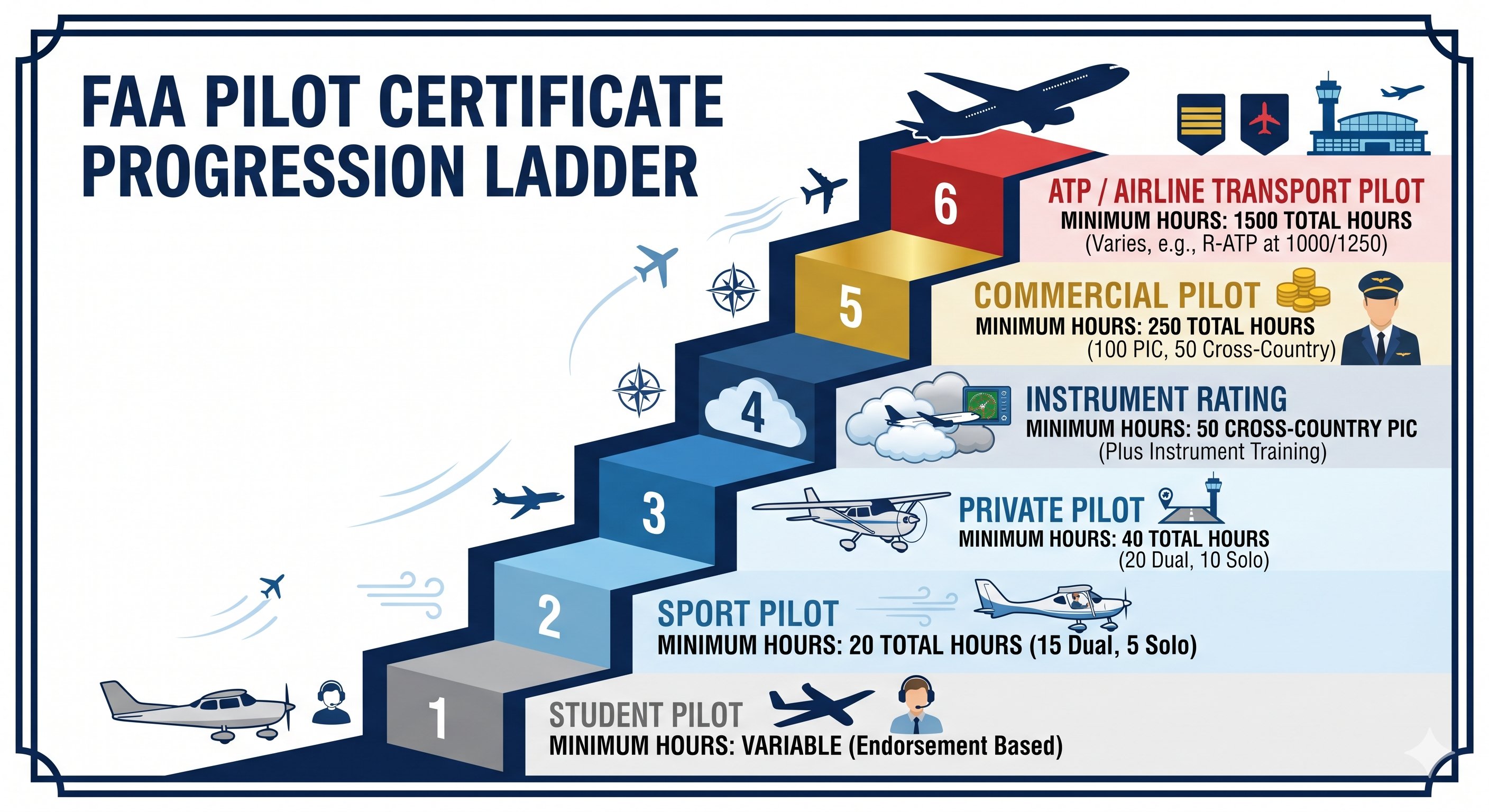
What it allows
A student pilot certificate allows you to fly solo — alone in the aircraft — once your CFI has endorsed you for solo flight and, separately, for each solo cross-country. You cannot carry passengers, fly for compensation, or fly in Class B airspace without a specific endorsement.
Medical requirement
You need a Third Class FAA Medical Certificate from an Aviation Medical Examiner (AME) before your first solo. Get this early — before investing heavily in training. See our full medical guide.
64 free PPL ground school videos on YouTube. Also offers a premium interactive course at freepilottraining.net with 700+ practice questions and a written exam endorsement.
Apply for your Student Pilot Certificate through IACRA before your first lesson. Your CFI will access the application and sign it — having it done in advance saves time.
Requirements
FAR Part 61 Subpart C
- Minimum age16 years (14 for gliders and balloons)
- Medical certificate3rd Class or BasicMed (before solo)
- ApplicationOnline via FAA IACRA — free
- CFI endorsementFor each solo and solo XC flight
- Knowledge testNone required for student cert itself
Private Pilot License (PPL)
The Private Pilot License is the most important certificate you'll earn. It's the foundation for everything that follows, and it opens up aviation for personal travel, recreation, and building hours toward a career.
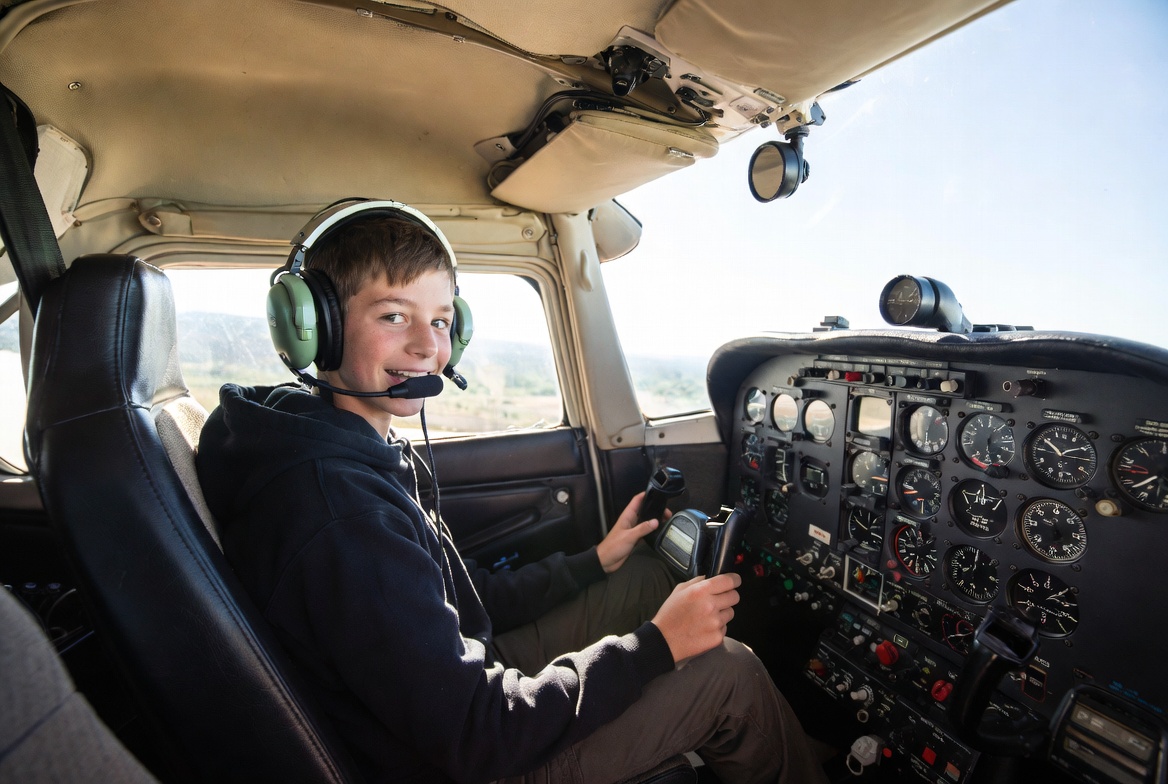
What it allows
- Fly single-engine aircraft as pilot-in-command
- Carry passengers (not for hire)
- Fly day and night VFR nationwide
- File IFR flight plans (but not fly IFR without the instrument rating)
- Share expenses with passengers (fuel and fees only — pro-rated)
What it doesn't allow
- Flying for compensation or hire of any kind
- Flying in IMC (clouds) without an instrument rating
- Acting as PIC in complex or high-performance aircraft without additional endorsements
Training overview
PPL training covers preflight inspection, basic maneuvers, stalls, ground reference maneuvers, navigation, weather interpretation, cross-country planning, night flying, and emergency procedures. It concludes with a practical test (checkride) with an FAA Designated Pilot Examiner.
The FAA requires 40 hours minimum, but most students take 55–70 hours. Weather, scheduling gaps between lessons, and the natural learning curve all add time. Budget accordingly.
Get a personalized PPL cost estimate based on your location and schedule.
Try Cost Estimator →Requirements (Part 61)
FAR 61.109
- 40 total flight hoursIncluding at least 20 hrs dual instruction
- 10 hours solo PICIncluding 5 hrs solo XC
- 3 hours night trainingIncluding 1 XC over 100 nm and 10 takeoffs/landings
- 3 hours XC dualCross-country flight instruction
- 3 hours checkride prepWithin 2 months of practical test
- FAA Knowledge Test70% or higher to pass
- Practical test (checkride)Oral + flight with FAA DPE
- 3rd Class MedicalOr BasicMed
Instrument Rating (IR)
The Instrument Rating is widely considered the most valuable rating a pilot can earn after the PPL. It allows flight in IMC (clouds, low visibility) under IFR, dramatically expanding the days and conditions in which you can safely fly. It's required for all commercial and airline operations.
What it allows
- File and fly IFR flight plans
- Fly in clouds (IMC) as long as the aircraft is IFR-equipped and current
- Fly instrument approaches to minimums at IFR airports
- Access to the full ATC IFR system
Why get it even for recreational flying?
Weather kills more GA pilots than any other factor. An instrument-rated pilot who gets caught in IMC has options — a VFR-only pilot has very few. Even if you never intentionally fly in clouds, IR training dramatically improves your situational awareness, ATC communication skills, and overall precision.
What the training covers
Hood work (simulated instrument conditions), IFR flight planning, ATC communications in the IFR system, instrument approaches (ILS, RNAV, VOR), holding patterns, partial-panel flying, and emergency IFR procedures.
Requirements (Part 61)
FAR 61.65
- Hold a Private Pilot CertificateASEL or AMEL for airplane IR
- 50 hrs PIC cross-countryCan include time from PPL training
- 40 hrs actual/sim instrumentAt least 15 hrs with a CFII
- Instrument XC flight250+ nm, 3 types of approaches
- IFR Knowledge Test70% or higher
- Instrument practical testOral + flight with FAA DPE
Commercial Pilot Certificate (CPL)
The Commercial Pilot Certificate is what legally allows you to earn money flying. The 250-hour total time requirement means most pilots spend significant time building flight experience between instrument training and commercial training — this is the primary time and cost driver on the career path.

What it allows
- Act as PIC or SIC for compensation or hire
- Banner towing, aerial photography, charter (with appropriate additional certificates)
- Instructing (only after CFI certificate)
- Flight operations under Part 135 (air taxi)
The commercial maneuvers
Commercial training introduces precision maneuvers that require a higher level of airmanship: chandelles, lazy eights, eights on pylons, steep turns at 50°, and power-off 180° accuracy approaches. The tolerances are tighter than PPL — the ACS expects commercial candidates to perform with professional precision.
Complex aircraft requirement
Commercial ASEL training requires a complex aircraft endorsement — a plane with retractable gear, constant-speed propeller, and flaps. The Piper Arrow, Beechcraft Bonanza, and Cessna 210 are common choices. Complex aircraft rent for more per hour, adding to cost.
Under Part 141, the commercial total time requirement drops from 250 to 190 hours — a savings of up to $15,000 in aircraft rental for full-time students.
Requirements (Part 61)
FAR 61.129 (ASEL)
- 250 total flight hours100 hrs PIC, 50 hrs XC PIC
- 10 hours night PIC XCIncluding 1 XC over 50 nm
- 10 hrs complex aircraftRetractable gear, C/S prop, flaps
- 10 hrs instrument trainingIn aircraft (not simulator)
- Instrument Rating requiredFor ASEL Commercial (61.123)
- 2nd Class MedicalTo exercise commercial privileges
- Commercial Knowledge Test70% or higher
Certified Flight Instructor (CFI)
The CFI is optional — but for pilots pursuing an airline career, it's practically essential. Instructing is the most accessible and economical way to build the 1,500 flight hours required for an Airline Transport Pilot certificate. You get paid (modestly) while logging valuable PIC time.
CFI, CFII, and MEI
The basic CFI allows you to instruct in VFR conditions in single-engine aircraft. The CFII (Instrument Instructor) adds authorization to provide instrument instruction. The MEI (Multi-Engine Instructor) authorizes instruction in multi-engine aircraft. Most career-path pilots pursue all three.
The FOI requirement
CFI training includes the Fundamentals of Instructing (FOI) — essentially a course in how to teach. You'll study learning theory, lesson planning, and critique methods. The FAA requires all CFIs to pass the FOI knowledge test (separate from the CFI knowledge test).
Career outlook
The pilot shortage of the 2020s has meaningfully improved CFI pay at larger flight academies. Regional airlines actively recruit from CFI ranks, and many operate structured pipeline programs where CFIs receive priority hiring consideration after reaching ATP minimums.
Requirements
FAR 61.183
- Commercial Pilot CertificateWith instrument rating (for airplane CFI)
- FOI Knowledge TestFundamentals of Instructing — 70%
- CFI Knowledge TestFundamentals of Instruction — 70%
- Flight proficiencyAll ACS tasks at commercial level
- Spin endorsementSpin awareness training required
- Practical testOral + flight demo with DPE
Airline Transport Pilot (ATP)
The Airline Transport Pilot certificate is the culmination of a pilot career. Since the FAA's 2013 first officer qualification rule, all airline co-pilots flying under Part 121 (scheduled air carriers) must hold an ATP certificate. It represents the highest standard of aeronautical knowledge and skill the FAA certifies.
The ATP-CTP requirement
Before taking the ATP knowledge test, you must complete an Airline Transport Pilot Certification Training Program (ATP-CTP) — a 30-hour course combining classroom instruction and full-motion Level C or D simulator time. It costs $4,000–$8,000 and covers high-altitude aerodynamics, weather, automation, crew resource management, and airline operations. Most regional carriers provide or subsidize this training for new hires.
Restricted ATP (R-ATP)
Pilots who graduate from an FAA-approved aviation college program (Embry-Riddle, UND, Purdue, and others) can earn an R-ATP at 1,000 hours (with a bachelor's degree) or 1,250 hours (with an associate's). Military pilots can qualify at 750 hours. The R-ATP allows serving as SIC but not PIC at airlines — full ATP requires 1,500 hours.
Airline career trajectory
Most pilots begin their airline career at a regional carrier as First Officer. In 2026, regional FO starting pay runs $70,000–$95,000. After building hours and seniority (typically 3–7 years), pilots transition to major carriers. Major airline captain salaries at United, Delta, American, and Southwest now routinely reach $300,000–$400,000+ at senior levels.
Many regional airlines offer direct pipeline agreements with flight academies, offering conditional job offers to students in structured programs. These reduce uncertainty and can provide access to better loan terms.
Requirements
FAR 61.159 (AMEL)
- 1,500 total flight hours500 hrs XC, 100 hrs night, 75 hrs instrument
- 250 hrs PICIncluding 100 hrs PIC XC
- Minimum age 2321 for R-ATP with aviation degree
- First Class MedicalRequired — obtain this early in training
- ATP-CTP course30 hours ground + sim. Required before knowledge test
- ATP Knowledge Test70% or higher
- Practical testIn a multi-engine aircraft or FFS
Ready to see what your full training will cost? Use our free estimator to get a personalized range.
Open Cost Estimator →