The full pilot pathway at a glance
Becoming a pilot isn't one event — it's a series of certificates and ratings, each building on the last. The path you take depends entirely on your goal: recreational flying, a career at a regional airline, or eventually a major carrier. Here's the complete picture.
64 free PPL ground school videos on YouTube. Also offers a premium interactive course at freepilottraining.net with 700+ practice questions and a written exam endorsement.
Most career pilots follow this exact path. Recreational pilots often stop after the PPL or add an instrument rating for safety. The total cost from zero to ATP-ready ranges from $70,000 to $110,000, with the bulk concentrated in building flight hours between commercial and ATP.
Take a discovery flight first
Before investing thousands of dollars in flight training, take a discovery flight (also called an introductory flight). This is a 1-hour lesson with a flight instructor where you'll actually handle the controls. It costs $150–$250 depending on location and aircraft.
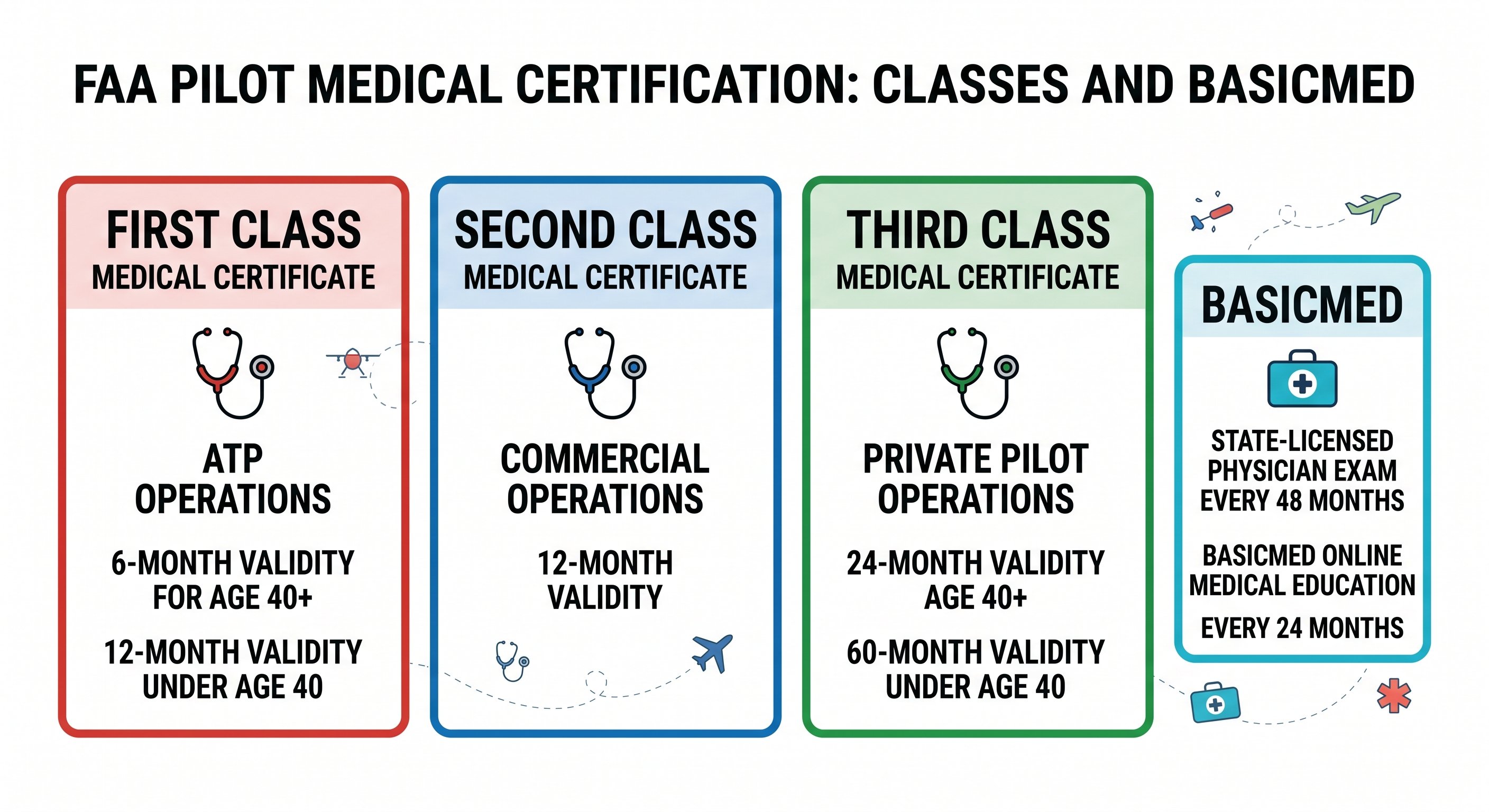
First, Second, and Third Class medical certificates
This isn't just a formality. Flight training requires real commitment — time, money, and mental energy. A discovery flight tells you whether the experience matches your expectations before you commit. Most flight schools offer them, and many aviation organizations like AOPA and EAA occasionally sponsor free or discounted discovery flights.
What to look for during your discovery flight: How organized is the school? Does the instructor communicate clearly? Is the aircraft well-maintained? These early impressions matter more than they seem.
Get your Student Pilot Certificate
The Student Pilot Certificate is your legal permission to fly solo. It's free, issued through the FAA's IACRA system online, and your flight instructor signs it. You'll also need a medical certificate before your first solo flight.
The FAA Medical Certificate
Before you solo, you need a medical certificate from an FAA Aviation Medical Examiner (AME). For most student and private pilots, a Third Class medical is sufficient. It costs $75–$150 and involves a basic physical — vision, hearing, cardiovascular, and review of your medical history.
If you have any medical history that concerns you, don't skip this step. Get your medical early — before you've invested significant time and money in training. Common concerns like controlled blood pressure, certain medications, and prior surgeries often don't disqualify you, but they may require extra documentation. See our full FAA Medical Guide →
Get your medical certificate before your first lesson if possible. Very rarely, a medical condition surfaces that affects flying eligibility. Finding out early saves you from investing in training you can't complete.
Earn your Private Pilot License (PPL)
The Private Pilot License is the foundation of everything. It allows you to fly single-engine aircraft, carry passengers, and fly in most weather conditions — but not for compensation. It's the most important certificate you'll earn.
What you'll learn
PPL training covers everything needed to fly safely as pilot-in-command: takeoffs and landings, navigation, weather interpretation, emergency procedures, night flying, and cross-country planning. The training is divided between dual instruction (with a CFI) and solo time (flying alone).
The PPL checkride
Training culminates in a practical test (checkride) with an FAA Designated Pilot Examiner (DPE). It has two parts: an oral exam covering regulations, weather, and flight planning, followed by a flight test where you demonstrate your skills. The oral typically lasts 1–2 hours, the flight portion 1–1.5 hours. Examiner fees run $600–$900 depending on location.
Complete ground school before or during early flight training. Pilots who finish their FAA written knowledge test early tend to reach checkride-ready status faster, because the ground knowledge directly supports flight training tasks.
Industry-standard online ground school. FAA written test pass guaranteed or your money back.
Add an Instrument Rating (IR)
The Instrument Rating allows you to fly in clouds and low visibility using cockpit instruments alone, following IFR (Instrument Flight Rules). It's not required for recreational pilots, but it's strongly recommended for anyone flying regularly or working toward a career.
Why the instrument rating matters
Weather is the leading contributing factor in general aviation accidents. IFR-rated pilots have a dramatically expanded envelope of safe flying days and are required by all airlines. Even if you never fly in actual IMC, the precision and discipline of instrument training makes you a better, safer pilot in all conditions.
The IR involves extensive hood work (simulated instrument conditions), IFR flight planning, approaches, holds, and navigating the IFR system with ATC. It's widely considered the most challenging and most rewarding rating to earn.
Earn your Commercial Pilot Certificate (CPL)
The Commercial Pilot Certificate is what legally allows you to be paid to fly. It requires higher standards of precision and airmanship than the PPL, and the 250-hour total time requirement means you'll spend significant time building experience between your instrument rating and commercial training.
The time-building challenge
Getting from ~100 hours (after PPL + IR) to 250 hours is the biggest financial hurdle between PPL and commercial. This is why many pilots pursue a CFI certificate next — instructing students is the most common way to build hours while getting paid (modestly) to do it.
Part 141 commercial requires only 190 hours vs. 250 under Part 61. For full-time students at a structured academy, this difference represents thousands of dollars in saved aircraft rental.
Become a CFI (Certified Flight Instructor)
The CFI certificate lets you teach other pilots. For career-track aviators, this is the most common path to building the 1,500 hours required for an ATP certificate, because you earn money (typically $25–50/hr) while logging flight time. Flight instructing is demanding work, but it makes you a significantly better pilot.
Most career pilots spend 2–4 years instructing before reaching ATP minimums. The CFII (instrument instructor) and MEI (multi-engine instructor) add to your value and marketability. Regional airlines actively recruit from CFI ranks and often have direct pipeline agreements with training academies.
Earn your ATP Certificate — and fly for the airlines
The Airline Transport Pilot certificate is the highest level of pilot certification. Federal regulations (Part 121) require all airline co-pilots to hold an ATP certificate. Getting here is the finish line for most career pilots.
The ATP-CTP requirement
Before taking the ATP knowledge test, you must complete an ATP Certification Training Program (ATP-CTP) — a 30-hour course combining ground training and full-motion simulator time. It costs $4,000–$8,000 and covers advanced aerodynamics, meteorology, and airline operations. Most regional carriers provide or subsidize this training for new hires.
Regional vs. major airlines
Most ATP-certificate pilots begin their airline career at a regional carrier (SkyWest, Endeavor, Mesa, etc.) as a First Officer. Regional FOs earn $70,000–$90,000/yr starting in 2026. After 3–7 years and 5,000–8,000 hours, many transition to major carriers (United, Delta, American, Southwest) where captain salaries reach $300,000–$400,000+.
Complete cost breakdown: Zero to ATP
These figures are based on the Redbird State of Flight Training Survey and community-reported data. Costs vary significantly by region, aircraft, and school structure — use the Cost Estimator for a personalized range.
| Certificate / Rating | FAA Min Hours | Realistic Hours | Cost Range | Notes |
|---|---|---|---|---|
| Private Pilot (PPL) | 40 hrs | 55–70 hrs | $10,000–$18,000 | Foundation of everything. Most important cert you'll earn. |
| Instrument Rating (IR) | 50 IFR hrs | 50–65 hrs | $10,000–$15,000 | Strongly recommended even for recreational pilots. Improves safety dramatically. |
| Commercial Pilot (CPL) | 250 hrs total | 250–280 hrs total | $20,000–$35,000 | Includes time-building from 100→250 hrs. Part 141 minimum is 190 hrs. |
| CFI Certificate | None (CPL required) | 30–50 hrs training | $4,000–$8,000 | Optional but essential for efficient hour-building toward ATP. |
| Multi-Engine Rating (MEI) | None defined | 10–20 hrs | $3,000–$7,000 | Required before instructing in multi-engine aircraft. |
| ATP Certificate + CTP | 1,500 hrs total | 1,500 hrs | $5,000–$15,000 | CTP course required. Many regionals subsidize or provide this training. |
| Total: Zero → ATP | — | 1,500 hrs total | $70,000–$110,000 | Accelerated programs typically $83–95k all-in. |
Common questions
How long does it take to become a pilot?
For a Private Pilot License, expect 4–8 months training part-time (2× per week) or 2–3 months full-time. The full zero-to-ATP path typically takes 3–5 years, with the bulk of that time spent building the 1,500 hours required for ATP through CFI work. Accelerated programs can get you airline-ready in 2 years but require full-time commitment and significant upfront investment.
Do I need perfect vision to become a pilot?
No. For a Private Pilot License, corrected vision to 20/40 is acceptable. Airline pilots (first-class medical) need vision correctable to 20/20. Glasses and contacts are both acceptable. LASIK and PRK are generally approved after a 6-12 month waiting period. See the full medical guide →
Is there an age limit to become a pilot?
There's no maximum age for a Private Pilot License. For airline pilots, FAA regulations require retirement at age 65 (or 60 for international operations). Starting training at 40 or 50 is entirely feasible for recreational flying and even some commercial operations. The timeline to a major airline career simply looks different.
Can I finance flight training?
Yes. Several lenders specialize in aviation training loans. Sallie Mae and Stratus Financial are the most commonly used. Interest rates vary, but many students finance $60,000–$100,000 over 10–15 year terms. Regional airlines' pilot pipeline programs also offer tuition reimbursement or payment deferral for qualifying students. See aviation scholarships →
What's the difference between a discovery flight and actual training?
A discovery flight is a single introductory lesson — you fly the aircraft with an instructor, get a feel for it, and decide if you want to continue. Actual training is a structured curriculum leading to a certificate. Discovery flights typically can't be logged toward your certificate hours (rules vary), but they're invaluable for making an informed decision.
Can prior military flight experience count toward civilian certificates?
Yes. Veterans with military flight experience can often receive credit toward civilian certificates. The process involves verifying your military training records and applying with the FAA. AOPA maintains a dedicated military transition resource. The GI Bill can also be used to cover flight training costs at approved schools.