The short version
Part 61 and Part 141 are both perfectly valid paths to the same FAA certificates. The difference is in structure, oversight, and minimum hour requirements — not in the quality of the pilots they produce.
Most small local flight schools operate under Part 61. Larger academies and university programs tend to be Part 141. Neither is inherently superior. The right choice depends on your availability, your goals, and whether you're training full-time or around another life.
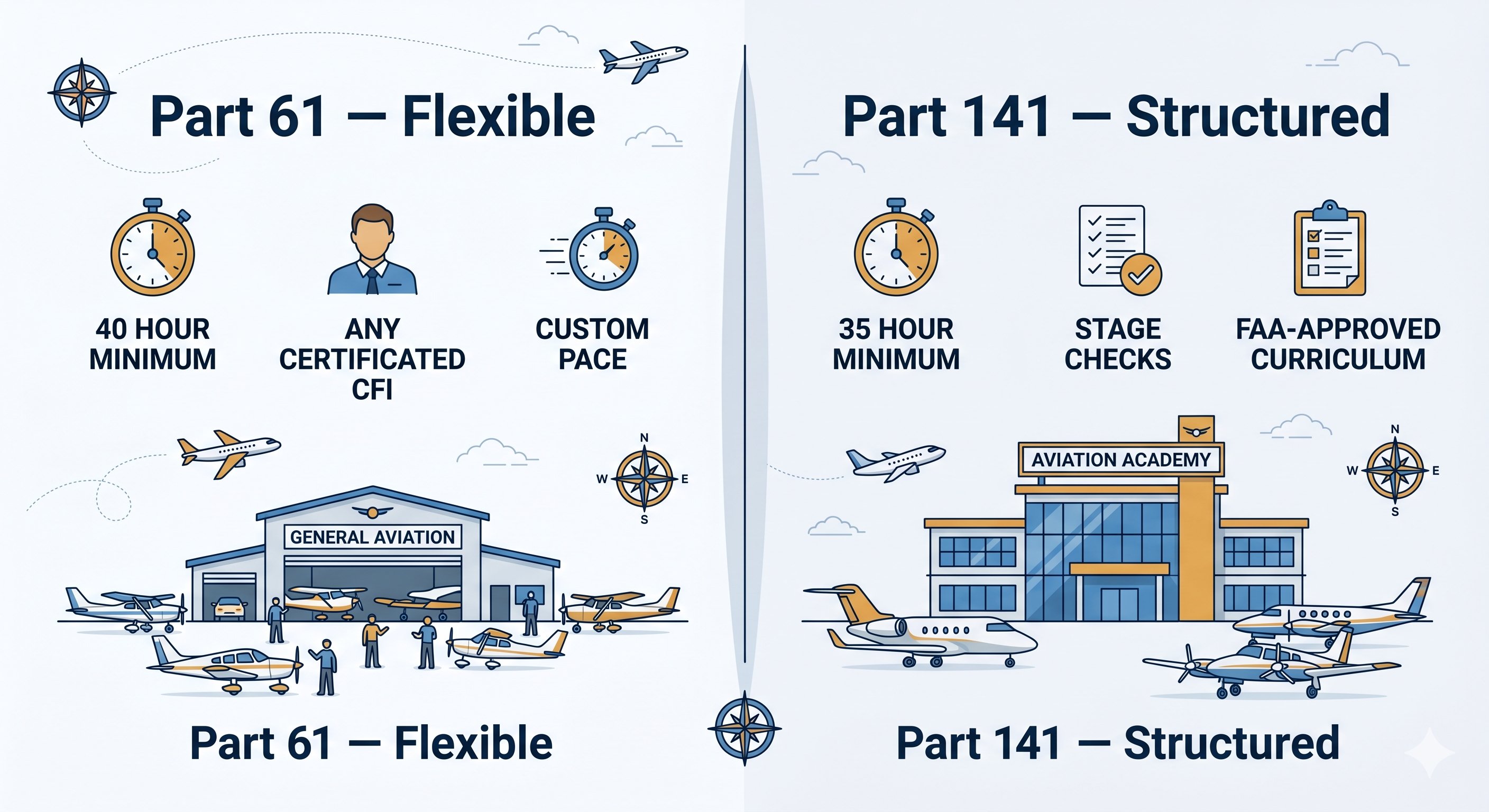
Side-by-side comparison
The hour requirements in detail
The most commonly cited difference is the lower minimum hours under Part 141. Here's how that plays out across all certificates:
| Certificate / Rating | Part 61 Minimum | Part 141 Minimum | Savings |
|---|---|---|---|
| Private Pilot (PPL) | 40 hrs | 35 hrs | 5 hrs · ~$900–1,200 |
| Instrument Rating (IR) | 50 hrs IFR | 35 hrs instrument | 15 hrs · ~$2,500–3,500 |
| Commercial Pilot (CPL) | 250 hrs total | 190 hrs total | 60 hrs · ~$9,000–15,000 |
| CFI Certificate | No specific min | No specific min | — |
| ATP Certificate | 1,500 hrs total | 1,500 hrs total | — |
The hour savings look great on paper — but only materialize if students stay on track. In practice, the majority of Part 141 students still exceed the minimums. Scheduling gaps, weather, and the learning curve affect everyone. The savings are real for disciplined full-time students, less so for part-timers.
The real difference: structure vs. flexibility
The hour difference matters less than most people think. What actually separates Part 61 and Part 141 day-to-day is how your training is organized.
How Part 61 training works
Under Part 61, your Certified Flight Instructor designs your training based on your needs and the FAA's Airman Certification Standards (ACS). There's no required syllabus — your CFI has discretion over what you practice, when you introduce new maneuvers, and how quickly you advance.
This is excellent for:
- Students who need to schedule lessons around work, family, or other commitments
- Students who need extra time on certain skills without feeling "behind"
- Training at small local airports where you might know your instructor personally
- Pilots adding ratings who are already experienced and just need the specific new skills
How Part 141 training works
Part 141 schools operate under an FAA-approved training course outline (TCO). Training must follow the syllabus in a specific order. Stage checks — evaluations with the school's chief CFI or assistant chief CFI — are required before advancing to each new phase. The FAA periodically audits the school to ensure the curriculum is being followed.
This is excellent for:
- Full-time students who can commit to a structured schedule
- Career-path pilots who want the commercial hour reduction (250 → 190)
- Students who benefit from a defined curriculum with clear milestones
- University aviation programs where the structure supports academic integration
Which is right for your situation?
Scheduling flexibility is the #1 advantage of Part 61. If you can only fly twice a week or need to pause training for a month, Part 61 accommodates that without derailing a syllabus.
The commercial hour reduction (60 fewer hours) can save $9,000–$15,000. For a career-path student who can commit fully, Part 141 is often the more cost-efficient route.
For recreational pilots who just want to earn their PPL and fly for fun, Part 61 is perfectly suited. The 5-hour minimum difference rarely manifests in practice anyway.
Most university programs (Embry-Riddle, UND, Purdue) are Part 141. The structure integrates well with academic schedules and aviation degree requirements.
Experienced pilots adding an instrument rating, commercial, or additional endorsement typically benefit from the flexibility of Part 61 and the ability to focus on exactly the skills they need.
Academies like ATP Flight School, Epic, and US Aviation operate under Part 141. Their structured pipeline programs are designed to efficiently move students from zero to airline-ready.
Stage checks: extra cost or extra value?
Part 141's required stage checks — evaluations with the school's chief CFI at the end of each training phase — are often cited as a disadvantage because they cost extra ($150–$300 each) and add time. But they also provide something valuable: an objective second opinion on your readiness before advancing.
Many students in Part 61 programs never get this kind of structured independent feedback until their actual checkride. Stage checks, while a nuisance to some, can catch weak areas early and ultimately improve checkride pass rates.
Part 141's checkride pass rates are often higher. The structured syllabus, stage checks, and standardized training tend to produce students who are consistently well-prepared for checkrides. This isn't universal, but it's a pattern worth noting when comparing programs.
What Part 61 and 141 do NOT determine
These two regulations say nothing about:
- Instructor quality — you can find excellent and poor instructors at both types of schools
- Aircraft quality or maintenance standards — both follow the same FAA airworthiness requirements
- Your final skill level — the certificate you earn is identical regardless of which path you took
- Career success — airlines hire pilots from both Part 61 and Part 141 backgrounds equally
- School reputation — some excellent schools run Part 61; some mediocre ones are Part 141
The FAA checkride is the same test regardless of how you trained. A DPE (examiner) doesn't know or care whether you trained Part 61 or Part 141 — they evaluate you against the same Airman Certification Standards.
Questions to ask any flight school
Whether you're evaluating a Part 61 or Part 141 school, these questions cut through the marketing and reveal what matters:
Before you enroll
- ✓What is your average time to PPL checkride (in hours and months)?
- ✓What is your first-attempt checkride pass rate for the past 12 months?
- ✓What is your instructor turnover rate? How long has each CFI been here?
- ✓How many aircraft do you have in your training fleet? What's the current condition?
- ✓What's the average wait time to schedule a lesson?
- ✓Do you guarantee a consistent instructor or will I be rotated?
Red flags to watch for
- ✗Reluctance to share checkride pass rates or average completion times
- ✗Requiring large upfront deposits before you've met your instructor
- ✗Very high instructor turnover (a sign of poor culture or low pay)
- ✗Aircraft that look poorly maintained or are frequently "down for maintenance"
- ✗Pressure to commit immediately or "lock in" a rate
- ✗No clear answer about who your primary instructor will be
Get a realistic cost estimate for Part 61 or Part 141 training based on your location and goals.
The bottom line
Stop worrying about Part 61 vs Part 141 as a deciding factor and start focusing on the quality of the school and the instructors. A great CFI at a Part 61 school will produce a better pilot than a mediocre CFI at a Part 141 academy, every time.
Use this framework instead:
- If you're training full-time for an airline career → lean toward Part 141 for the commercial hour savings
- If you're training part-time around a life → Part 61 flexibility will serve you better
- If you're just earning a PPL for fun → the difference barely matters; find a good instructor you trust
In every case: visit the school in person, meet the instructors, and ask the hard questions before committing any money.